The Left’s voting rights outrage is about power, not people
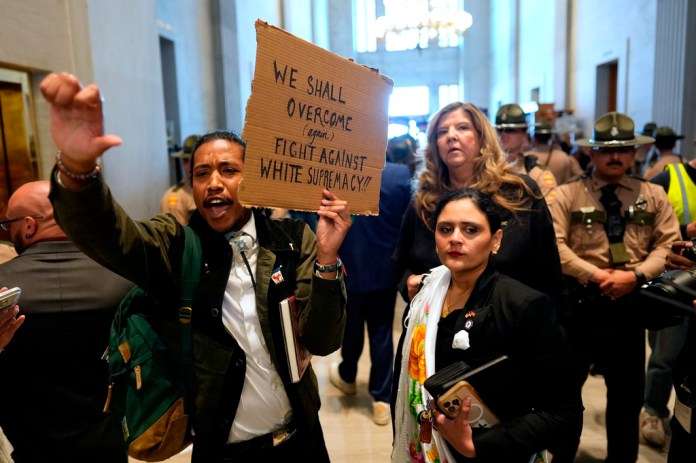
This opinion piece employs charged, derogatory language ('race-baiting provocateurs,' 'outrage machine,' 'the con') to frame voting rights activism as performative and self-serving rather than substantive. The article centers the author's interpretation of Supreme Court jurisprudence and Democratic Party strategy while dismissing and delegitimizing activist voices through personal attacks. The framing conflates party interests with voter interests and assumes bad faith among progressive advocates without substantive engagement with voting rights concerns.
Primary voices: media outlet, elected official, academic or expert
- This article does not address empirical evidence on voter dilution or the effectiveness of majority-minority districts in enabling minority political representation
- This article does not cite voting rights scholars or civil rights organizations' analysis of the Louisiana v. Callais decision
- This article does not examine the historical context of redistricting decisions used to minimize black electoral power outside of majority-minority frameworks
Framing depends on whether subsequent redistricting produces measurable changes in minority representation and electoral outcomes, which may vindicate or undermine the article's core claims about Demo
Establishment framingCharged languageOpinion/analysis
The Left is good at theater. The Supreme Court’s April 29 decision in Louisiana v. Callais reinterpreted Section 2 of the Voting Rights Act and cleared the way for states to redraw majority-minority congressional districts. The response was immediate and predictable: rallies, social media outrage, Confederate flag burnings, and declarations of a second coming of Jim Crow.
Democrats who have spent decades herding black voters into racially engineered districts finally sense the jig is up. And they are not going quietly.
Tennessee state Rep. Justin Jones — who burned a paper Confederate flag in the state Capitol rotunda last week to protest the ruling — is the perfect symbol of this moment. Jones recently appeared with comedian D.L. Hughley on a podcast, where the two endorsed calls for black athletes to boycott SEC schools. Jones brings the activist theater; Hughley brings the audience.
Together they represent a well-worn industry of race-baiting provocateurs who have built careers stoking grievance, manufacturing outrage, and then stepping aside while others pay the price.
The boycott call tells you everything you need to know about who these people actually serve. Jones and Hughley aren’t demanding that black students without athletic scholarships leave those same campuses. Professors aren’t being told to resign. Only the athletes — whose labor and talent generate billions in revenue — are expected to forfeit their education, their NIL earnings, and their shot at a professional career for someone else’s political performance.
If that’s solidarity, it’s an awfully selective version of it. It also explains in plain terms why the Left continues to hemorrhage support from black men, who are increasingly unwilling to absorb someone else’s ambitions on their dime.
The “our votes are being taken away” framing is equally disconnected from what actually happened at the court. No black voter lost the right to cast a ballot. What changed is whether states are constitutionally required to construct congressional districts around racial composition specifically to produce reliably Democratic seats.
That’s not a voting rights question. That’s a Democratic Party infrastructure question. And the Left knows the difference.
Black Americans are arguably the most partisan voting bloc in modern political history, consistently delivering upward of 90% of their votes to Democratic candidates. Majority-minority districts drawn along racial lines were never just about protecting black political voices. They were about protecting Democratic incumbencies. The party packed black voters into perfectly constructed districts, maximized the yield, and called it representation. When those districts get redrawn, the political casualty isn’t black voting power — it’s the structural advantage the Democratic Party built on the quiet assumption that black voters are a captive constituency.
Jones, Hughley, and the rest of the outrage machine conflate those two things because the distinction, if widely understood, would expose the con.
None of this means the laws being revisited were wrong to begin with. The Voting Rights Act was necessary. The history that produced it — systematic disenfranchisement, violence at the polls, legally enforced exclusion — was real and well-documented. Laws designed to remedy that history deserve serious treatment.
But serious treatment means being willing to ask hard questions as conditions change. A legal framework built to address explicit racial exclusion in 1965 can be revisited and applied in ways that don’t constitutionally discriminate against other groups. Revisiting a law isn’t the same as betraying its purpose. Sometimes it’s the only way to preserve it.
Burning a flag in a capitol hallway makes for a compelling image. Appearing on a podcast to demand that young black men sacrifice their futures makes for shareable content. What neither does is serve the people they claim to represent. The race-grievance industry has a business model, and that model requires an endless supply of outrage, enemies, and black Americans willing to pay the tab.
Comments
No comments yet. Be the first.
Sign in to leave a comment.