Vijay Prashad: The Necessary Furture
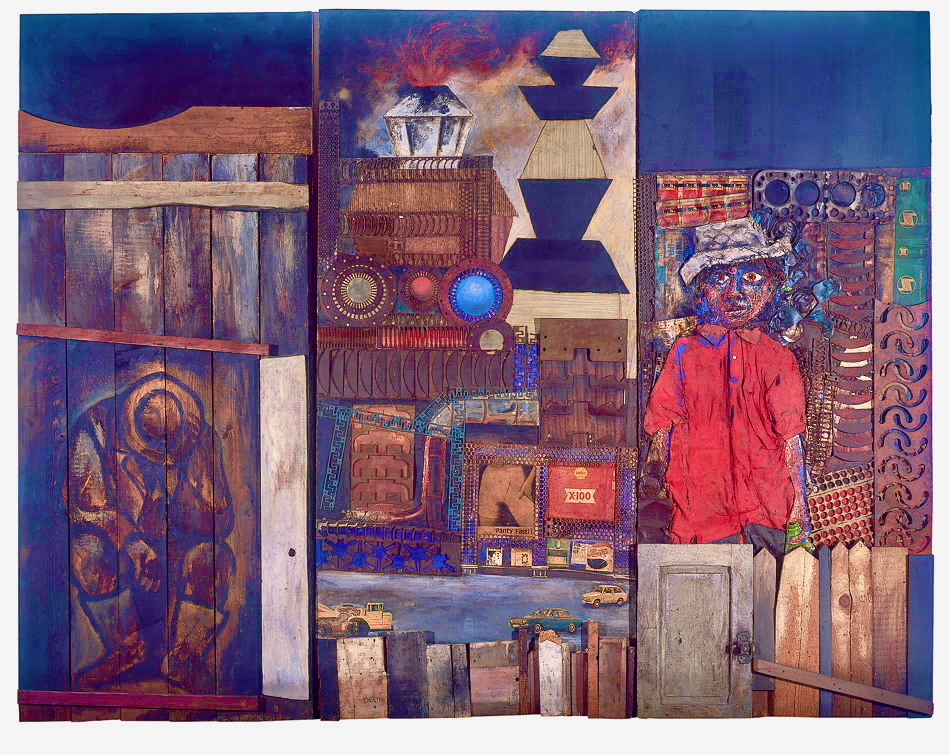
Dark forces seek to colonise the future to ensure it remains subordinate to accumulation, not dignity. Talk of the future is not utopian fantasy but affirmation this order is intolerable and impermanent.
Antonio Berni, Argentina. Juanito Laguna (triptych), n.d. Painted wood and metal collage. 220 × 300 cm. Courtesy of Casa de las Américas, Cuba. (Via Tricontinental Institute)
 In 2022, the roughly 10,500 citizens of the Pacific Island state of Tuvalu began to migrate not from one country to another but from their physical islands to the digital world.
Faced with the prospect that climate change could make its low-lying territory uninhabitable in just a few decades, Tuvalu set out to become the “first digital nation,” building a three-dimensional record of its land, archiving its culture and preparing digital systems of identity and governance so that it could continue to function even if its people are scattered across the world.
In 2025, the International Court of Justice, in the case Obligations of States in Respect of Climate Change, issued a ruling that said, “once a State is established, the disappearance of one of its constituent elements would not necessarily entail the loss of its statehood.”
If Tuvalu loses its 26 square kilometres to the rising seas, it will not disappear from the memory of its people, nor will it stop being a state. But a people cannot live only in a digital archive.
Their island might not have a future on our planet, but the people will continue to seek dry land in other territories and to preserve their nation in the digital landscape.
Who has a right to a future? The billionaires, certainly. There are now more than three thousand billionaires on the planet, with twelve of the richest holding more wealth than the poorest half of humanity — more than four billion people.
Take Elon Musk as an example. His net worth of roughly $840 billion means that his wealth is greater than the GDP of roughly 83 percent of the world’s nations when taken individually, including Argentina.
If money is taken as the index of possibility, then Musk’s future appears almost limitless. The average Argentinian, by contrast, might feel that the future is slipping away.
Alfonso Soteno Fernández, Metepec, State of Mexico, Mexico, Árbol de la vida / Tree of Life, 1975. Open-fired clay painted with varnished vinyl paint, 6 m. Courtesy of Casa de las Américas, Cuba. (Via Tricontinental Institute)
In 1969, Roberto Goyeneche sang Astor Piazzolla and Horacio Ferrer’s tango “Chiquilín de Bachín” (Little Boy from Bachín), reflecting the reality of so many Argentinian children then and now:
| Por las noches, cara sucia de angelito con bluyín | At night, a dirty-faced little angel in blue jeans |
Antonio Seguí, Argentina. Untitled, 1965. Oil on canvas, 200 x 249 cm. Courtesy of Casa de las Américas, Cuba. (Via Tricontinental Institute)
Today, over half of Argentina’s children live in poverty. They have been banished from the future by the assault of President Javier Milei’s government.
| Cada aurora, en la basura | Every morning, amid the trash, |
It is this imposed present that Tricontinental‘s 100th dossier, The Future (May 2026), insists is impermanent. It is an unusual text for several reasons, but mainly because it is deeply philosophical, offering a historical-materialist account of the future as something more than the next page on the calendar.
The future, the dossier argues, is not a neutral extension of the present but a rupture with it toward a socialist horizon.
Calendrical time, which treats tomorrow as if it could only be a repetition of today and makes disaster appear inevitable, is not enough; what we need is a conception of time that opens the future to transformation and human development.
These are not merely rights but human necessities. To stand by while billions of people starve and remain illiterate — to accept that they have been denied a future — is not acceptable for any of us.
Julio Le Parc, Argentina, Modulación 455 / Modulation 455, 1981. Acrylic on canvas, 200 x 200 cm. Courtesy of Casa de las Américas, Cuba. (Via Tricontinental Institute)
In a world saturated by war, debt, climate catastrophe and social despair, even the ability to imagine a future beyond capitalism has been systematically eroded.
Capitalist realism has trained us to believe that the present order is eternal, that exploitation and hierarchy are permanent facts of human life rather than historical structures produced by class power. Yet history teaches us something different.
Every social order appears permanent until a moment of rupture. Feudalism once imagined itself eternal; colonial empires believed their rule would last forever.
Capitalism too will pass. The future, therefore, is not a gift handed down by the calendar. It is a terrain of struggle.
The dossier asks: is there a future? It answers: Of course there is. We are fighting to build it, and we are building it now.
The Future insists that rupture is necessary because capitalism has reached a stage where its productive capacities are immense while its social outcomes are catastrophic.
The contradiction is not technical but political. Capitalism develops the productive forces while simultaneously sabotaging their emancipatory potential.
José Venturelli, Chile, Serigrafía / Serigraph, 1970, edition 15/90. 260 x 430 mm. Courtesy of Casa de las Américas, Cuba. (Via Tricontinental Institute)
The dossier identifies the “enemies of the future” that conduct this sabotage:
platform capital, which atomises social life and reorganises labour into existential precarity;
These forces seek to colonise the future before it arrives, ensuring that tomorrow remains subordinate to the needs of accumulation rather than human dignity. Yet the future persists because human beings continue to resist.
Across the Global South, peasants, workers, women and gender dissidents, migrants and the unemployed struggle daily against a system that denies them dignity.
Alfredo Plank, Ignacio Colombres, Carlos Sessano, Juan Manuel Sánchez, and Nani Capurro, Argentina. Che, collective series, 1968. Oil on canvas, 195 x 150 cm each. Courtesy of Casa de las Américas, Cuba. (Via Tricontinental Institute)
Spontaneous uprisings may topple governments, but only organised forces can construct enduring alternatives. The great revolutions of the twentieth century were not accidents of history; they were the product of patient political work carried out over decades.
To speak of the future today is therefore not an exercise in utopian fantasy. It is an affirmation that the present order is intolerable and impermanent.
The future will not arrive automatically. It must be built collectively, consciously, and internationally. In that struggle lies the true meaning of hope.
PS: The art in The Future, a selection of which appear in this newsletter, are drawn from Casa de las Américas’ immense Arte de Nuestra América Haydée Santamaría collection in Havana, Cuba. The collection is an exceptional archive of mainly Latin American and Caribbean art built through Casa’s decades of anti-imperialist cultural internationalism.
Vijay Prashad is an Indian historian, editor and journalist. He is a writing fellow and chief correspondent at Globetrotter. He is an editor of LeftWord Books and the director of Tricontinental: Institute for Social Research. He is a senior non-resident fellow atChongyang Institute for Financial Studies, Renmin University of China. He has written more than 20 books, including The Darker Nations and The Poorer Nations. His latest books are Struggle Makes Us Human: Learning from Movements for Socialism and, with Noam Chomsky, The Withdrawal: Iraq, Libya, Afghanistan and the Fragility of U.S. Power.
This article is from Tricontinental: Institute for Social Research.
Comments
No comments yet. Be the first.
Sign in to leave a comment.