Abdul El-Sayed’s historic Senate run builds on Palestine’s rich legacy in Michigan politics
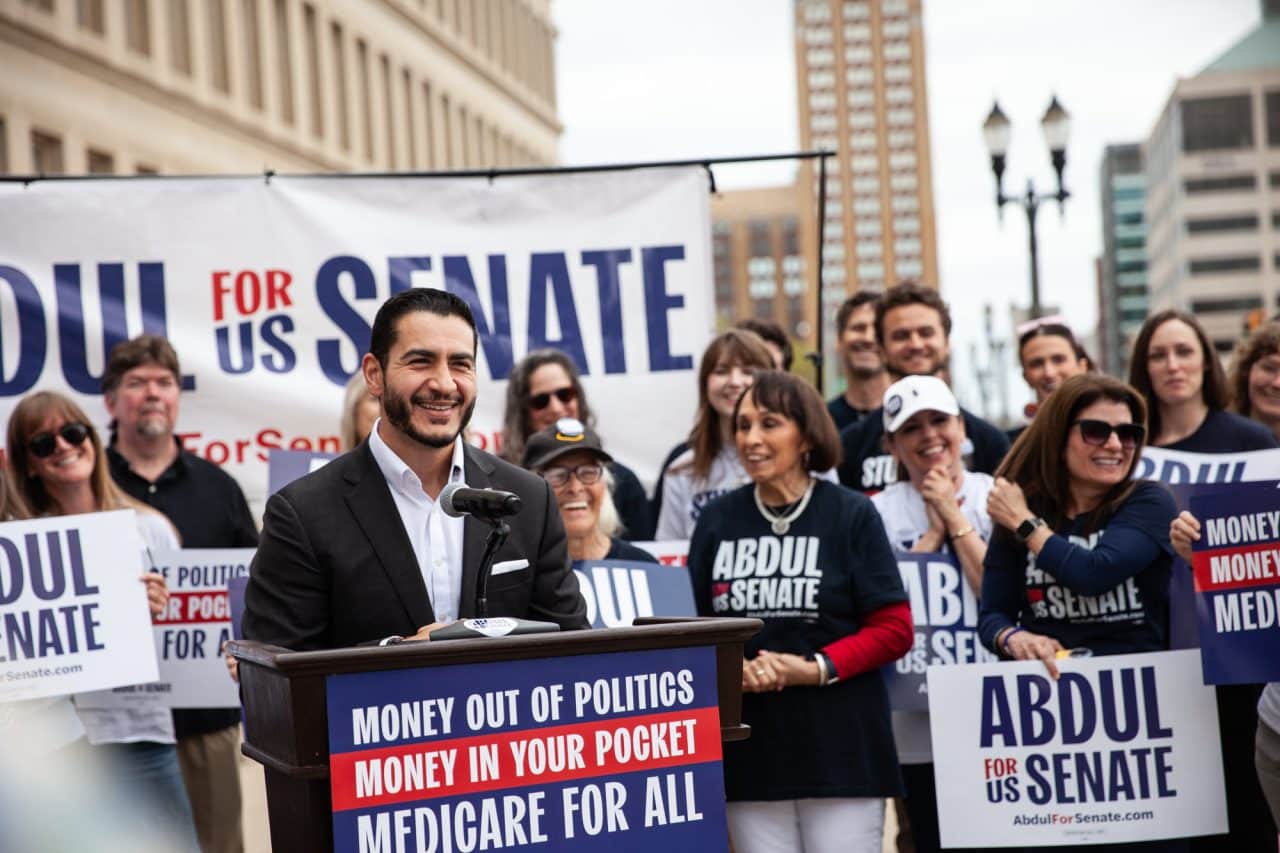
Following Zohran Mamdani’s stunning victory in 2025’s New York City mayoral election, a wave of progressive pro-Palestine candidates has entered Democratic primary races, alongside a rising tide of Palestine solidarity in organized labor and an increasing acceptance of longstanding left-wing views within the party. Israel’s genocidal actions in Gaza has created an opportunity for a new crop of leaders, and Michigan’s Abdul El-Sayed is just one of the latest names to rise to national prominence as he runs for the party’s nomination in the race to fill Gary Peters’ seat on the United States Senate.
A poll released May 11 puts El-Sayed at the front of the race, leading U.S. rep Haley Stevens by 10 points, and he is currently leading in RealClearPolitics average of polls. If he is elected he would be the first Muslim Senator in the nation’s history and one of only seven Arab Americans. This would be a political victory for the pro-Palestine Left, to say the least, and would rival Mamdani’s election in its significance. El-Sayed would be arguably the most progressive Senator ever elected, as he supports single payer health care, comprehensive criminal justice reform, and a full arms embargo against Israel. He would also, if elected, be the most powerful representative of the Palestinian cause in the United States.
Prior to Mamdani’s victory this past fall, such a situation would be unthinkable in American politics, but in fact when one considers El-Sayed’s Michigan roots and his background in local politics it makes perfect sense. Indeed, El-Sayed comes from a long tradition of Palestine solidarity, progressive labor organizing, and joint struggle between oppressed communities in and around Detroit for decades. If he enters the Senate next year, he’ll do so as a proud representative of a well established tradition in Michigan politics.
To understand recent developments in Michigan politics, such as the rise of El-Sayed, we must recognize that interweaving solidarity between the Palestinian struggle and every other battle for justice is a longstanding tradition in Detroit. In the 1960s, radical Black organizations like UHURU took strong stances in support of the Palestinian people in the spirit of global anti-colonial revolution, publishing communiques and Op-Eds in local Black papers and Wayne State University’s student newspaper the South End. Also at Wayne State, progressive Lebanese American lawyer Abdeen Jabara helped found the Association of Arab American University Graduates, which advocated for the Palestinian cause and built relationships with Black radicals, creating alliances and institutional memory which persists to the present. A watershed moment for Palestine solidarity in Detroit’s labor movement was the 1973 wildcat strike in which 2,000 auto workers walked off the job to demand that the leadership of the United Auto Workers divest from Israel in response to a planned ceremony in which the union’s president was set to receive an award from the B’nai B’rith International organization. The strike was organized by the newly formed Arab Workers Caucus, which continued its push for divestment to the union’s 1974 national convention and successfully pushed several locals to divest from Israel in 1975, foreshadowing the BDS movement of the last two decades and El-Sayed’s calls this year to block all arms transfers to Israel.
Of course, it would come as no surprise that metro Detroit with one of the largest Arab American communities in the United States would be a center for Palestine solidarity, but narratives that focus on demographics dramatically underplay the immense labor of Arab American activists to build solidarity in the labor movement and the Black freedom struggle, as well as the Black freedom struggle’s internationalism and the progressive labor movement’s emphasis on solidarity among all the world’s workers. This historical connection was reinforced once again when El-Sayed won the endorsement of Detroit’s Black Slate organization this month, a notable victory which speaks to deep progressive currents in the city’s politics. Today, we see the Palestinian cause becoming increasingly intersectional, connected to anti-ICE protests, queer liberation, feminism, and efforts to push back against the consolidation of media by tech oligarchs.
Beyond the realm of radical grassroots politics, Arab Americans and their allies have been building alliances with the progressive wing of the Democratic Party beginning in the early 1980s with the late Jesse Jackson’s Rainbow Coalition. Following Jackson’s passing this past February, James Zogby recounted in Mondoweiss how Jackson reached out to the Arab American community during his presidential campaigns, at one point working on voter registration drives in Dearborn, where the Lebanese community had recently grown following the displacement of hundreds of families by the then ongoing Lebanese Civil War. When Bernie Sanders won an upset primary victory in Michigan in the 2016 election, he did so in many ways as part of a larger relay race in which Jackson and his allies built relationships in Arab American communities and brought Palestinian and Lebanese issues into relation with other progressive causes. Once again, while media narratives about Michigan politics often focus on ethnic and religious feelings of solidarity in the state’s Arab American communities, this is an oversimplification of a complex history of joint struggle and solidarity. Jackson went on to push for recognition of Palestinian statehood in the 1988 Democratic Party platform. He spoke out in support of the Gaza solidarity encampments near the end of his life.
In 1990, Nelson Mandela received a hero’s welcome in Detroit following his release from prison, following mixed and even hostile receptions in New York City and Miami owing to his refusal to condemn Yasser Arafat. The UAW played an integral role in the struggle against apartheid in South Africa. It was one of the first major unions in the United States to call for a ceasefire in Gaza in 2023 and commit to forming a Divestment and Just Transition working group, echoing the 1973 wildcat strike and underscoring deep commitments to international solidarity and social justice forged in Detroit’s history.
Finally, we observe that Abdul El-Sayed enters his campaign with the endorsement of Vermont Senator Bernie Sanders, who, despite his personal commitments to labor Zionism, has enjoyed immense popularity in Michigan, including in the heavily Arab cities of Dearborn and Hamtramck. Sanders, who offered ultimately insufficient but meaningful criticism of Israel’s actions in Gaza during the 2014 war in a live debate against Hillary Clinton, opening a space for much more forceful recognition of the Palestinian cause in American left-wing politics and building a foundation for the Michigan-founded Uncommitted Movement and a new wave of populist candidates on the party’s left flank. Following Sanders’ upset victory in the 2016 presidential primary for the Democratic nomination, Palestinian-American Rashida Tlaib was elected to the House representing Michigan’s 13th congressional district. A year later she hosted the 2019 Democratic Socialists of America Douglas-Debs fundraising dinner with Abdul El-Sayed, then the head of Detroit’s Health Department. El-Sayed would go on to unsuccessfully run for governor in 2018, losing the nomination to current Michigan governor Gretchen Whitmer.
Today, El-Sayed has entered the Senate contest in a dramatically different landscape than he faced eight years ago. A fundraising email from AIPAC refers to his views and those of Maine’s Graham Platner as “a direct threat to the US-Israel relationship”. What is significant about this moment is not so much AIPAC focusing on progressive candidates in its fundraising, an old tale. No, what is noteworthy is El-Sayed’s bold reply: “I’m Abdul El-Sayed and I endorse this message”. It is a strong rebuke to AIPAC, but also signals a recognition that an uncompromising message is his best shot at victory. Even if he wins the primary, El-Sayed will face off against Republican Mike Rogers in November, a tremendous test of the electoral viability of Palestine solidarity and left-wing populism in an important swing state. Whatever happens, his historic momentum to this point builds on decades of work and will undoubtedly inspire progressive candidates in the decades to come.
Comments
No comments yet. Be the first.
Sign in to leave a comment.