7 Examples of Gaza Media Coverage That Prove Pro-Israel Bias
The article employs heavily charged language ('genocide,' 'dehumanizing,' 'racist') and frames media bias as proven fact rather than contested interpretation. The author's own book is the primary evidence source, centering activist/critical scholarship rather than media studies experts or quantitative methodologists who might contextualize findings. Omissions of counterarguments (e.g., why outlets frame Israeli security claims differently, editorial standards around sourcing) and lack of engagement with journalistic norms strengthen the advocacy tone.
Primary voices: academic or expert, media outlet
- This article does not address methodological limitations or peer review status of the author's book analysis
- This article does not present counterarguments from media organizations or journalism ethics experts defending coverage decisions
- This article does not contextualize how editorial standards around verification and attribution may explain differences in framing rather than bias alone
- This article does not compare Gaza coverage intensity to other active conflicts (Ukraine, Yemen, Syria) to establish relative editorial prioritization
Framing may shift if academic scrutiny of the underlying book's methodology produces divergent findings or if subsequent Gaza coverage trends differ from the October 2023–early 2024 period analyzed.
Activist-sourcedCharged languageDissenting framing
Ask anyone who has followed news about Gaza with even a smidgen of critical thinking, and they will tell you: Media organizations are biased against Palestinians — and systematically favor Israel.
It’s easy to say but harder to prove. Doing empirical analysis that shows these biases is time-consuming and complex, full of pitfalls and nuances that can muddy the picture. Yet the double standards are everywhere — and there are ways to do sober, qualitative work that elucidates not only the differences in how Israeli and Palestinian life are covered, but also also in how other recent conflicts are covered.
For my new book “How to Sell a Genocide: The Media’s Complicity in the Destruction of Gaza,” I attempt to demonstrate, beyond a reasonable doubt, that U.S. media coverage of the war on Gaza was one-sided, racist, dehumanizing, and often veered into outright incitement.
I examined over 12,000 articles from the New York Times, the Washington Post, CNN.com, Politico, Axios, USA Today, and The Associated Press, along with 5,000 TV segments that aired on CNN and MSNBC. The focus is on center-left media outlets influential with the Biden administration during the first year of the conflict — with an emphasis on the first few months, when Israel firmly established its narrative justifying the genocide, rendering mass death inevitable.
Here are seven statistical findings that prove the U.S. media’s bias against Palestinians.
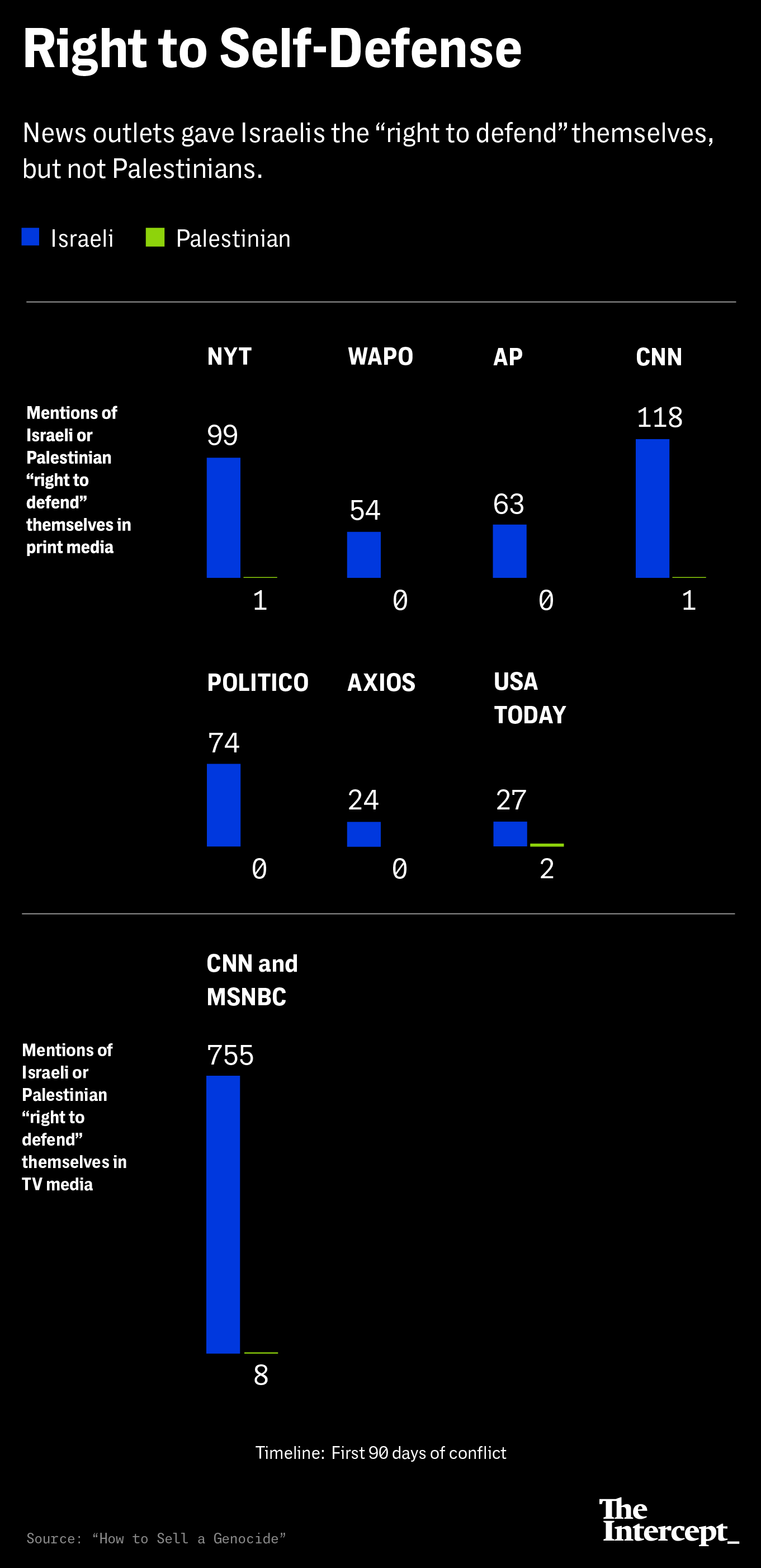
Israel’s “Right to Defend Itself”
The media’s penchant for invoking a nation’s “right to defend itself,” typically followed by the rationalization of mass civilian killing, was reserved almost exclusively for Israel. On CNN and MSNBC, guests, anchors, and reporters mentioned the right to self-defense for Israel 94 times more than they did for Palestinians. In print media, Israel was afforded this right over 100 times more frequently than Palestinians in Gaza.
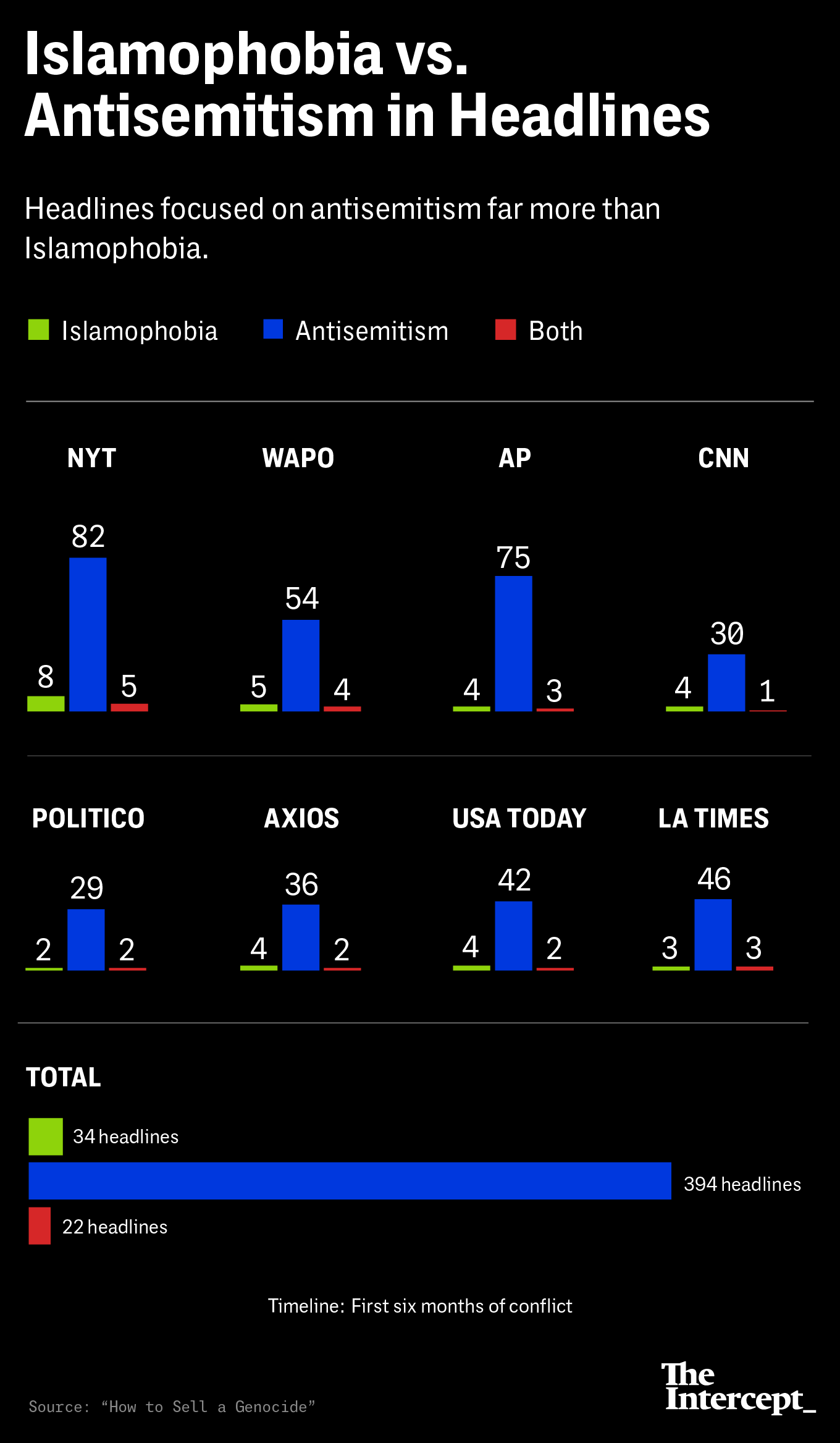
Antisemitism vs. Islamophobia
While incidents of antisemitism and Islamophobia were on the rise in the months after October 7, coverage focused almost entirely on antisemitism with little or no regard for anti-Muslim bigotry or how the mass killing in Gaza impacted Palestinians stateside. This was especially true on college campuses, where students protesting Israel’s war were tarred as antisemites in the mainstream press, while Muslim, Arab, and Palestinian students who faced discrimination barely received any attention.
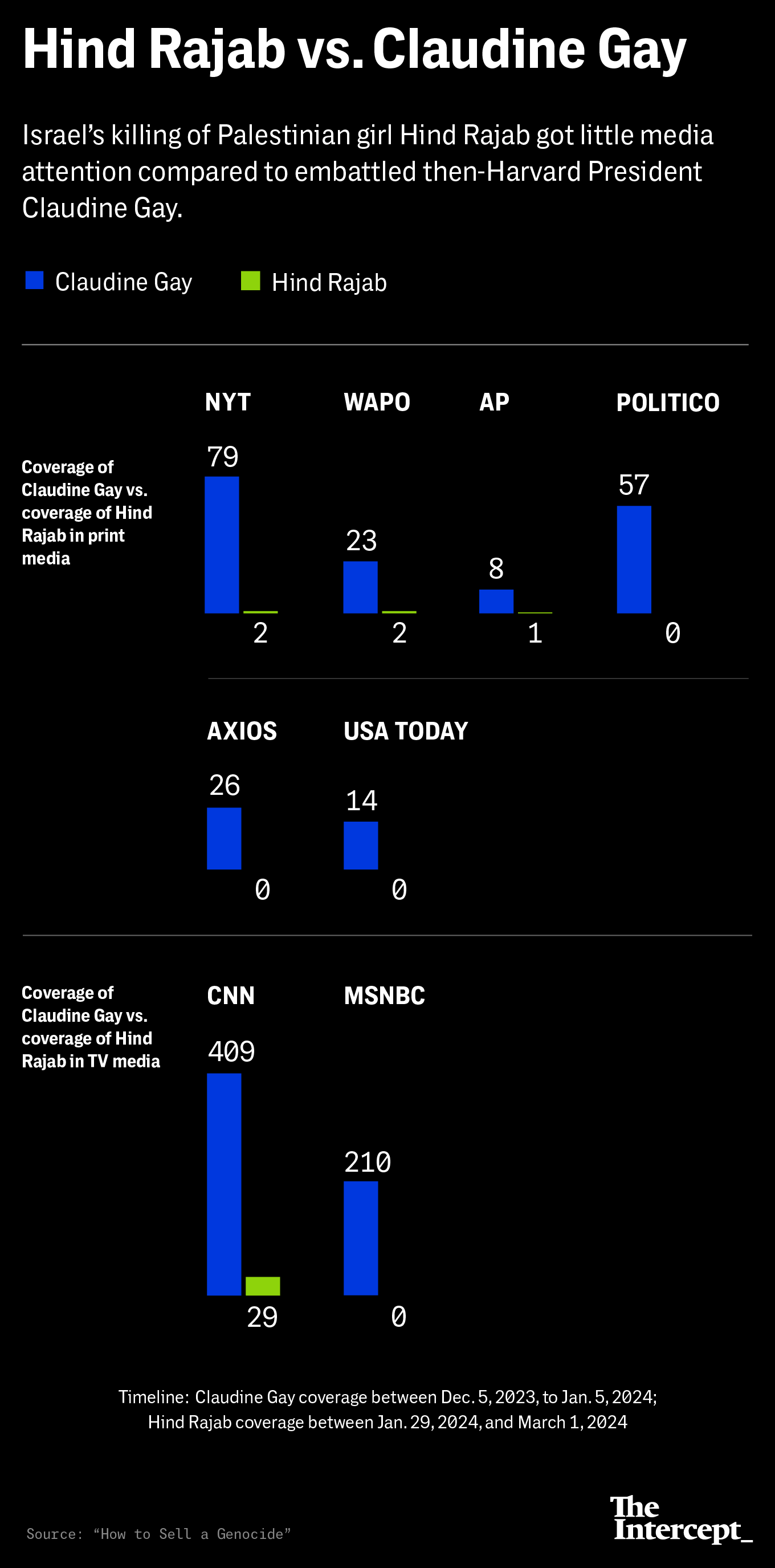
Campus Antisemitism vs. Killing Children in Gaza
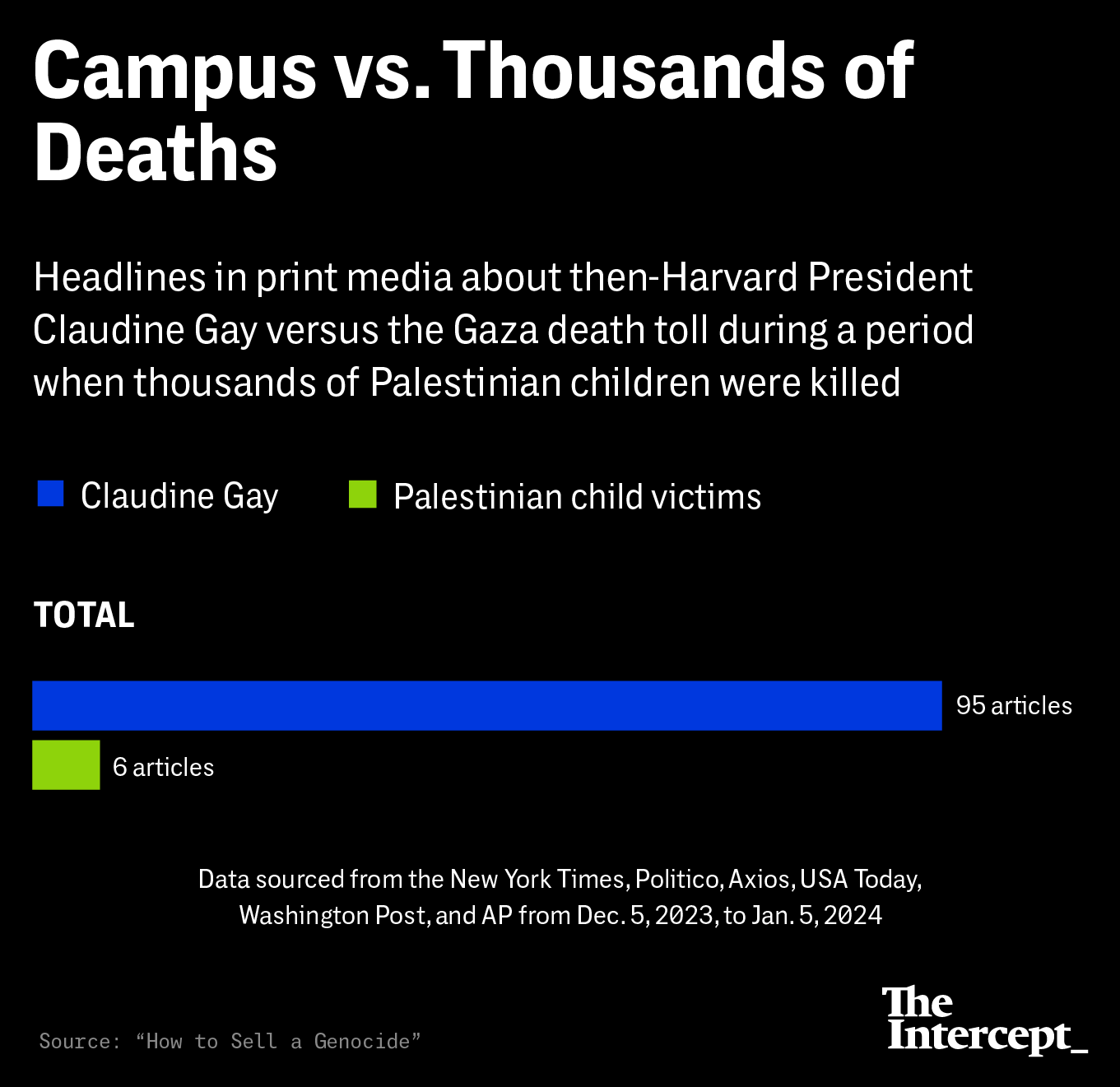
For a poignant example of how Palestinians are dehumanized, consider the media’s treatment of former Harvard University President Claudine Gay in comparison to their coverage, or lack thereof, of the killing of Hind Rajab. Not long after Gay resigned under pressure from Congress amid a monthslong fixation on allegations of antisemitism on college campuses and allegations of plagiarism by Gay over 20 years prior, the Israeli military opened fire on a car carrying Rajab and her family and left the 5-year-old Palestinian girl to die. On the New York Times homepage, stories about Gay appeared in 15 of the 31-day period covering the height of the scandal, whereas Rajab didn’t appear once in the month that followed her death.
Comments
No comments yet. Be the first.
Sign in to leave a comment.