The Error in Banning the Nakba Day March
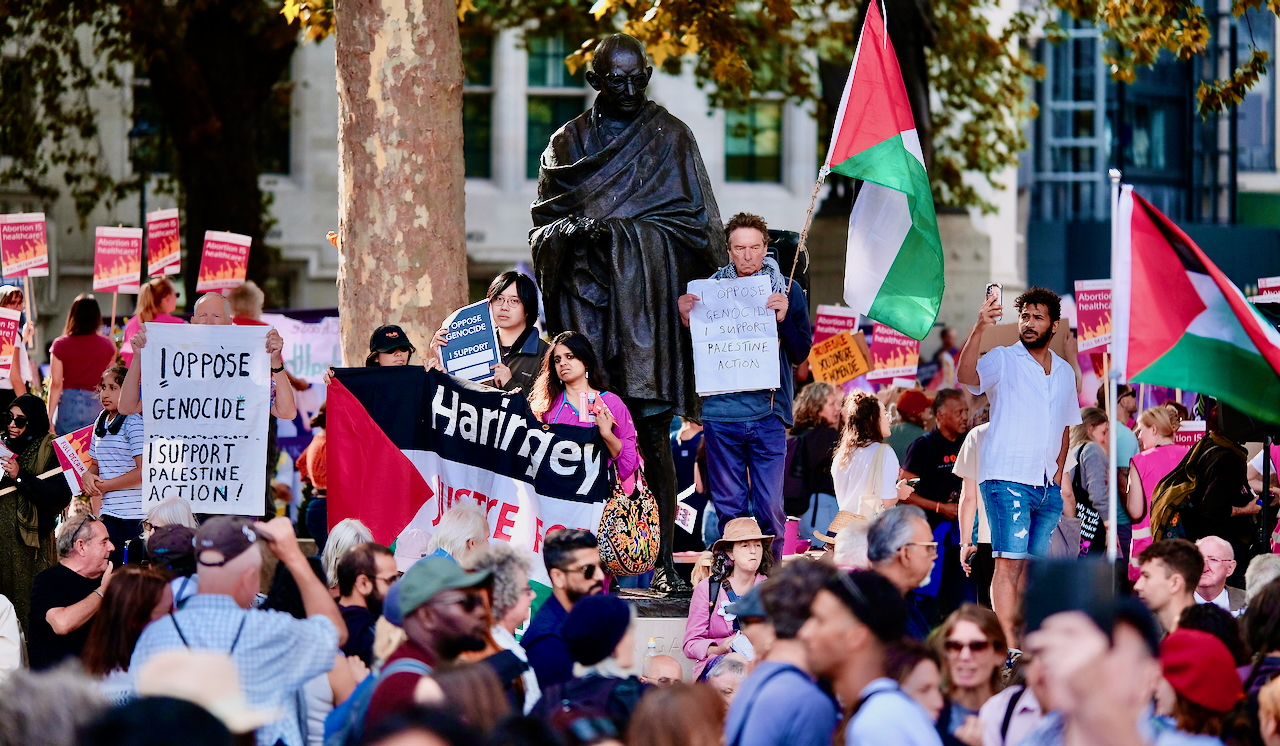
Police wrongly want to ban a Palestine rally on Nakba Day on Friday but are allowing the right-wing’s anti-Islam rally the same say, writes Nailah Sharif, a retired London Metropolitan Police detective.
Protesters support Palestine Action at the statue of Mahatma Gandhi, Parliament Square, London, September 2025. (Alisdare Hickson / Flickr / CC BY-NC-SA 4.0)
 As a retired Metropolitan police detective, I’m alarmed that senior officers might ban Palestine marches in central London in the wake of the Golders Green stabbings.
Every march I have attended as a citizen has been nothing but peaceful. There are children in buggies, strangers helping elderly people and LGBTQ groups with their beautiful pride flags raised in the air.
I have spoken to dozens of serving officers who have policed the marches. All of them have said that they are peaceful. One even said that policing them is “a doddle – easy overtime.”
Representatives from Jewish groups like Na’amod, Jews for Justice for Palestinians and Jewish Bloc for a Free Palestine have been marching alongside everyone else and have been applauded and cheered.
Senior police now claim that the marches have driven the rise in antisemitism, without explaining how protests that include Jewish groups can be deemed to be terrorising the same community it is asked to keep safe.
The Community Security Trust (C.S.T.) has recorded 3,700 antisemitic incidents in 2025, the second-highest annual total ever. Fifty-three percent of C.S.T.’s 2025 incidents reference Israel, Gaza, or Oct. 7 — meaning the war, not a London march, is the triggering factor.
The single largest vector is online: 1,541 incidents on social platforms, 70 percent tied to Middle East events. The biggest 2025 spikes coincided with the Israel–Iran war and a Glastonbury performance, not with Palestine marches.
Meanwhile, the Muslim group, Tell MAMA, recorded 6,313 cases of Islamophobia in 2024, a 43 percent rise. It is telling that this statistic seems to receive less attention from senior police than antisemitism statistics.
In fact, they have granted far-right figurehead Tommy Robinson permission to hold his “Unite the Kingdom” march tomorrow, May 15.
It will pass through Trafalgar Square, Whitehall and Parliament Square – the political centre of London.
This will happen on the same day that the Palestine Solidarity Campaign (P.S.C.) wanted to hold a rally to commemorate Nakba Day, which marks Israel’s ethnic cleansing of much of historic Palestine in 1948.
The P.S.C.’s preferred route, including one used at least twice without incident, was rejected by police.
Last year, Robinson held a rally that produced clashes between protesters and police. Robinson’s supporters called for a ban on Islam and shutting down mosques. Imagine if the same threats were made towards the Jewish community?
Yet there is no public briefing about banning Robinson’s rally on May 16. Only about the Palestine march on the same day. Two assemblies, two standards.
For me, the Met Police is responsible for this by being active cheerleaders. The Commissioner himself has spoken at length, repeatedly, about chants from the Palestine protests and misleadingly claimed that organisers want to march near synagogues.
The role of senior police in a democracy is to facilitate lawful assembly. To police the threat. To police the law. Not to police the politics.
This comes at a crucial time when police need to be seen uniting people – not to be complicit in divisive rhetoric.
The damning Casey Review, published in 2023, found the Met Police relationship with Londoners is fragile and their communications are too often perceived as taking sides.
Nailah Sharif is a former Metropolitan police detective.
Comments
No comments yet. Be the first.
Sign in to leave a comment.