Canceled over Palestine: Biotech CEO Rami Elghandour on Rutgers Disinviting Him as Graduation Speaker
This interview centers the speaker's perspective and grievance almost exclusively, with Amy Goodman asking sympathetic follow-up questions that amplify his narrative. The framing emphasizes vagueness of university rationale ('very vague,' 'no specifics') and portrays the cancellation as disproportionate ('a handful of students' vs. 'a class of a thousand'). Union statements condemning the decision are quoted prominently, while Rutgers' actual reasoning—beyond the brief mention of 'complaints about social media posts on Israel-Palestine'—is not substantively explored.
Primary voices: media outlet, elected official, NGO or civil society, corporate or institutional spokesperson
- This article does not address the specific content of Elghandour's social media posts that prompted complaints.
- This article does not include direct statements from Rutgers University administration beyond the paraphrased 'complaints about social media posts' and the dean's vague characterization.
- This article does not include perspectives from the students or groups who complained about the invitation.
- This article does not address whether Elghandour's films or public statements on Gaza are cited by complainants as relevant context.
Framing may shift if Rutgers provides detailed justification, student organizers respond publicly, or additional context about the social media posts emerges.
Activist-sourcedAnti-interventionistDissenting framing
AMY GOODMAN: This is Democracy Now!, democracynow.org. I’m Amy Goodman.
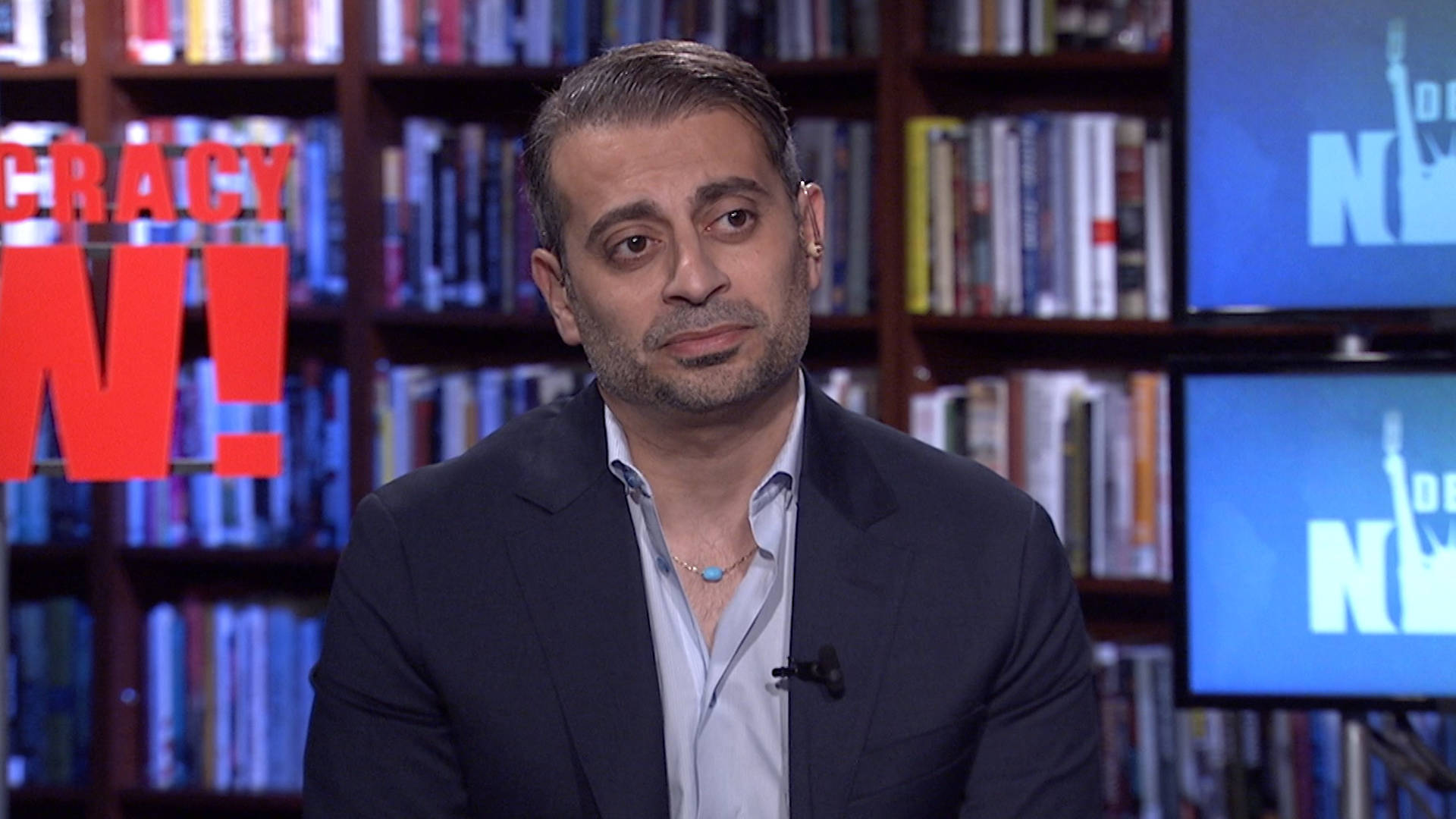
In New Jersey, Rutgers University has abruptly withdrawn its invitation to a prominent biotech entrepreneur and alum to speak at its engineering school convocation. Rami Elghandour, a 2001 alum of the engineering school, had been scheduled to deliver a graduation address at Rutgers’ New Brunswick campus May 15th, but his invitation was canceled over what the university said were complaints about his social media posts on Israel-Palestine.
Two unions of educators at Rutgers University issued a joint statement condemning the university’s decision to cancel the speech, calling it politically motivated suppression that, quote, “reflects a broader pattern of universities applying a Palestine exception to their stated commitments to free speech,” unquote.
Elghandour is also executive producer of the Oscar-nominated film The Voice of Hind Rajab, about the killing of a Palestinian child and her family in Gaza, along with paramedics who tried to rescue them, and the film American Doctor that premiered earlier this year at Sundance Film Festival, the film following three doctors who go to Gaza to volunteer.
Rami Elghandour joins us now in New York.
RAMI ELGHANDOUR: Thanks, Amy. It’s a pleasure to be here, and I appreciate the opportunity.
I was invited by Rutgers in December of 2025, principally because of my student engagement. I do a lot of student engagement as an alum with Rutgers University, and I love the students and spend a lot of time with them. I actually did a fireside chat with this dean, that issued me that invitation in December, in March, in early — in early March, I believe. And then, a couple of weeks ago, about two weeks before I was set to give the graduation address, I received the call that I was disinvited.
RAMI ELGHANDOUR: As you shared, it was very vague. There was no specifics. I asked for specifics. It was, to quote the dean, that my social media posts “oppose the beliefs of a few students.” I asked, “How many students?” And he said, “A few.” A few, to me, sounds like maybe five or so. So, it seemed unbelievable to me that for a class of a thousand students, that a handful of students having complaints would lead to this outcome. And, look, I am obviously a big proponent of free speech, but disagreement is not harm. Having a different point of view is not harming these students in any way to lead to this sort of outcome.
AMY GOODMAN: I want to ask you about your background. You are alum of Rutgers. And then talk about what you went on to do.
RAMI ELGHANDOUR: Sure, yeah. So, I graduated from Rutgers in 2001 with a degree in electrical computer engineering. I worked for five years as an engineer. I then went on to business school at Wharton Business School in Philadelphia. From there, I got into venture capital and moved to the great state of California, where I was in venture for about five years, as well. I then joined my first startup. I built that startup from about 30 to a thousand people, took it public on the New York Stock Exchange, was there for about seven years. I then left, took a couple years off and joined my most recent company, Arcellx, where I’m chairman and CEO. And for that organization, I ran it for the past five-and-a-half years. We were just acquired by Gilead for $7.8 billion. And we make a cancer therapeutic that is what I believe to be the best therapeutic option ever developed for multiple myeloma.
AMY GOODMAN: And so, has Rutgers courted you through the years?
RAMI ELGHANDOUR: Of course. I feel like I am the poster child for Rutgers School of Engineering. I’ve made a lot of my degree. I get asked all the time, “Is the engineering degree valuable,” given what I do today? And it’s absolutely valuable. And I’m so proud of Rutgers, and it’s really just been heartbreaking to go through these last couple of weeks.
AMY GOODMAN: It’s interesting that Rutgers has dealt with some student complaints over your invitation versus what happened with another event just last month. In April, the Rutgers chapter of Students Supporting Israel invited a former soldier from the Israeli Defense Forces who had served in Gaza last year to come to campus. Despite protests by pro-Palestinian and Muslim and Arab groups and a petition signed by over 7,000 people of the Rutgers community demanding the event be canceled, the event took place as planned.
RAMI ELGHANDOUR: Yeah, I mean, look, I think if I had to summarize this entire dialogue around Israel and Palestine, I would summarize it using the word false equivalency. And it’s a false equivalency across a couple of different metrics. The first one is on free speech. So, on the one side, we talk about these cancellations. I’ve seen a lot of these articles online about my speech was canceled, and there was a speech canceled at GW Law. But that speech was not canceled. That speaker actually withdrew. I’m actually an alum of the School of Engineering. That speaker was not even a law graduate, let alone had any association with Georgetown. So, it seems like there’s, on one side, actual free speech; on the other side, not so much.
Let’s talk about America, America first, on the one side. I’ve never heard a pro-Palestine advocate ask for one penny for Palestine. On the pro-Israel side, we’re constantly asked — not even asked, demanding — unlimited funding and political cover. So, I keep hearing this sort of, like, false equivalency, like, “Oh, both sides are kind of the same.” They are not the same.
And then, lastly, from a principles perspective, on the Palestine side, we are advocating for equality. On the pro-Israel side, Israel is the only country in the world that still automatically and systematically prosecutes children in military court. They just passed a law that legitimized or passed the death penalty only for Palestinians, for one ethnic minority.
So, look, you asked about my background, Amy. I’m a CEO who made their career by being in the details. I constantly hear that, you know, there are sort of two sides to this issue. And there are two sides, but they couldn’t be more starkly different.
RAMI ELGHANDOUR: I really was talking about the journey that got me here. You know, a lot of the student engagement I do, the one question they ask me is: How did I manage to be as successful as I’ve been without compromising my beliefs and my values? So, I go mostly through my career arc, and the two things I focus on are being yourself and choosing kindness as a way to lead.
AMY GOODMAN: And do you get pushback at Arcellx for your views?
RAMI ELGHANDOUR: I do not. I have friends, as well as colleagues, that are of all different races, ethnicities, including Jewish friends and colleagues. And at Arcellx itself, I have had no issues. I’ve had multiple attempts from outside of Arcellx to cancel me or silence me over my speech and my time there as CEO, but never from within the company.
AMY GOODMAN: On April 20th, Congressmember Ro Khanna wrote on social media, “The free ride is over. Israel has a $45 billion defense budget. I am Team America,” Khanna wrote.
You replied to the post, writing, “Forget a free ride. They’ve committed genocide. They’re running dungeons where they train dogs to sexually assault prisoners… Weapons embargo is the absolute minimum. Sanctions and diplomatic isolation are beyond justified. This we’ll sell them weapons won’t fly…” unquote.
On Sunday, Democracy Now! reached out to Rutgers to invite a representative to join us on the show or send us a statement on why your speaking invitation was rescinded. Rutgers sent us the following statement: quote, “In response to objections from students regarding Mr. Elghandour’s social media posts, including one that shared an inflammatory claim, and following the Dean’s own discussions with Mr. Elghandour that raised concerns about whether the event and his remarks would remain consistent with the celebratory nature of the occasion, the School of Engineering decided to rescind the speaking invitation for the school convocation.”
Interestingly, today, The New York Times columnist Nicholas Kristof has a new article out, headlined “The Silence That Meets the Rape of Palestinians.” In it, Kristof writes about a Gaza journalist detained by Israel in 2024. Nicholas Kristof writes, quote, “On one occasion, he said, he was held down, stripped naked, and as he was blindfolded and handcuffed, a dog was summoned. With encouragement from a handler in Hebrew, he said, the dog mounted him. … He tried to dislodge the dog, he said, but it penetrated him.” Kristof goes on to write, “Other Palestinian prisoners and human rights monitors have also cited reports of police dogs being coached to rape prisoners,” unquote. Kristof’s piece links to reports from BBC, Al Jazeera and Middle East Eye. Your comments on what has been cited?
RAMI ELGHANDOUR: Yeah, I mean, first of all, I just want to be clear that Rutgers never shared that with me. So it is dishonest at this point to come out and point to this tweet, when I repeatedly asked what the source of this disinvitation was. And they said they never even reviewed my social media, let alone had a specific tweet to point to. And you can verify that in that their initial statement to the Associated Press said that, said, “We hadn’t reviewed anything.” And now, after drawing a lot of fire, they decided to point to something.
The second thing I’ll say, before I get to the human rights issue, is that the idea that, as a public company CEO, I’m just tweeting willy-nilly things that are not verifiable is just farcical and laughable. So it’s an embarrassing position for the university to take.
The third, though, and the most important of these, is: How morally bankrupt can you be to read that tweet and have your concern be the content of the tweet, rather than the accusations in it? And the fact that Palestinians are systemically not believed despite the overwhelming evidence, as I talked about in this false equivalency dynamic, of rape, murder, prosecution, I mean, we are talking — forget the genocide in Gaza. Forget the terrorism in the West Bank. Save the Children, one of the most prominent organizations in the world, says that half of the children abducted by Israel are sexually assaulted. What are we talking about? Like, how is this still a dialogue in this country? And this is maybe the most disturbing thing I have ever heard.
RAMI ELGHANDOUR: Yeah, sorry. This is the most disturbing thing I’ve ever heard, with respect to this sexual assault by animals.
AMY GOODMAN: I thank you for being with us, Rami Elghandour, biotech entrepreneur, scheduled to deliver a graduation address at Rutgers, but his invitation was canceled. He’s executive producer of the Oscar-nominated film The Voice of Hind Rajab. I’m Amy Goodman. Thanks for joining us.
The original content of this program is licensed under a Creative Commons Attribution-Noncommercial-No Derivative Works 3.0 United States License. Please attribute legal copies of this work to democracynow.org. Some of the work(s) that this program incorporates, however, may be separately licensed. For further information or additional permissions, contact us.
Comments
No comments yet. Be the first.
Sign in to leave a comment.