Two Democrats join GOP to advance Warsh Fed nomination
The article presents factual reporting on a procedural vote with minimal editorializing. It centers government sources (senators' votes, Warsh's testimony, DOJ actions) and includes direct quotes from Warsh on Fed independence. The framing acknowledges both Democratic defections and Republican support without valorizing either position, and includes a clarifying note that the chairman cannot unilaterally cut rates—a detail that contextualizes concerns about political pressure. Language is largely neutral and descriptive rather than charged.
Primary voices: elected official, state or recognized government, academic or expert
- This article does not address Democratic criticism or concerns about Warsh's nomination from within the party beyond the abstentions.
- This article does not provide substantive detail on Warsh's monetary policy record during 2006-2011 or economic analysis of his stated positions.
- This article does not explore labor unions' or progressive advocacy groups' positions on the nomination.
Framing may shift after the Tuesday procedural vote and any subsequent full Senate confirmation vote, depending on the margin and outcome.
Government-sourcedBoth-sides framingNeutral language
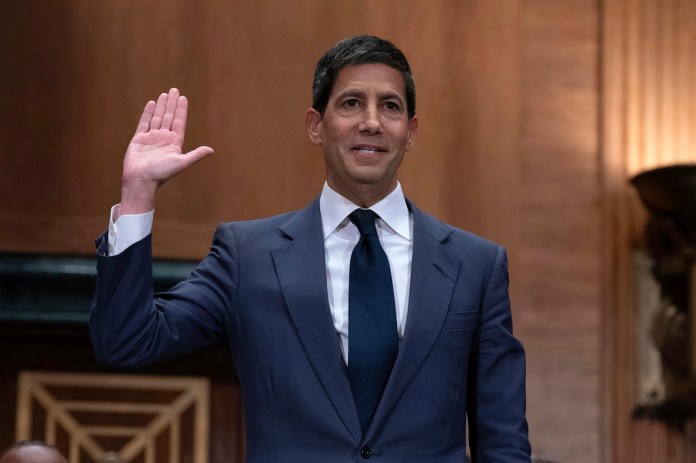
The Senate voted 49-44 Monday to move toward a final vote on Warsh’s nomination to serve on the Fed board, with Sens. John Fetterman (D-PA) and Chris Coons (D-DE) joining Republicans. A separate procedural vote on his nomination to chair the board is expected Tuesday.
Sens. Michael Bennet (D-CO), Steve Daines (R-MT), Bill Hagerty (R-TN), Cindy Hyde-Smith (R-MS), Ashley Moody (R-FL), Lisa Murkowski (R-AK), and Pete Ricketts (R-NE) all did not vote.
Warsh, 56, is set to replace Fed Chairman Jerome Powell, who Trump has publicly lambasted for refusing to bow to pressure from the White House to lower interest rates. Warsh had his nomination advanced through committee last month after his nomination hearing before the Senate Banking, Housing, and Urban Affairs Committee.
Warsh previously served on the Fed’s Board of Governors from 2006 to 2011, during the worst of the Great Recession.
During his confirmation hearing, Warsh faced a number of questions on his monetary policy philosophy, the independence of the Fed, his personal finances, and more.
Powell had been under investigation by the Justice Department for claims he made during congressional testimony about cost overruns for renovations of the Fed’s headquarters. But Powell argued the inquiry was an effort by Trump to influence interest rate policy. The DOJ later dropped the probe, but many of the questions Warsh faced were about Fed independence, in light of the situation.
Warsh vowed repeatedly throughout the hearing that he would remain a faithful steward of the Fed’s independence if he were confirmed as its next chairman.
“Let me be very clear: Monetary policy independence is essential,” Warsh told the panel. “Monetary policymakers must act in the nation’s interest. Their decision is the product of rigor, deliberation, and unclouded decision-making.”
Still, he argued that politicians, including Trump, weighing in on interest rate policy is not necessarily a threat to Fed independence.
It is worth noting that Warsh alone cannot cut interest rates, even as chairman. That is because while the chairman leads the Fed board and messaging, interest rate decisions are up to a 12-person board called the Federal Open Market Committee. The FOMC decides collectively what the course of interest rate policy should be.
During the hearing, Warsh vowed reform at the Fed and blamed the years of inflation on “a legacy of the policy errors” in 2021 and 2022 as the country was emerging from the pandemic.
If confirmed by the full Senate, Warsh should be in place to lead the Fed’s June meeting.
Comments
No comments yet. Be the first.
Sign in to leave a comment.