The Other Border Problem: How Russia and China’s Lawfare Threaten the Arctic
This article presents a hawkish assessment of Arctic geopolitics centered on U.S. strategic interests and security concerns. The framing treats Russian and Chinese actions as illegitimate 'lawfare' while implicitly validating U.S. interpretations of international law; language choices like 'excessive maritime regulations,' 'shadow fleets,' and 'ceding control' carry loaded implications. The article references the 2025 National Security Strategy and advocates for U.S.
Primary voices: elected official, state or recognized government, international body
- This article does not address Russia's or China's stated legal or strategic rationales for their Arctic claims and regulations.
- This article does not explain the technical or environmental basis for Russia's Article 234 pollution restrictions or acknowledge shared environmental interests.
- This article does not discuss how U.S. Arctic policy or military presence may be perceived as provocative by Russia or China.
- This article does not examine the economic dependencies of Arctic nations on Russian or Chinese cooperation.
Framing of Arctic disputes may shift as ice melt accelerates resource accessibility, climate agreements evolve, or military incidents occur in contested waters.
Government-sourcedHawkish framingThink-tank-cited
What happens when the Arctic starts to look like the South China Sea?
Historically, a neutral region where cooperation prevailed, the Arctic is quickly becoming a contested space. This is no more evident than in the increasing scope and volume of Russian and Chinese lawfare affecting the region. Through excessive maritime regulations, coordinated challenges to Western continental shelf claims, and the use of shadow fleets to avoid accountability, Russia and China are increasingly coordinating their efforts to exert influence and challenge Western claims to Arctic resources and freedom of navigation. As these tactics continue to converge, the United States and its partners — Arctic and non-Arctic — should establish clear strategies to respond and counter or risk ceding control of this critical region to those who seek to reshape the law in their favor.
Asserting full control over U.S. borders is a primary goal of the 2025 National Security Strategy. Yet threats to America’s Arctic border have received little public attention. Through concerted efforts, Russia and China are attempting to undermine the laws and norms that support U.S. geopolitical and economic interests in the Arctic. The United States should adopt a coordinated counter-lawfare strategy to preserve freedom of navigation, deter aggression, and uphold international law in the Arctic. The costs of inaction could be devastating for U.S. strategic interests and for the freedom and prosperity of U.S. allies and partners.
How Russia is Undermining the Legal Foundations of the Arctic
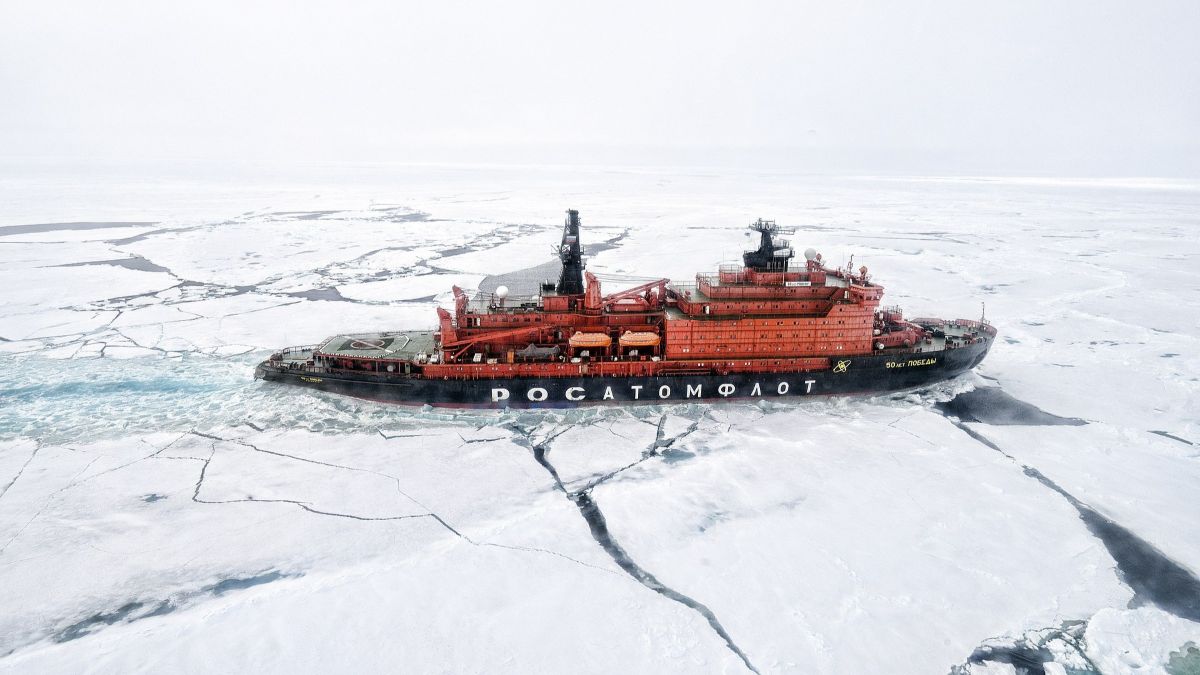
Russia’s Arctic lawfare has primarily focused on control of the Northern Sea Route. The route runs across the Arctic from the Barents Sea through the Bering Strait, connecting East Asian manufacturers with European consumer markets. While it is currently impassable for most of the year, melting Arctic ice is rapidly changing its accessibility.
Recognizing its strategic importance to both the Russian economy and national security, Moscow leverages contested readings of the United Nations Convention on the Law of the Sea to expand and solidify its control of the Northern Sea Route. Notably, Russia has drawn straight baselines around most of its offshore archipelagos (contrary to generally accepted readings of the Convention), thus recharacterizing key international straits as internal waters. This ostensibly provides an international legal foundation for Russia to treat the Northern Sea Route as a series of sovereign choke points, which Russia has indicated it may defend with force if challenged.
In parallel, Russia uses a non-standard interpretation of Convention Article 234 to impose robust pollution and navigation restrictions on vessels transiting the Northern Sea Route. In addition to tariffs and requirements for insurance and state approval, Russian domestic law also mandates the use of Russian ice pilots and costly Russian icebreaker escorts by any non-sovereign foreign vessel desiring to transit the Northern Sea Route.
In addition to establishing a discriminatory transit regime for international commerce, Russia is building a narrative that frames external pushback as unlawful interference with Russian sovereignty. Russia now controls which merchant vessels use the Northern Sea Route, and its designation of straits used for international navigation as internal waters severely limits the ability of warships to enter without potential for escalation. Yet, acquiescence to Russian claims, either due to ignorance or complacency, has the capacity to cement Russian control of the Northern Sea Route, providing impunity to shadow fleet vessels and heightening risk of escalation if states challenge Russia’s control of this maritime domain.
Most nations contest Russia’s interpretation of Convention Article 234, and America’s persistent objection may be enough to keep Russia’s claim from solidifying. However, without operational challenge by the United States and its partners, Russia nevertheless maintains effective operational control of the Northern Sea Route, dictating terms of passage and limiting the freedom of navigation. The United States should continue to argue that the Convention’s rule regarding transit passage (as codification of customary international law) applies to the straits Russia has claimed as internal waters.
Meanwhile, China bolsters its Polar Silk Road ambitions by reaping the rewards of its “no limits” partnership with Russia. In exchange for Chinese support of excessive Russian maritime claims, China gains preferential access to the economically beneficial Northern Sea Route, including increased availability of sanctioned Russian petroleum and liquified natural gas transported along the Northern Sea Route to China with impunity by Russian shadow fleet vessels. A Chinese icebreaker’s safe Northern Sea Route transit in Sept. 2024 further demonstrates increasing military and lawfare cooperation. In 2025, Russia announced that it is training Chinese seafarers to navigate polar waters as it develops the Northern Sea Route as part of a wider, multimodal Trans-Arctic Transport Corridor. Each small lawfare action will accrete into a larger fait accompli if the United States ignores this strategic threat.
Russian Lawfare Helps It Target Critical Undersea Infrastructure
In addition to sanctions evasion, the shadow fleet is instrumental to Russia’s hybrid warfare targeting critical undersea infrastructure — the cables and pipelines underpinning global commerce and defense cooperation. Specifically, the shadow fleet vessels often fly flags of convenience (leveraging the patchwork enforcement framework of the Law of the Sea Convention) and violate International Maritime Organization requirements by spoofing their automatic identification system signals or turning them off altogether. These actions obfuscate the reality of Russian illicit activity, allowing Russia to evade sanctions enforcement and denying accountability to countries affected by damaged subsea cables.
For example, despite strong suspicion and prolonged investigations of Russian involvement in undersea cable damage in the Baltic Sea in 2024 and 2025, prosecutions have generally been stymied by the difficulties of proving intent in court, especially when many undersea cables are accidentally damaged each year. This legal attribution gap makes shadow fleet operations an attractive component of Russia’s lawfare strategy, leading NATO and the European Commission to frame the pattern as a serious hybrid threat requiring intensified monitoring and collective resilience measures.
How Russia and China are Undermining the U.S. Extended Continental Shelf Claim
China and Russia engaged in concerted lawfare in response to the U.S. announcement of an extended continental shelf claim in the Arctic in 2023, which defines the outer limits of U.S. seabed and subsoil rights beyond 200 nautical miles. Although the U.S. claim follows decades of data collection and generally follows the scientific requirements of Article 76 of the Law of the Sea Convention, because the United States is not a party to the treaty, it has not submitted its extended continental shelf claim to the Commission on the Limits of the Continental Shelf.
By contrast, most of Russia’s Arctic extended continental shelf claims have been positively recommended by the Commission (meaning they’re scientifically supported under Article 76), but those claims also partially overlap with U.S., Danish (via Greenland), and Canadian extended continental shelf claims. Overlapping claims are not adjudicated by the Commission and should be negotiated between the claimant states or adjudicated by an international tribunal, and both Russia and China (which claims to be a “near-Arctic state”) have sought to undermine the credibility of the U.S. claim by releasing statements challenging its legality.
Russia announced its non-recognition of the extended continental shelf claim, stating that the United States is “unilaterally trying to reduce the area of the seabed” under the jurisdiction of the International Seabed Authority, is selectively applying international law, and is disregarding its international legal obligations. China followed suit, releasing a separate denunciation echoing Russia’s claims, calling the U.S. claim “illegal and invalid” and framing it as U.S. “hegemonic” selectivity.
Together, Russia and China are eroding perceptions of lawful U.S. behavior to weaken the maritime legal order that the United States seeks to uphold, and they are making progress, which has challenged the United States to defend its claim. For the claim to solidify and ultimately achieve legitimacy, the United States should rally allies and partner nations behind it, while working to diminish the influence of Russian and Chinese narratives.
Developing a U.S. Response to Arctic Lawfare
Failure to respond to Russia and China’s Arctic lawfare comes at a huge strategic cost. China has identified polar and maritime legal frameworks as underdeveloped and ripe for exploitation and, working in concert with Russia, is actively seeking to shape norms and laws in these areas to its advantage. Because customary international law is built through state practice, Russia and China’s persistent objections to U.S. claims — like the extended continental shelf claim — may prevent those positions from solidifying into law.
On the flip side, allowing excessive Russian maritime claims to go unchecked may help to solidify those claims, as much as they are at odds with the Law of the Sea Convention. Adversary lawfare also erodes U.S. legitimacy and credibility with allies and partners, preventing the United States from building coalitions to contest illegitimate claims. Legal ambiguity surrounding critical undersea infrastructure further compounds the risk. If left unchecked, combined Russian and Chinese lawfare efforts have the capacity to rewrite international norms and allow them to assert dominance over the Arctic’s strategic waterways.
Russia and China routinely argue that the United States bypasses the very rules that it expects others to follow, pointing to the fact that it has not ratified the UN Convention on the Law of the Sea. However, America’s position is that most of the convention is simply a codification of customary international law, which is a primary source of international law established by state practice and obligations. The United States abides by the convention — and defends freedom of navigation throughout the world — on that basis. Under customary international law, freedom of navigation and continental shelf rights are inherent for all coastal states.
These rights of coastal states are also affirmed by another treaty to which the United States is a party: the 1958 Convention on the Continental Shelf. The International Court of Justice’s North Sea Continental Shelf Cases also stand for the fundamental principle that a legal continental shelf exists ipso facto (by the fact itself) and ab initio (from the beginning), even before a coastal state charts the full extent of its entitlements, by virtue of its sovereignty over the land. America’s 2023 extended continental shelf claim relied on the methodology set forth in Article 76 of the UN Convention on the Law of the Sea. Therefore, U.S. assertions regarding both freedom of navigation and extended continental shelf claims are in accordance with international law, notwithstanding its non-ratification of the law of the sea convention.
The rules that govern the Arctic should remain solid as the ice melts. A concerted U.S. counter-lawfare strategy is essential to reversing these gains and is fully consistent with existing strategic guidance. Developing such a strategy directly supports the National Security Strategy and National Defense Strategy’s objectives of defending the homeland and ensuring economic prosperity in the Arctic, while also aligning with U.S. Northern Command commander Gen. Gregory Guillot’s strategic approach.
A counter-lawfare strategy strengthens campaign planning and theater resilience by enabling the United States and its allies to assert sovereignty, exercise legal rights, and ensure freedom of navigation and commerce. It enhances combat effectiveness and communicates both capability and credibility. Counter-lawfare raises the cost of adversary aggression, limiting space for their gray zone operations, and signaling a credible deterrence posture in the Arctic.
A counter-lawfare strategy should have two prongs: directly challenging Russian and Chinese Arctic claims and providing training and education to promote counter-lawfare efforts with allies and partners. Identifying and challenging transgressions at the lower end of the escalation spectrum helps prevent more audacious behavior in the future. An interagency response to counter-lawfare ensures that adversary misuse of international law is consistently identified and publicized across the national security community and to allies and partners.
First, the United States should leverage regional fora, such as the Arctic Security Forces Roundtable or the Arctic Chiefs of Defense, to elevate the need for a counter-lawfare strategy. In addition, clarifying the legal regime governing critical undersea infrastructure, such as the cables targeted in recent Baltic Sea incidents and addressed by NATO’s Baltic Sentry mission, is a particular priority.
The United States should build on counter-lawfare efforts in U.S. Indo-Pacific Command and U.S. European Command to develop a coordinated Arctic strategy. Relevant combatant commands should work with their regional centers to educate stakeholders and build a community of practice for counter-lawfare as part of homeland defense and deterrence.
Lessons learned from Ukraine’s successful lawfare campaign against Russia — particularly the importance of controlling the legal narrative — should directly inform Arctic campaign planning. Open-forum exchanges among allies and partners, academic engagement, and cross-border dialogue are force multipliers for counter-lawfare efforts, amplifying the ability to identify malign behavior, share best practices, and build durable institutional knowledge. The combatant commands and regional centers can organize events and research collaborations to counter false Russian and Chinese narratives in areas where the law remains unsettled.
Russia and China have long engaged in lawfare against the United States and its allies and partners in the Arctic, and they will continue to do so. They are poised to exploit recent legal disagreements between the United States and NATO over Greenland. Therefore, now is the time for the United States and its allies and partners to advance national interests in the region by using every tool at their disposal, including an Arctic counter-lawfare strategy.
Long-term resilience and interoperability depend on developing a shared understanding of international law across the alliance and closing gaps in how lawfare tactics are recognized across the security community. Maintaining freedom of navigation and legitimacy in the Arctic directly counters adversary objectives to control these strategic waterways and critical resources, protects U.S. trade, and pays lasting dividends for national security. Arctic border security will only be achieved if the United States defends the legal architecture that supports it.
Jill Goldenziel, Ph.D., is a professor at the National Defense University – College of Information and Cyberspace and a fellow at the Office of Legal Affairs at NATO’s Supreme Headquarters Allied Powers Europe (Allied Command Operations). She is a top expert on lawfare and regularly advises the combatant commands and the Joint Force on Counter-Lawfare Programs. The views expressed in this article are her own and do not necessarily represent those of her University, the Department of Defense, or any other arm of the U.S. government.
Kathy Paradis is a U.S. Navy officer and judge advocate, currently assigned as the Military Professor of International Law at the George C. Marshall European Center for Security Studies, where she regularly lectures on the impact of lawfare on strategic security. The views expressed in this article are her own and do not necessarily represent those of the Marshall Center, the U.S. Navy, the Department of Defense, or any other arm of the U.S. government.
Kathryn Bryk Friedman, Ph.D., serves in a consultative capacity as a distinguished professor/North American Arctic policy advisor at the Ted Stevens Center for Arctic Security Studies. Kathryn is a recognized foreign policy expert with two decades of experience collaborating with and advising U.S., Canadian, and European government officials on security, defense, borders, migration, and water security. Her work sits at the intersection of law, security, defense, and geopolitics. The views expressed in this article are her own and do not necessarily represent those of the Stevens Center, the Department of Defense, or any other arm of the U.S. government.
Comments
No comments yet. Be the first.
Sign in to leave a comment.