It’s Time For Reparations For Taxpayers Forced To Pay Reparations
The article employs highly inflammatory rhetoric ('white guilt,' 'self-loathing,' 'charlatans,' 'race-baiters') and frames reparations exclusively as leftist 'wealth redistribution schemes' and 'money grabs' driven by identity politics. Sources are minimal and largely circumstantial (city documents, ProPublica database); the centerpiece is ad hominem criticism of Robin Rue Simmons' nonprofit compensation rather than substantive engagement with reparations policy rationale. The framing presupposes taxpayer victimhood and treats opposition to reparations as the default position.
Primary voices: media outlet, state or recognized government, corporate or institutional spokesperson
- This article does not address the historical basis for reparations policies or evidence regarding redlining's intergenerational wealth impacts.
- This article does not include perspectives from reparations advocates or the communities targeted by these programs.
- This article does not contextualize Evanston's reparations program within broader municipal revenue structures or compare its cost to other city expenditures.
- This article does not distinguish between different reparations models or acknowledge legitimate policy debate about implementation.
Framing may intensify if reparations programs expand nationally or face legal challenges; conversely, political shifts could reduce the salience of this framing.
Charged languagePro-capital framingEstablishment framing
Reparations have become quite popular among the “white guilt” liberal set who insist the rest of us pay for crimes 21st century Americans did not commit. The redistribution of wealth schemes driven by identity politics are popping up in leftist-led cities across the country. They seem to be making critical race theory charlatans and professional race-baiters a lot of money while sowing more division and discrimination.
How about reparations for taxpayers forced to pay unjust reparations?
Take Evanston, Illinois, for example. The Chicago suburb teeming with self-loathing, wealthy white liberals and misplaced Big 10 football and basketball teams in 2019 became the first U.S. city to launch a reparations program. The city of some 75,000 souls has committed $20 million to the cause of assuaging its guilt for past transgressions of segregating and redlining black residents.
The money is supposed to compensate today’s black residents for past racial injustice. The recipients were not enslaved nor are they necessarily victims of discrimination. But they get a hefty check, regardless.
‘Incredible’
In its latest round of redistribution with one-sided representation, Evanston announced in February that it will be issuing $25,000 individual payments to 44 people, according to the city’s Reparations Committee. The money, Fox News reported, comes from $276,588 in Evanston’s real estate transfer tax, a collection from the sale of property in the college town. The city also levies a tax on cannabis sales, although that revenue stream reportedly hasn’t been sufficient to meet the reparations wish list.
City leaders would also like to strap a tax on Delta-8 THC products — weed lite, if you will — to keep the reparations train rolling.
Last June, the Reparations Committee announced it had doled out a total of $6.36 million “to ancestors and direct descendants of the Black Evanston community,” the Evanston Roundtable reported.
At the time, Tashiek Kerr, assistant to the city manager, (not to be confused with the assistant to the regional manager), said Evanston officials had met with “116 out of 126 residents in the direct descendants group,” the newspaper reported. “These residents are related to Black Evanston residents who lived in Evanston from 1919 through 1969.”
A total of nearly $3 million was disbursed to those residents, with another 135 recipients sharing $3.5 million, all black applicants who claim to have faced discriminatory housing practices. The payments are supposed to be used for housing assistance — mortgage payments, down payments, home repairs and the like.
The committee’s chairwoman, Robin Rue Simmons, described the funding totals as “incredible.” The audience burst into applause, the Roundtable reported.
And so it goes with the history of reparation proposals and plans. Like all leftist money grabs, it’s never enough. (*See the expansion of welfare, affirmative action, the Community Reinvestment Act of 1977”, etc.)
Reparations Chaser
It will probably come as little surprise that Simmons, a former Evanston city council member, is the founder and executive director of FirstRepair, a 501(c) (3) “that provides expertise, technical assistance, and advocacy for local reparations nationwide.” The reparations chaser also serves as commissioner of the National African-American Reparations Commission (NAARC) and as a board member of the National Coalition of Blacks for Reparations in America (N’COBRA), according to her bio.
Simmons’ not-for-profit reported $1.18 million in revenue and nearly as much in expenses in 2024, according to the leftist reporting site ProPublica’s database. FirstRepair paid out $228,142 in executive compensation. Simmons pocketed about $210,000. That’s not a bad living for the director of a tax-deductible “social action” organization.
Simmons, according to her bio, also has developed dozens of “affordable houses” funded through tax dollars, and she manages a “handful of residential and commercial properties that she owns in Evanston.”
The social justice warrior was the council member who introduced the reparations ordinance in fall 2019. The motion passed 8 to 1, with the only opposition coming from a council member who found the housing program “restrictive.” She said the plan was “‘dictating to Black people what they need and how they will receive it’ rather than, say, providing ‘cash payments or other options that respect the humanity and self-determination of Black people and allow them to determine how best to repair themselves,’” the Chicago Sun-Times reported.
Simmons told the newspaper she wasn’t surprised when city officials “instantly welcomed” her reparations idea. Evanston is a “liberal city,” after all.
‘Race as a Proxy’
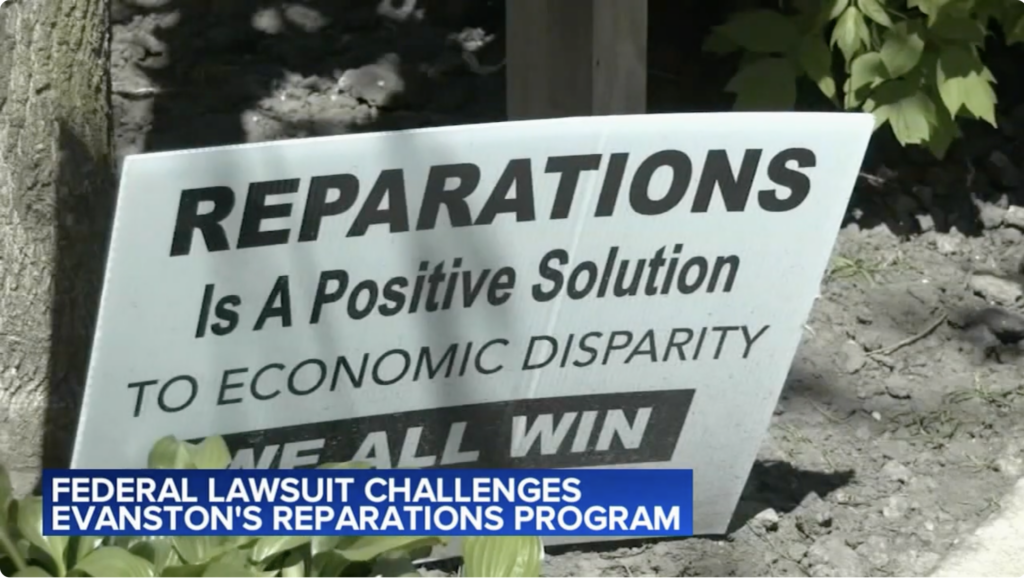
But fighting past discrimination with present and future discrimination sounds inherently unfair. A federal judge earlier this year ruled that Judicial Watch’s lawsuit, which argues the taxpayer-funded reparations program violates the 14th Amendment’s Equal Protection Clause, may proceed.
The complaint cites previous cases in arguing, “Remedying discrimination from 55 to 105 years ago or remedying discrimination experienced at any time by an individual’s parents, grandparents, or great grandparents has not been recognized as a compelling governmental interest….” A recent U.S. Supreme Court ruling, Louisiana v. Callais, asserts as much in gutting a provision in the Voting Rights Act that has long allowed discriminatory race-based gerrymandering in drawing political maps.
Here’s another problem, according to Judicial Watch. At no point in the application process are individuals who claim to be “descendants” or “ancestors” of victims of housing discrimination required to prove the authenticity of their claims. The six plaintiffs suing the city are not black and say they are being discriminated against based on their race.
“In effect, Evanston is using race as a proxy for having experienced discrimination during this time period,” the lawsuit asserts.
‘The Same Old Problems’
A growing number of leftist-led cities are pushing the shakedowns. The Economic Policy Institute, a liberal-leaning think tank, reported that as of the end of 2024 at least seven states, four counties, and 30 cities have established city-level task forces or commissions.
But polls show the vast majority of Americans don’t support reparations, particularly not taxpayer dollars going to pay for the sins of generations long past. Many see the divisive programs for what they are, a racket. And just like the massive amounts of fraud uncovered in an array of state welfare programs, the grifters have been and will continue to line up around the reparations tent.
As John H. McWhorter wrote in City Journal in 2022, the wealth redistribution schemes will not solve the societal problems the reparations crowd claims to be addressing. And if the past as any indicator, “any funds given to the usual suspects in municipal and social service bureaucracies would rarely reach the people they were intended for, and would just perpetuate the same old problems.”
Matt Kittle is a senior elections correspondent for The Federalist. An award-winning investigative reporter and 30-year veteran of print, broadcast, and online journalism, Kittle previously served as the executive director of Empower Wisconsin.
Comments
No comments yet. Be the first.
Sign in to leave a comment.