Air Force MQ-9 downs aerial targets with cheap air-to-air missiles
The article centers General Atomics' announcement and marketing language without critical distance, using the company's framing of cost-effectiveness as the primary narrative hook. While it includes a think-tank cost estimate and Pentagon budget figures, it lacks skeptical voices or analysis of whether this represents genuine efficiency or corporate profit-seeking. The framing emphasizes threat (Iranian drones, destroyed aircraft) to justify expanded weapons spending, aligning with defense industry interests.
Primary voices: corporate or institutional spokesperson, state or recognized government, think tank or expert analyst, media outlet
- This article does not address the cost-benefit analysis compared to other counter-drone systems or their effectiveness rates.
- This article does not include perspectives from non-defense analysts or peace advocates on whether expanded drone armament addresses root causes of conflict.
- This article does not examine General Atomics' financial interest in expanding MQ-9 capabilities or competitive dynamics with other contractors beyond CCA competition.
Framing may shift if actual combat performance data from the demonstration becomes available or if Iran escalates/de-escalates drone operations, affecting the perceived urgency of this capability.
Corporate-sourcedGovernment-sourcedThink-tank-cited
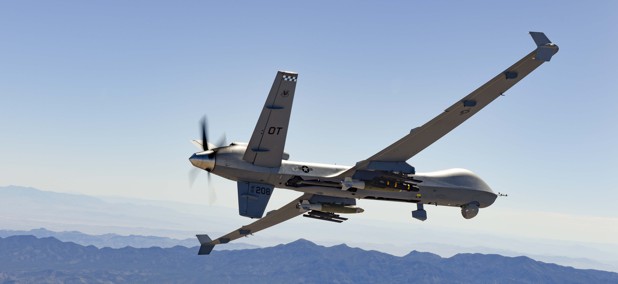
A 2023 photo of an MQ-9 Reaper during live-fire exercises over the Nevada Test and Training Range. U.S. Air Force / Airman 1st Class Victoria Nuzzi
An Air Force MQ-9 drone has downed aerial targets with a relatively inexpensive air-to-air missile, part of the Pentagon’s quest for more cost-effective defense against drones.
MQ-9 maker General Atomics announced on Monday that the Air Force had used a Reaper armed with laser-guided Advanced Precision Kill Weapon System, or APKWS, missile in a demonstration at the Nevada Test and Training Range.
“We recognize the value that a system like APKWS brings to the MQ-9 aircraft as a tool to counter one-way attack drones,” General Atomics President David Alexander said in a press release. “APKWS can increase the number of weapons the MQ-9A is able to carry, as well [as] being able to carry new lower cost weapons.”
Since Operation Epic Fury began in February, Iran’s $30,000 Shaheds have damaged overseas bases, destroyed U.S. aircraft, and killed American troops. The U.S. military has used fighter jets armed with million-dollar missiles to down the one-way attack drones. An APKWS costs $25,000 to $40,000, according to think tank analysts.
The $30 million MQ-9 is often used for intelligence missions but can be armed with AGM-114 Hellfire missiles, GBU-12 Paveway IIs, GBU-38 Joint Direct Attack Munitions, GBU-49 Enhanced Paveway IIs or GBU-54 Laser Joint Direct Attack Munitions, according to a service fact sheet.
A General Atomics spokesperson referred questions to the Air Force, and the service did not immediately respond when asked for more details about the demonstration.
Nearly 40 U.S. aircraft, including an estimated two dozen MQ-9, have been destroyed during the war in Iran, according to The War Zone’s analysis of open-source information.
As General Atomics boosts the capabilities of its MQ-9, it’s also competing against Anduril and Northrop Grumman to build Collaborative Combat Aircraft for the Air Force as drone wingmen alongside fighter jets.
In March, the Air Force’s lead buyer for fighters and advanced aircraft said the service was beating the Biden administration target of acquiring CCAs for a fraction of the cost of an F-35 Joint Strike Fighter.
The Defense Department is seeking nearly $1 billion to buy the Air Force’s first CCAs, 2027 budget documents released last month show. The service is planning to announce an Increment 1 production decision in the next five months.
Comments
No comments yet. Be the first.
Sign in to leave a comment.