Nehru’s pluralistic vision that has long held together one of the most diverse nations on earth is being dismantled by the steady march of Hindu majoritarianism, as reflected in India’s latest election results, writes Betwa Sharma.
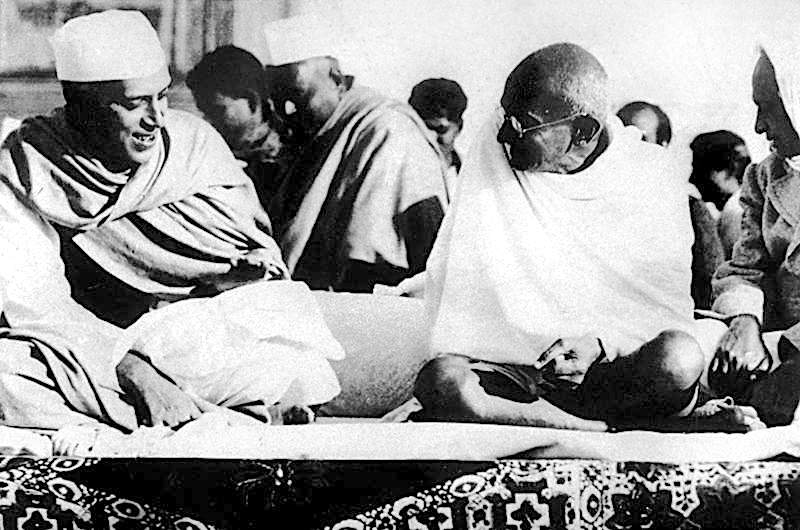
Nehru and Gandhi in 1937. (Unknown/Public Domain/Wikimedia Common)
By Betwa Sharma
in New Delhi
Special to Consortium News
India is one of the most diverse places on earth, with hundreds of ethnic groups and thousands of languages and dialects. To unify such a vast nation, Jawaharlal Nehru, the founding prime minister at independence in 1947, launched a secular, pluralistic vision that today is in grave danger.
Nehru’s insistence on tolerance in a nation with an 80 percent Hindu majority survived decades despite communal tensions that at times succumbed to violence.
Diametrically opposed to Nehru, a Hindu-nationalist movement established in 1925, aligned in the early years with German and Italian fascism, spawned what has become the powerful Bharatiya Janata Party (BJP), which today poses a danger to India of one-party rule.
Led by Prime Minister Narendra Modi, the BJP’s latest triumph was the stunning election upset, declared last week, in West Bengal. A key state in eastern India with a population of 100 million people, it is home to the historic city of Kolkata (formerly Calcutta), which served as the capital of British India until 1911.
Within a span of four decades, West Bengal has moved from communist to centre-left rule to a mandate for a right-wing, ideologically-driven party rooted in Hindu nationalism.
After years of methodically expanding its organisational base in the state, this breakthrough marks the culmination of a long and determined political project by Modi’s party.
West Bengal was a major obstacle to the BJP’s dominance of India. The party now controls the vast majority of governments of India’s 28 states and eight territories as well as the central government in Delhi.
West Bengal was a significant victory against resistance to the rise of the BJP. The party, which views India primarily as a Hindu nation, pushes toward cultural homogenisation and is starkly at odds with the country’s secular traditions established by Nehru.
Modi’s Bharatiya Janata Party (BJP) traces its ideological roots directly to the Rashtriya Swayamsevak Sangh (RSS), a Hindu nationalist movement founded in 1925 that had direct contacts with both Italian fascists and German Nazis. During British rule it was an opponent of the secular pluralism espoused by Nehru’s Indian National Congress.
Mahatma Gandhi was assassinated in 1948 by Nathuram Godse, a former member of the RSS, who accused Gandhi of being too conciliatory toward Muslims during and after the Partition and placed Muslim concerns above those of Hindus.
While the BJP publicly venerates Gandhi, sections of the Hindu right have continued to regard him with hostility, increasingly openly and unapologetically during the BJP’s last twelve years in power, which has been a time of unprecedented Islamophobia.
The RSS supported the establishment in 1951 of the Bharatiya Jana Sangh party as the way to challenge Nehru’s Congress government.
The party criticised Nehru’s “pseudo-secularism,” which it said undermined the Hindu majority’s cultural dominance, a well as his socialist economic planning and non-aligned foreign policy. It was generally anti-communist and pro-Western. Nehru, for his part, vowed to prevent Hindu nationalists from turning India into a “Hindu Rashtra” or a ‘Hindu Pakistan.”
Opposition to 1975-1977 national emergency rule by Indira Gandhi, Nehru’s daughter, saw the RSS banned and Hindu nationalists jailed.
The BJP’s transformation from a marginal political force into India’s dominant party accelerated during the late 1980s and early 1990s through the Ram Janmabhoomi movement centred on the Babri mosque in Ayodhya.
Hindu nationalist organisations, including the BJP, the RSS, and the Vishwa Hindu Parishad (VHP), claimed that the 16th century mosque stood on the birthplace of the Hindu deity Ram and symbolised centuries of historical injustice, mobilising millions through religious processions, political campaigns, and emotionally charged rhetoric that fused faith with nationalism.
The demolition of the mosque by Hindu workers on Dec. 6, 1992 was followed by deadly communal violence. It became a watershed moment in Indian politics, dramatically expanding the BJP’s support base by consolidating Hindu votes across caste and regional lines. In January 2024 Modi controversially inaugurated a new Ram temple built on the site of the destroyed mosque.
The party increasingly positioned itself as the defender of Hindu interests against what it portrayed as the Congress Party’s secular “appeasement” politics.
By 1996 the BJP grew to be the biggest party in Parliament leading to a coalition government headed by the BJP’s Atal Bihari Vajpayee, prime minister in 1996 and 1998-1999, marking a more moderate phase in the BJP’s political trajectory.
Modi was the chief minister of the western state of Gujarat, which experienced terrible communal riots in 2002, after which he was denied a visa to the United States until he became prime minister.
Modi became party leader in 2013 and won an outright majority for the BJP in 2014. He and the BJP has ruled India since. He has also remained determined to continue opposing Nehru’s secular and pluralistic vision at every turn. In a speech to Parliament last July, Modi called out Nehru’s name 14 times for criticism.
The BJP’s victory in West Bengal is a watershed moment in the history of the Hindu nationalist movement to defeat Nehru’s legacy and seek to dominate this massive and diverse land, desiring a “Hindu Rashtra” or state.
The tension around the election has been sharp in Bengal, anchored by Kolkata, a vibrant city of Hindus, Muslims, Anglo-Indians, and small, but centuries-old Jewish and Armenian communities, symbolising plurality rather than uniformity.
The Hindu right also lays some claim to the city, since one of its most prominent ideologues, Shyama Prasad Mukherjee, a Bengali Brahmin who founded the Bharatiya Jana Sangh in 1951, the predecessor to the BJP, hailed from Kolkata.
With a majority of 207 seats in the 294-member state legislature, the BJP decisively ended the rule of the All India Trinamool Congress (TMC), which had governed West Bengal for 15 years after coming to power in 2011 after its own historic upset, ending 34 years of uninterrupted rule by the Communist Party of India (Marxist).
The TMC’s tally collapsed from 215 seats in 2021 to 80 seats on Monday. Its percentage of votes received across the electorate — used to measure overall public support beyond just seats won — declined from 48 percent 2021 to about 41 percent.
Mamata Banerjee, the state’s chief minister for 15 years, has been a formidable regional leader known for launching welfare schemes for women and for consistently challenging the BJP’s dominance to largely contain the Islamophobia seen in other states. She lost not just her government but her own seat.
Even as the governor of Bengal has dissolved the State Assembly, Banerjee has so far refused to resign and rejected the result, calling it “immoral” and “illegal.” She alleged large-scale irregularities and bias by the Election Commission of India (ECI), an independent body that conducts elections.
In March she said: “In their ‘One Nation, One Leader, One Party’ frenzy, the BJP has systematically weaponised every democratic institution… [to] erase voters from electoral rolls [and] impose a single-party rule.”
Sanjay Raut, the parliamentary chair of the opposition Hindu nationalist Shiv Sena (UBT) party, accused the election commission of being “slaves” to Modi. He called for all opposition parties to come together against the “dictatorship of the centre and partisan behaviour of the election commission.”
The new chief minister, Suvendu Adhikari, who defeated Banerjee, claimed that Muslims voted for her while Hindus voted for him, making the communal polarisation at the heart of BJP politics clear.
The results were followed, almost immediately, by post-poll violence, a recurring feature of the state’s political culture. At least four people were killed in the unrest.
Voting in West Bengal. (Election Commission of India/Wikimedia Commons)
While Muslims constitute 34 percent and Hindus 63 percent of the total deletions in the SIR voter revisions, the figures are disproportionately high for the former, considering they make up only 27 percent of the state’s population.
The exercise came suddenly, just before the election, leaving people with the trauma of being disenfranchised overnight and scrambling to prove they still had a right to vote.
Families spent money they could hardly spare, running from office to office, struggling with paperwork that was confusing or incomplete. Small clerical mistakes, spelling or transliteration differences, or even name changes after marriage stripped them of their vote.
And in this atmosphere of heightened Islamophobia, there was an underlying suspicion that the exercise was deliberately designed to exclude Muslim voters and thereby give the BJP an electoral advantage.
Only a small fraction of the 2.7 million names on the discrepancy list meant for tribunal hearings were actually restored, while many cases remained unheard or pending when time ran out, and the election went ahead anyway.
Rather than a unified Muslim voting bloc backing the TMC, the results showed fragmentation, with Muslim votes split among multiple parties, including the Indian National Congress and smaller parties, weakening the TMC’s traditional support base in districts with a high Muslim population.
The BJP, even without winning Muslim votes, benefited from this fragmentation, while more effectively consolidating Hindu votes than before through better organisation and a strong campaign around poriborton (change).
The TMC was weighed down by incumbency, economic stagnation, unemployment, anger over corruption that tends to build when a party has been in power for 15 years, a somewhat lacklustre campaign, and a weakened grassroots machinery.
Women’s safety is also believed to have been an issue following the August 2024 rape and murder of a 31-year-old woman at a government medical college and hospital.
For over three decades, from 1977 to 2011, the state was ruled by the Left Front led by the Communist Party of India (Marxist), making it one of the longest-serving democratically elected communist governments in the world. This period was marked by land reforms and strong rural networks, but was criticised for industrial stagnation.
In 2011, Mamata Banerjee’s TMC ended Left rule, ushering in a new era centred on welfare politics and regional identity. The TMC retained power in 2016 and 2021, defeating a rising BJP.
The Bengal result also needs to be seen in terms of what it would mean if the BJP continues to win state after state, and what it will ultimately do to India’s federal political character.
Three other states — Assam, Tamil Nadu, and Kerala — and one Union Territory, Puducherry, along with Bengal, declared results on Monday.
In Puducherry (formerly Pondicherry), a former French colony on India’s southeastern coast and now a Union Territory, an alliance which includes the BJP retained power.
In Tamil Nadu, the Tamilaga Vettri Kazhagam (TVK), a brand-new party led by actor-turned-politician Vijay, emerged as the single largest party but fell short of a majority. Dominant regional parties DMK and AIADMK won 59 and 47 seats, respectively, and the BJP won one seat.
In Kerala, the Indian National Congress-led United Democratic Front won 102 seats, defeating the Communist Party of India (Marxist)-led Left Democratic Front, which won 35 seats, while the BJP-led National Democratic Alliance secured 3 seats.
Betwa Sharma is the managing editor of Article 14, the former politics editor at HuffPost India, and the former U.N./New York correspondent for the Press Trust of India. She has also reported for numerous publications, including The New York Times and The Intercept.
Comments
No comments yet. Be the first.
Sign in to leave a comment.