Four takeaways from Nebraska and West Virginia’s primary elections
The results from Tuesday’s primary elections in Nebraska and West Virginia are largely in, setting several candidates up for competitive battles ahead of the general election this fall.
Outside of the secretary of state’s race, in which Bob Evnen suffered a bruising loss, incumbents in Nebraska generally did well. Gov. Jim Pillen (R-NE) handily secured the Republican Party’s nomination in his bid for reelection and is set to face Democrat Lynne Walz in November. Sen. Pete Ricketts (R-NE) was among other incumbents advancing their bids for reelection, clinching over 81% of ballots counted.
In Nebraska, Democrats pulled off an unusual election strategy in the state’s U.S. Senate race, with the party boosting Cindy Burbank. Burbank bested William Forbes, an alleged Republican “plant,” by an 89% to 10% margin, as of early Wednesday morning. Burbank has pledged to step aside for independent Senate candidate Dan Osborn.
Democrats see Osborn as their best chance to flip the seat blue and defeat Ricketts in the general election. The state Democratic Party endorsed Burbank for the primary but backed Osborn for the general election, as part of its strategy to keep Forbes from winning the primary and to select a senate candidate most likely to secure the seat.
‘Blue dot’ race too close to call
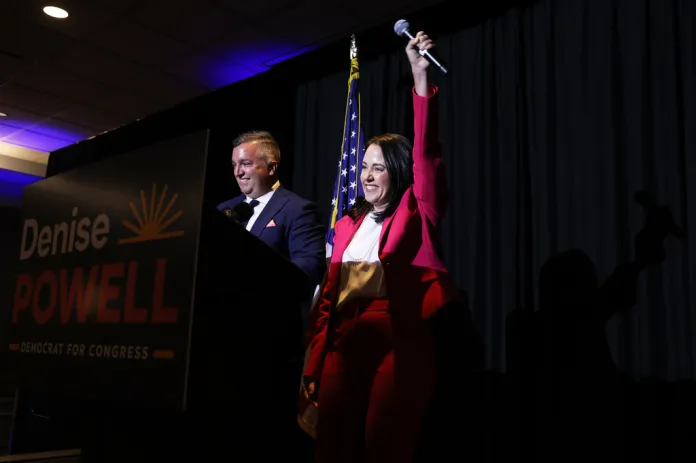
The Democratic primary race in Nebraska’s 2nd Congressional District, in Omaha’s “blue dot,” remains too close to call on Wednesday morning.
As of late Tuesday evening, about 1,000 votes separated state Sen. John Cavanaugh and Denise Powell, the top two candidates vying to flip the House seat blue, in a campaign to replace retiring Rep. Don Bacon (R-NE). Powell holds a razor-thin lead, but the Associated Press has not yet called the race, as ballots continue to be counted. Douglas County, home to the most Democrats in Nebraska, counts early voting ballots people return on late Monday and Election Day on the Friday after the election, according to the Nebraska Examiner.
The race is significant as it is seen as the only competitive congressional district in the state. Democrats see it as up for grabs, now that Bacon is retiring after four terms. The Democrat who wins the primary election is headed for a brutal campaign stretch, as they prepare to face Republican Brinker Harding in November.
Evnen ousted by right-wing challenger
Nebraska’s secretary of state Republican primary saw a major upset. Incumbent Bob Evnen, who was seeking a third term, lost the election against Omaha businessman Scott Petersen, 54% to 45%. Petersen challenged Evnen from the Right, touting his support for President Donald Trump. Petersen ran on election transparency, arguing that people are losing confidence in election systems.
He is set to face off against Democratic primary winner, school nutrition director Sarah Slattery, in November. Slattery won her party’s primary with 91% of the vote.
What happened in West Virginia?
West Virginia also held primary elections on Tuesday, as it engaged in its first statewide race in which voters had to show photo ID at the polls.
Incumbents largely fared well in the state, with Sen. Shelley Moore Capito (R-WV) successfully fending off five primary challengers.
Capito secured 66.5% of the vote, with an estimated 99% of ballots counted as of Wednesday morning. She is set to face Democrat Rachel Anderson in the general election.
Reps. Carol Miller (R-WV) and Riley Moore (R-WV) also secured their party’s nomination for the 1st and 2nd Congressional Districts, respectively.
The winner of the Democratic primary in the 2nd Congressional District has not yet been declared. Morgantown community organizer Ace Parsi holds a slight lead against Fairmont teacher Stephanie Tomana and Navy veteran Steve Wendelin.
Comments
No comments yet. Be the first.
Sign in to leave a comment.