Newsom announces two-year balanced budget, uses rollout to trash Trump
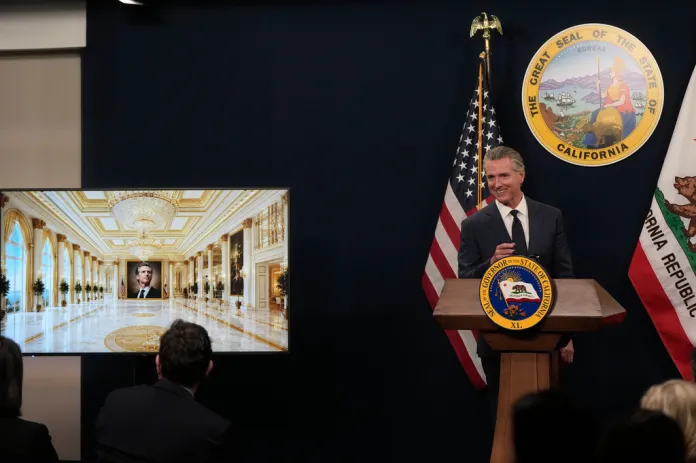
Gov. Gavin Newsom (D-CA) on Thursday unveiled a revised California budget proposal that he said keeps the state balanced for the next two fiscal years, pushing back on critics who have accused him of overspending and setting up his successor to hold the bag.
“I could’ve gotten out of here with a 12-month solution, stacked up a lot of wins, not had any of these questions about any of these cuts, and then really socked it to the next administration,” Newsom said in Sacramento as he rolled out a roughly $350 billion spending plan that avoids sweeping cuts.
Newsom, who is term-limited and considered an early front-runner in the 2028 presidential race, added that he was not “trying to get out of dodge” but instead wanted to leave behind a budget that remains structurally balanced after he leaves office.
“I think that’s important,” he said. “I want to underscore that we are balancing not just for the next fiscal year, which ends July of next year, but we’re balancing for another year.”
The governor has worked to protect many of the signature programs that have defined his tenure leading the nation’s most populous state and one of the world’s largest economies. He framed the revised budget as proof that California can preserve its progressive priorities while also strengthening reserve accounts and rainy-day funds.
“We’re cutting deficits, but we’re not cutting corners,” Newsom said.
But a recent report from California’s Legislative Analyst’s Office warned that the state is on an unsustainable financial trajectory, arguing that current revenues are unlikely to keep pace with the cost of maintaining existing government operations and the slate of initiatives approved under Newsom and Democratic lawmakers over the past several years. Analysts found that expenditures have consistently grown faster than incoming revenue, leaving California with a structural budget imbalance.
That growing gap had emerged as one of the biggest threats to Newsom’s fiscal record and a potential vulnerability for opponents eager to portray Sacramento Democrats as overly reliant on volatile revenue streams. Still, an unexpected surge in tax collections tied to investor enthusiasm around artificial intelligence companies eased some of the immediate pressure. Revenues are $16.5 billion higher than projected in January, helping the state avoid a $2.9 billion deficit, ensuring there is no budget hole next year, and slashing the shortfall in half the following year.
Newsom has avoided sweeping tax hikes and has shown little appetite for dramatically scaling back the costly policy agenda he championed during his tenure.
Republican lawmakers argued Newsom failed to confront the state’s long-term fiscal challenges meaningfully, criticizing his budget proposal as too limited to prevent future deficits. With Democrats holding supermajorities in both legislative chambers, Republicans have little influence over the final budget negotiations. They have until mid-June to pass the budget.
“Governor Newsom appears to define fiscal success narrowly: if the budget doesn’t collapse on his watch, it’s a balanced one,” Republican Assemblyman David Tangipa said in a statement.
Alongside spending reductions, Newsom proposed several major new investments, including a $5 billion block grant for teacher training and support, $500 million to expand math and literacy programs in high-need schools, affordable housing reforms aimed at lowering construction costs, and a $100 million fund to help wildfire victims secure loans to rebuild homes destroyed in recent fires.
He also announced a $300 million infusion for California’s health insurance exchange after federal lawmakers reduced funding earlier this year. The money would help stabilize subsidies within Covered California, the state’s Obamacare marketplace, eliminate monthly premiums for the lowest-income enrollees, and reduce out-of-pocket costs for middle-income families purchasing insurance through the exchange.
Newsom also used the budget rollout to sharpen his attacks on President Donald Trump, accusing him of being indifferent to the economic pressures facing ordinary Americans.
Trump’s remarks earlier this week became a focal point of Newsom’s criticism. During an exchange with reporters about negotiations with Iran, Trump was asked whether concern for Americans’ financial well-being was influencing his approach to an agreement.
“Not even a little bit,” Trump said. “The only thing that matters when I’m talking about Iran — they can’t have a nuclear weapon.”
Newsom seized on the comments, saying Trump “doesn’t particularly give a damn about the financial situation of the average American.”
The governor also accused the president of undermining affordability, attacking innovation, and weakening the national economy, while arguing California continues to outperform much of the country and the developed world despite those headwinds. At one point during the presentation, Newsom displayed meme-style slides, including one depicting Trump and Treasury Secretary Scott Bessent as characters from the movie Dumb and Dumber.
Comments
No comments yet. Be the first.
Sign in to leave a comment.