Gaza elders who survived the Nakba on being displaced by Israel again
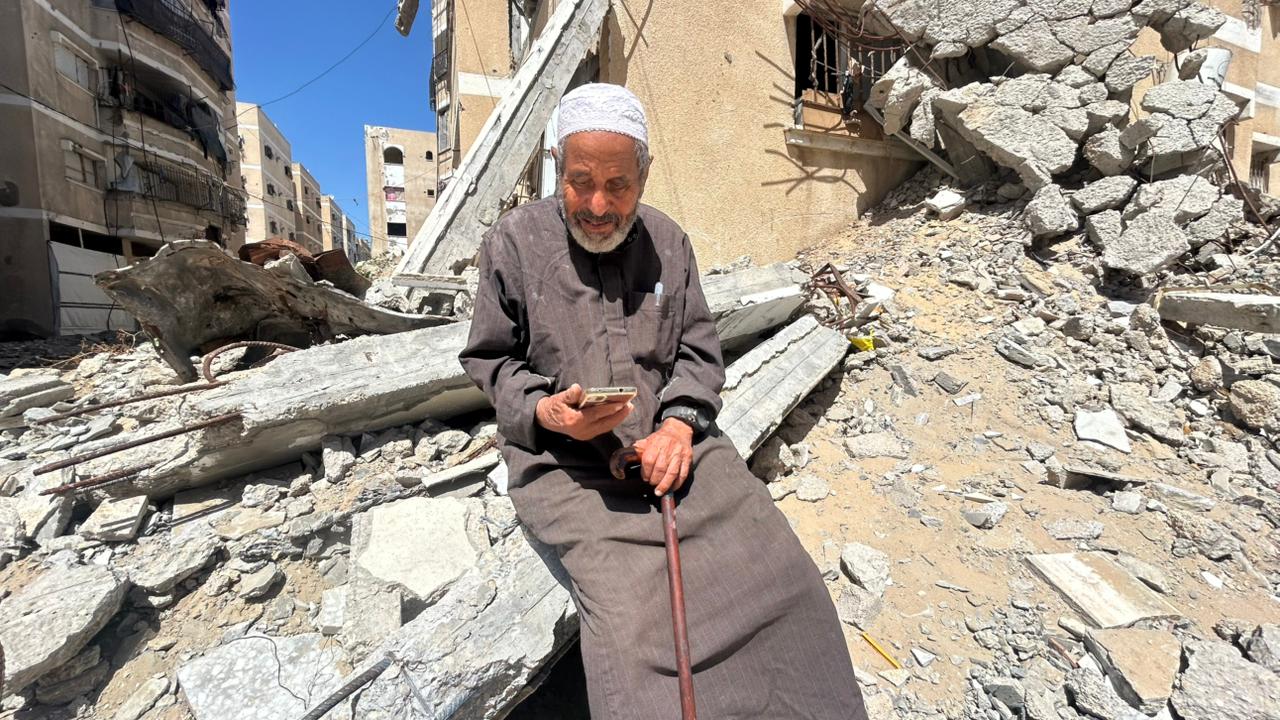
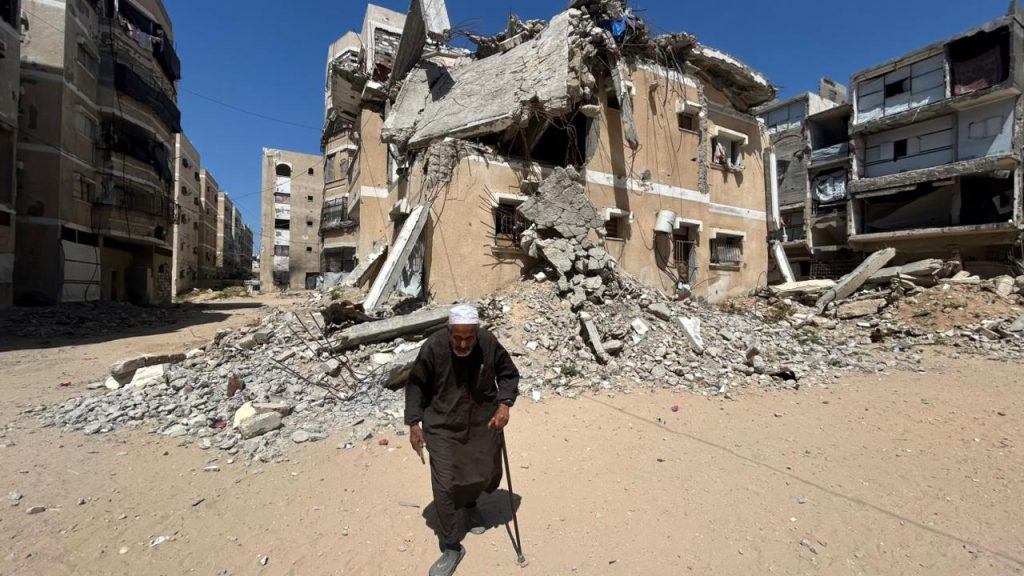
Ismail Atiya Nasir al-Din treads cautiously through the ruins of his three-story home in the Amal neighborhood of western Khan Younis, his frail, wrinkled hands clutching the wooden cane he leans on. Slowly, he makes his way to a concrete slab that fell on the side of what little remains of his house, which Israeli missiles knocked down in the winter of 2025. Sitting down, out of breath, he raises his eyes to the sky, then whispers verses from the Quran until the grief passes enough for him to speak.
He is 91 years old, grandfather to roughly 150 grandchildren from twelve sons and daughters, and still sums up his life in the childhood years pre-1948, when Zionist militias drove him and his family out of their homeland. Today, he shares the one room left standing beneath the rubble with a son and four grandchildren. Known for his memory, his eloquence, and his habit of reaching for a line of poetry or a Quranic verse when ordinary words fall short. Nasir al-Din reaches for them often today, as he marks seventy-eight years since the Nakba in a renewed state of displacement.
“I believed the pain of displacement and exile had ended with those days and would never return,” he says, his voice breaking. “But this has been the occupation’s plan since before the establishment of what they call Israel: to kill us, displace us, and seize our homeland. The same goals, the same tragedies — separated by 78 years.”
For the generation that survived 1948 and never left Gaza, this war carries a weight that younger Palestinians cannot fully share. Between 750,000 and one million Palestinians were expelled from their homeland by Zionist militias and the new Israeli army during Israel’s establishment in 1947–49. Many fled to Gaza, which saw its population nearly triple as refugees poured in from Jaffa, Beersheba, and beyond. Nasir al-Din was among them, and he has lived in Gaza ever since — through occupation, repeated wars, and through a blockade now in its eighteenth year. By October 2025, UNOSAT satellite imagery found approximately 81 percent of all structures in the Strip had been damaged, with more than 123,000 destroyed outright. Nearly the entire population has been displaced, many of them repeatedly. He watches the founding catastrophe repeat itself.
Born in the Mahjar Barqal area of the Jaffa district in historic Palestine, his family moved to the village of Beshit in the Ramla district in 1940. He was a child there and remembers it as a place of abundance. “Ya Allah, how beautiful those days were before the Nakba,” he says. “In our house, my mother would prepare the bath for us, feed us vegetables, and before sleep, she would tell us stories while giving us raisins, dates, and dried figs. Our home overflowed with life and hope.”
He says he had lived his life trying to recreate that same warmth for the family be built in Gaza. But the occupation prevented this from happening.
The first attack on Beshit came at midnight on March 30, 1948. Residents fought back with old rifles and drove the militia off, though six Palestinians were killed. A fiercer second attack came on the night of May 11. This time, the fighters ran out of ammunition. The militia entered, and the population fled.
“We escaped to the neighboring village of Yibna for three days, then returned to Beshit to collect some food, clothes, the donkey and the cart,” he says. “Then we moved from area to area until we reached the Gaza Strip on November 2, 1948.” He lists the villages they passed through: Yasour, al-Jaldiyya, Jisr, Samuel, Barqousiya, Dukrin, Zeita al-Khalil, Iraq al-Manshiyya, al-Faluja, al-Majdal, al-Khassas, Hirbiya. The journey took months. No food for days at a time. Months sleeping in the open. His mother placed their clothes in an oven to kill insects because there was no water to wash them. “We ate grass from the ground,” he says, clapping his palms together.
His gaze drifts, and his words begin to trace the parallels. “People have been starved. Children die of hunger and cold. Rodents swarm with infestation. Parents don’t get a chance to say goodbye to their loved ones.” He mentions briefly that he lost a son and a grandchild in an airstrike, then refuses to say more.
‘Multiple Nakbas’
When Nasir al-Din found himself in a tent again eighteen months ago, displaced from Khan Younis to Rafah to al-Mawasi before returning to his ruined home, the distance between 1948 and now collapsed entirely. Eight months after the October 2025 ceasefire, the humanitarian situation in Gaza remains dire, with OCHA reporting severe restrictions on aid entry and reconstruction materials, and the siege continues. Food, medicine, and cement — all remain subject to Israeli control at the crossings.
“I was struck by a shock that has not left my mind or heart,” he says. “I began to remember that tent we lived in during 1950 and 1951. It is the same tent. The same enemy that expelled us. But the material and psychological pain is many times greater.”
Israeli Agriculture Minister Avi Dichter remarked in November 2023 that the war would end with a “Gaza Nakba 2023.” For Nasir al-Din, no official statement was needed to name what he was living through. “We called what happened to us in 1948 a Nakba,” he says. “But what we have lived through in this war — no words are adequate. Perhaps it is Nakbas, plural. Something worse and more terrible than anything that happened in the year of the Nakba.”
He finished his schooling in Khan Younis in 1955 and became a teacher, one of dozens of students sharing a single textbook, walking fifteen kilometers to borrow it from a classmate. “Everyone was clinging to life and education,” he says. “We had none of the basic necessities, yet we studied. The same scenes are repeating now. Children go to school under bombardment. Secondary students sit their exams in tents or destroyed classrooms and pass and go to university.”
“My life long, I have not forgotten my village Beshit,” he says. “My children and grandchildren know every detail of it. We fled then, and we flee now — not abandoning our homeland, but escaping death. We will not leave, no matter what happens.”
‘More terrifying. More deadly.’
A few streets away, in the Katiba neighborhood of central Khan Younis, 85-year-old Fatima Ibrahim Khalfallah sits on a small rock beside a cold fireplace outside a makeshift shelter of corrugated metal and canvas pitched over the rubble of her destroyed home. She has not lit the fire in days. There is no wood, no vegetables, no meat. She eats whatever a charity kitchen provides, whenever it does. She turns the ash with a small stick.
Khalfallah was eight years old when armed Jewish Zionist militias forced her family from Beersheba in 1948. “They came and made us leave,” she says, in the plain, unhurried cadence of her Bedouin dialect. “They said: go to King Farouk. We were forced out of our homes by fear of death,” she recalls, referring to the Egyptian monarch who at the time positioned himself as the defender of Palestinians against Zionist militias. Khalfallah recalls how she and her family had lived simply: a tent of goat hair, two sheep, a camel, a donkey, wheat, barley, and onions from their own fields. All of it left behind.
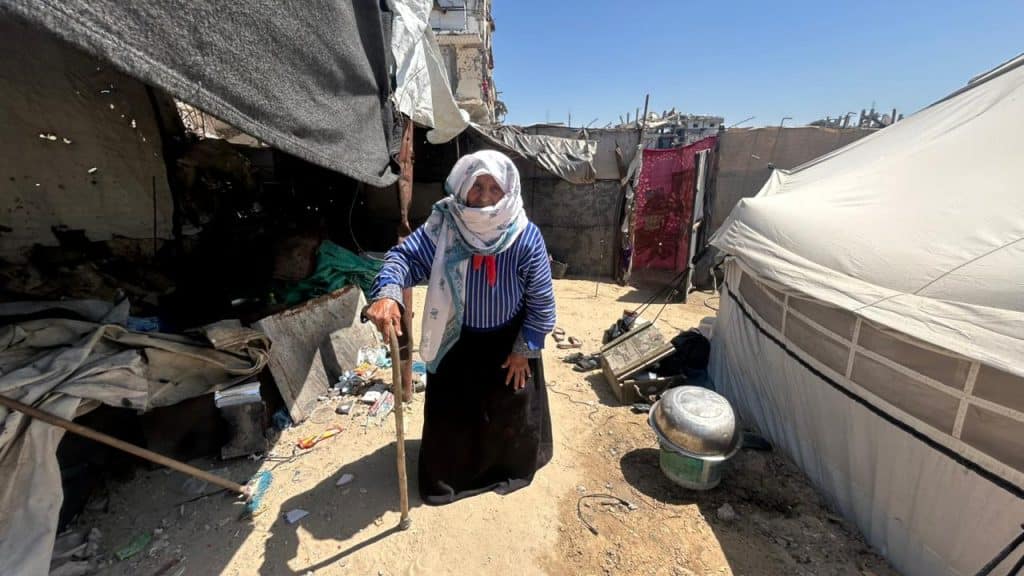
She grew up as a refugee in Gaza, beginning life in tattered tents before eventually settling in Khan Younis and building a five-room, 170-square-meter home. She never went to school, and marks time not by years but by events: she was eight when the Nakba came; her eldest son was born the year before Israel occupied Gaza. Now two of her unmarried sons live with her in the makeshift shelter: Amal, forty-seven, and Jamal, who suffers from a severe neurological illness. Her other four children are scattered.
She turns her head to cry before the words come: “Is it possible that my life began in a tent and ends in a tent? Our Nakba has fallen on no other people on earth. Must we pay twice for being Palestinian — from 1948 till now?”
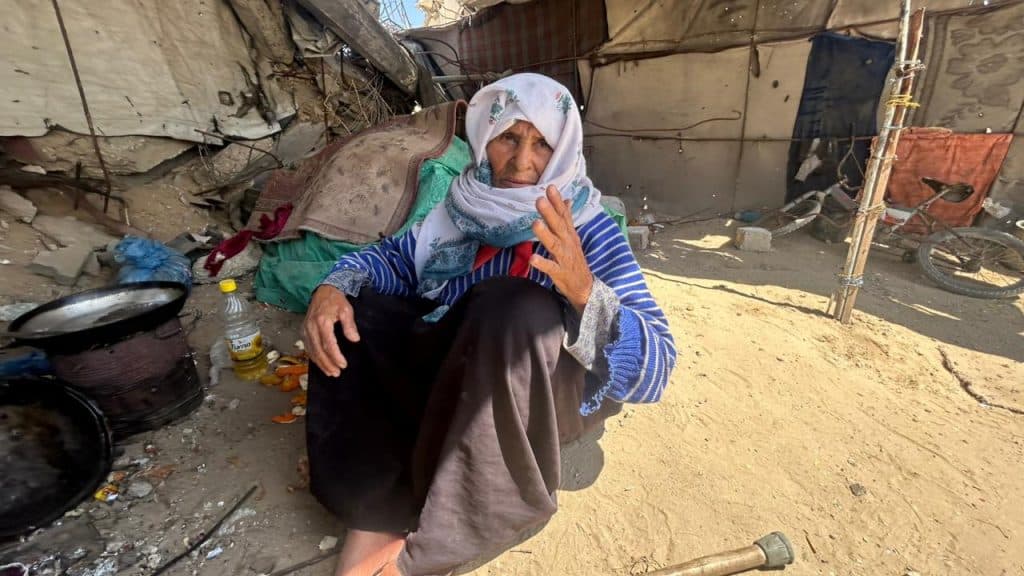
The parallel she draws is precise, not rhetorical. “Every moment I connect my life now to those years after the Nakba — sleeping outdoors, eating when food appeared, hungry most of the time, until eventually there was a tent. That same scenario has repeated during this war.”
She has long since let go of the dream of returning to Beersheba. Her dream now is smaller and more desperate: to stay in the tent she has pitched on the ruins of her home, and not to be forced to move again. She has been displaced four times since October 2023.
She pauses, then adds: “This Nakba is more terrifying, more deadly, more destructive. The same form of displacement, the same hunger and thirst and fear — but multiplied many times over.”
Mohamed Solaimane Mohamed Solaimane is a Gaza-based journalist, who is published in international outlets like Drop Site News, The Nation, El Pais and many others. He holds a PhD, which he completed from his tent in al-Mawasi.
Comments
No comments yet. Be the first.
Sign in to leave a comment.