Iran’s capabilities ‘significantly degraded’ but still a threat to Strait of Hormuz
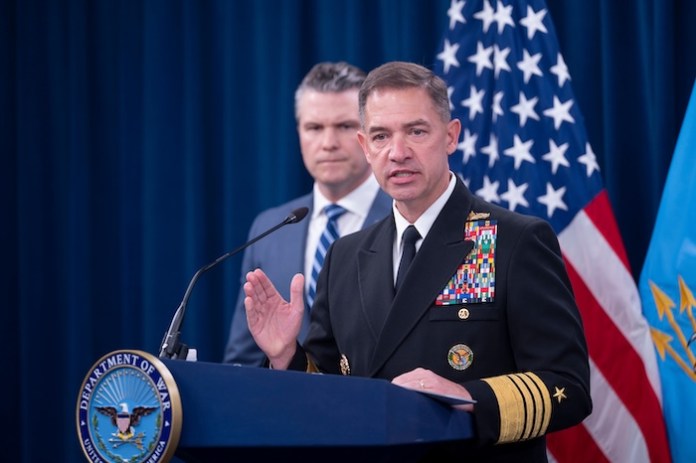
A senior military official acknowledged to lawmakers on Thursday that while the U.S. military has significantly degraded Iran’s military capabilities, its forces still remain a threat, particularly in the Strait of Hormuz.
Adm. Brad Cooper, the commander of U.S. Central Command, told lawmakers on the Senate Armed Services Committee on Thursday that the U.S. and Israeli militaries have “significantly degraded” Iran’s military capabilities and that Iranian forces “no longer threaten regional partners or the United States in ways that they were able to do before.”
Commercial shipping through the Strait of Hormuz has slowed down dramatically, and prior to the start of the war, approximately one-fifth of the world’s oil traveled through it. Iran threatened to target those vessels with drones and missiles and has made good on that threat multiple times. After President Donald Trump announced a ceasefire on April 7, the U.S. subsequently began its own blockade of ships heading to or coming from Iran.
“The Iranian capability to stop commerce has been dramatically depleted through the strait, but their voice is very loud,” Cooper added in his first public testimony since the war began. “And those threats are clearly heard by the merchant industry and insurance industry.”
Simultaneously, Cooper said the U.S. had met its military objectives laid out in Operation Epic Fury, even though Iran continues to threaten shipping through the strait and has acted on the threat.
Trump has threatened to restart offensive military operations against Iran if its leaders do not agree to a deal with the U.S.
“They are a very large country, and they retain some military capability,” Cooper added.
He rejected media reporting that Iran retains about 70% of its mobile launchers and prewar missile stockpile, saying that those numbers “are not accurate,” and he disputed reporting that the U.S. bombed more than 20 schools during the conflict.
He had a heated back-and-forth in the hearing with Sen. Kirsten Gillibrand (D-NY), who asked about the New York Times’s reporting that the U.S. had bombed 22 schools during the war.
“There’s no indication that we have that’s been corroborated,” he said, adding that the only active civilian casualty investigation is the one into the strike that hit a school in Minab, Iran, in the first days of the war that killed roughly 170 people.
Cooper said in his written testimony that in the 38 days of major combat operations, the U.S. conducted more than 13,500 strikes, destroying more than 85% of Iran’s ballistic missile, drone, and naval defense industrial base and more than 90% of Iran’s naval mines, and U.S. forces destroyed 82% of Iran’s air defense missile systems along with the radar and command architecture that tied together Iran’s fixed-wing airfields, hangars, fuel storage and munitions stockpiles.
In some ways, Iran’s asymmetric warfare efforts have worked, and in other ways, it has not during the conflict.
Iran’s “Axis of Resistance,” or the proxy forces it has sponsored for decades, including Hamas, Hezbollah, and the Houthis, has largely not come to Tehran’s defense amid the war. Israel’s military has systematically degraded most of Iran’s proxy forces since Hamas’s Oct. 7, 2023, attack in southern Israel forever changed the region.
Yet Iran has also proven it can shut down shipping in the strait at any time, in part due to the geography of the region.
Retired CENTCOM Cmdr. Joseph Votel, who was in the position a decade ago, told the Washington Examiner that the U.S. will likely have to “contend” with Iran’s ability to shut down the strait in the future.
“When we think about asymmetric threats here, and I think what we’re learning here, is that in addition to drones and missiles and proxies, which they’ve used, one of the most important asymmetric capabilities they have is the ability to directly impact global economy by exerting the geographical advantage they have over the Strait of Hormuz, and I think that’s something we will have to contend with more in the future,” he said.
Votel noted that while there are more options the military could utilize to create the conditions for ships to safely transit the strait, he believes “the real focus needs to be, I think, on trying to get to some type of negotiated agreement that allows us to move forward.”
Comments
No comments yet. Be the first.
Sign in to leave a comment.