SCOTUS Could Do The Funniest Thing And Mandate A Single Election Day At Jay Jones’ Request
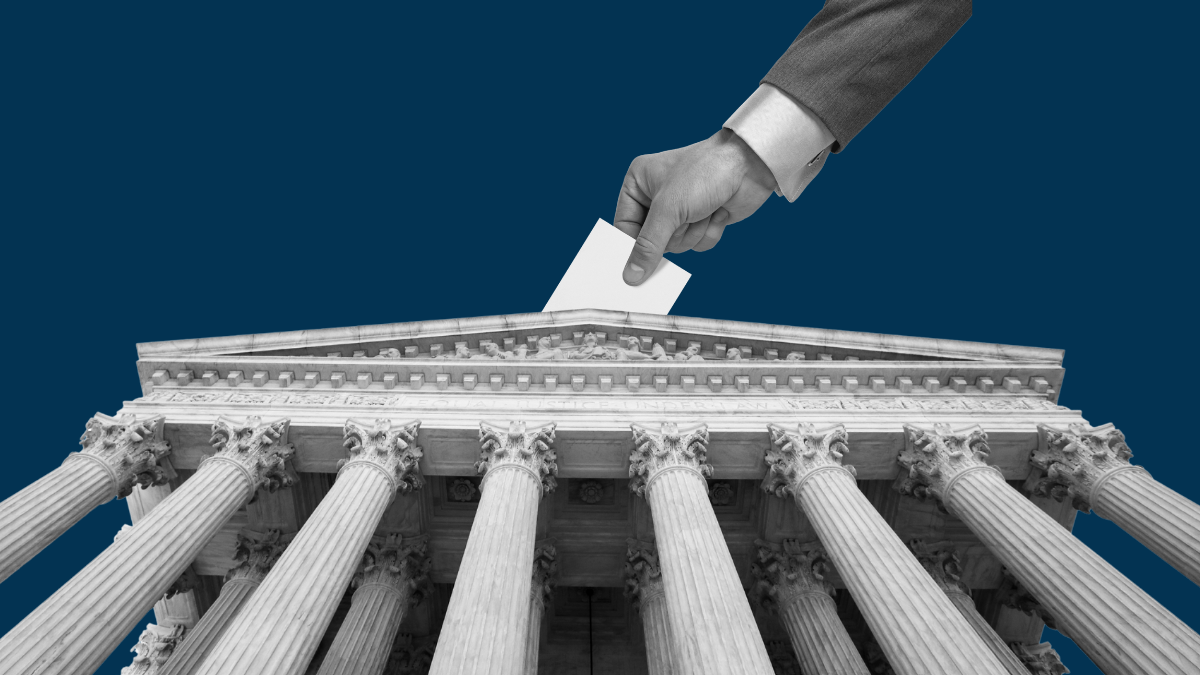
Jay Jones, the Virginia attorney general who fantasized about executing a Republican colleague and wished death on his children, has not developed a reputation for thoughtful reflection. So perhaps it’s unsurprising that, in his typographically-challenged frenzy to salvage Virginia Democrats’ gerrymandering efforts, he has accidentally made a case to the U.S. Supreme Court against the months-long “election season” that his fellow Democrats prize. The only thing that could make the cosmic irony sweeter would be the Supreme Court taking Jones up on his request to interpret the Constitution as mandating a single Election Day.
The Virginia Constitution requires constitutional referendums, like the one Democrats rammed through changing the makeup of the state’s congressional representation from six Democrats and five Republicans to 10-1, to be passed twice by the legislature, with an election between passages. Unfortunately for Democrats, when they passed the referendum the first time, voters were already more than a month into the early voting period for the election that was constitutionally required to take place after the referendum’s first passage. The Virginia Supreme Court struck the referendum down on these grounds last week.
Instead of accepting the highest Virginia court’s interpretation of Virginia law, Jones has placed himself in the awkward position of arguing that Virginia’s 45-day election actually takes place on a single day. In an appeal to the U.S. Supreme Court, Jones argues that federal law “expressly fixes a single day for the ‘election’ of Representatives and Delegates to Congress.”
The Virginia Constitution, Jones insists, “unmistakably indicates that, as a matter of ordinary English usage, the ‘general election’ takes place in ‘November,’ not over a three-month period beginning in September.” Election integrity advocates who have long complained about Democrats’ extension of Election Day into a months-long process via early and mail-in voting could hardly have said it better.
Even Vox, hardly a wellspring of serious constitutional analysis, cautioned that Jones was shooting Democrat interests in the foot by asking the Supreme Court to weigh in on that claim.
Of course, Jones is asking to have it both ways: he would presumably like to keep Virginia’s expansive voting season — one of the longest in the country — but would also like the court to define the 45-day period as a single-day event to protect Democrats’ gerrymandering attempt. But the court can easily consider his spirited defense of a singular Election Day without indulging his contradictory demands.
As Jones says, “federal statutes” such as 2 U.S.C. § 7 “settle the question” of when elections should be held. That statute requires that elections for congressional representatives shall occur on “The Tuesday next after the 1st Monday in November, in every even numbered year.”
The Virginia Constitution sets the same date for state legislative elections. In fact, Jones points out, the “Virginia Constitution has set elections to take place on a single day for more than 150 years, long before the General Assembly established early absentee voting.”
His argument bears some similarities to those made by the Republican National Committee and amici in a case currently under consideration by the Supreme Court. He even cites that case, Watson v. RNC, numerous times in his brief. At issue in that case, which was heard by the justices in March, is a Mississippi law that allows mail ballots arriving up to five business days after Election Day to be counted as long as they were mailed by Election Day.
The RNC, joined by the United States and other amici, argued that accepting ballots after Election Day violates the federal establishment of a single Election “Day.” Paul Clement, arguing for the RNC, and U.S. Solicitor General John Sauer, arguing for the United States in support of the RNC, did not challenge early voting — and did not need to do so to win their case. But some amici hinted that expansive early voting regimes that stretch “Election Day” out for months could run afoul of federal law.
As a brief by members of Congress and the American Center for Law and Justice put it, “Allowing ballots to be cast too early … similarly deprives Election Day of its force and meaning.”
Even several justices, during oral arguments, raised the point that a textual interpretation of “Election Day” would seem to call the months-long voting process popular in Democrat localities into question.
“We don’t have Election Day anymore. We have election month or we have election months,” noted Justice Samuel Alito. “Early voting can start a month before the election. The ballots can be received a month after the election.”
Justice Amy Coney Barrett observed: “It seems to me that if you look at the historical practice, what an election meant was showing up in person and casting your vote and being qualified as the voter on that same day.”
Even Justice Elena Kagan, one of the liberals on the court, acknowledged that “if you said to Congress [in 1872, when Congress extended the designated November Election Day to representatives], do you think that the Civil War provides a precedent for early voting generally among the civilian population, I think they would have laughed at you.”
As Clement noted, challenges to early voting have been brought at the circuit court level before, and rejected. However, they have been seriously considered. In the 9th Circuit’s 2001 decision in Voting Integrity Project, Inc. v. Keisling, Clement observed, Judge Andrew Kleinfeld “admits there’s actually a pretty good argument based on the text and [the Supreme Court’s 1997 decision in Foster v. Love] that early voting is problematic.” (In Foster, the Supreme Court had struck down an open primary election process in Louisiana that allowed congressional candidates to win their seats before Election Day.)
Kleinfeld wrote that the federal statute “may reasonably be construed to mean that all voting in federal elections should take place on a single day.” However, the 9th Circuit upheld Oregon’s early mail voting process because federal statutes permitted absentee voting for residents who were away from home on Election Day, and because the court in Foster described an election as being “consummated” on Election Day.
If Jones really wants the court to examine the legality of Virginia’s six-week-long voting marathon, the court has some reading material in Kleinfeld’s opinion and beyond. In an amicus brief for the Claremont Institute’s Center for Constitutional Jurisprudence, filed in support of the RNC in its case against Mississippi, John Eastman laid out a thorough history of the constitutional intent motivating the establishment of a single Election Day.
“A multi-day election is not simply ‘more time to vote;’ it constitutes a fundamental alteration of the legal nature of the event,” he wrote. “It transforms the election from a discrete, simultaneous act of sovereign choice into an extended process – one in which the electorate remains fluid and exposed to the dangers the Constitution was designed to foreclose.”
Virginia’s 2025 election, in which Jones was elected, provides an apt example of the dangers of such fluidity. When news broke that Jones had fantasized about the murder of his Republican colleague and his children, many Virginians had already cast their votes — depriving them of the ability to weigh Jones’ homicidal proclivities in their evaluation of him.
Now, Jones insists that interpreting the prescribed Election Day as “the entire period of early voting beginning in September” is a “novel and manifestly atextual interpretation” of federal and state law. Or, as Chief Justice Cleo Powell of the Virginia Supreme Court put it in her dissent last week, “extending elections in the Commonwealth of Virginia beyond a single day … would directly conflict with the federal mandate that elections for federal offices be held on a single day.”
The RNC didn’t ask SCOTUS to go that far in Watson. But if Jones really wants the court to rule that Election Day, as prescribed in federal law, must be a single-day event, more power to him. If salvaging Virginia Democrats’ gerrymander hinges on turning election season back into Election Day, that’s a trade plenty of Virginia conservatives will take.
Elle Purnell is the assignment editor at The Federalist. She has appeared on Fox Business and Newsmax, and her work has been featured by RealClearPolitics, the Tampa Bay Times, and the Independent Women's Forum. She received her B.A. in government with a minor in journalism. Follow her on Twitter @_ellepurnell.
Comments
No comments yet. Be the first.
Sign in to leave a comment.