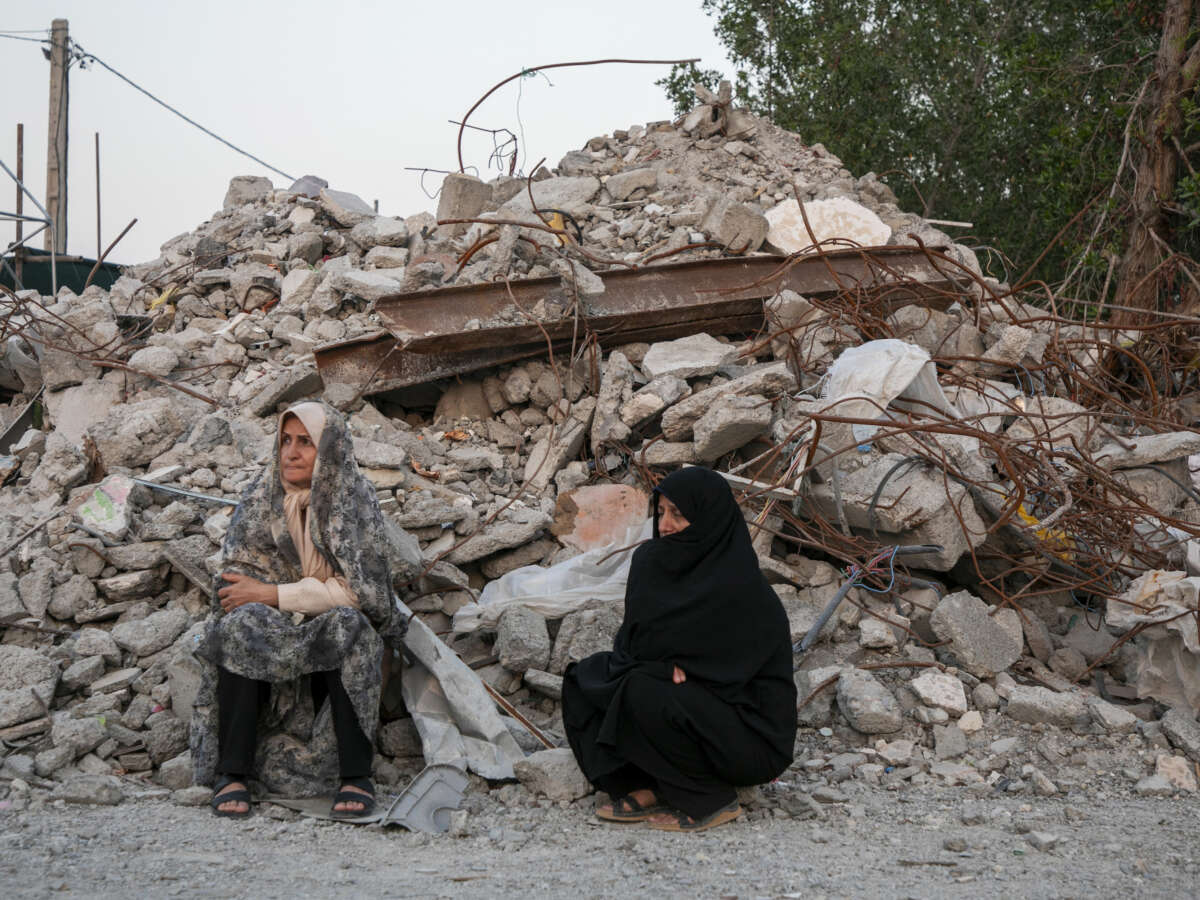
Perhaps some things should never be spoken — for, when they are, they leave us aghast, in a state of horror. Think here of the ghostly figure in Edvard Munch’s “The Scream.” During the height of the war on Iran, Donald Trump threatened: “A whole civilization will die tonight, never to be brought back again.” Those are words that elicit something frightening, terrifying. Let’s be frank. The words, which clearly constitute a genocidal threat, are atrocious and should make all of us want to scream.
That threat came after Trump also threatened the Iranian government to “Open the Fuckin’ Strait, you crazy bastards, or you’ll be living in Hell — JUST WATCH! Praise be to Allah.” Not only is this not “presidential,” but it’s characteristic of someone who has a warped moral compass; it is indicative of someone who has failed to understand the dignity and preciousness of human life.
Even if never carried out, the threats — and the ones he’s issued since then — speak to the fundamental and despicable depravity and horror of the threat. There are over 93 million people in Iran, which means that Trump is fantasizing about their total annihilation. This is inhuman and ruthless. It is evil.
To address the issue of Trump’s inept moral compass, I conducted this exclusive interview with Norman Solomon, who is the national director of RootsAction and executive director of the Institute for Public Accuracy. He is the author of War Made Invisible: How America Hides the Human Toll of Its Military Machine. Solomon insightfully argues that there is a larger existential issue at stake that speaks to the history of U.S. militarism and its terror spread around the world. Within this context, Trump, who is himself unfit for office, is a symptom of a deeper and unchecked form of U.S. military power.
George Yancy: What manner of man is Trump?
Norman Solomon: The beyond-huge problem is that he’s president of the United States, and that is what’s so mind-blowing and extremely dangerous about “what manner of man” he is. The fact that Trump can be president — for the second time yet — with control over two branches of the U.S. government and dominance of the Supreme Court, points us urgently to questions about how the fascistic political movement that he leads can be defeated. And a key question is, “What manner of country is the United States?”
Our current crises are in many ways the most extreme and dangerous to human survival in any lifetimes because Trump has shamelessly intensified and boosted the proclivities of all nuclear-age presidents while bottom-feeding and spewing the toxic layers of U.S. society with flagrant racism, xenophobia, misogyny, and contempt for those who are not white rich males. It doesn’t in the slightest lessen the enormity of Trump’s huge guilt in committing crimes against humanity to point out that many of his predecessors have also been guilty of terrible war crimes, including what the Nuremberg tribunal called the “supreme international crime” — a war of aggression. In this century, four presidents have given orders that qualify them to stand in the dock at The Hague to face war crimes charges.
Last summer and this year, Trump launched a completely unprovoked war of aggression against Iran.
President Barack Obama, who expanded warfare with drones that were experienced by so many people under them as airborne instruments of terror, tripled up to 100,000 the number of U.S. troops in Afghanistan.
President George W. Bush launched and continued a so-called “war on terror” that, according to the Costs of War project at Brown University, has directly resulted in close to 1 million deaths and, including indirect results, has killed at least 4.5 million people.
Yes, Trump is clearly unfit, and that in and of itself is a humungous 24/7 problem for the United States and the rest of the world as long as he’s president. At the same time, his regime would be impossible without its ability to gain and retain near-dictatorial power in many respects because of a dire shortage of democracy in the United States — a shortage that, while severely worsening in the past 15 months, has always been present, no matter what civics textbooks told us.
In your book, War Made Invisible, you open with two quotes by writer and philosopher Aldous Huxley. One quote reads, “The propagandist’s purpose is to make one set of people forget that certain other sets of people are human.” I know about the history of white supremacist propaganda, both in the U.S. and abroad, and how it worked to dehumanize Black people and how white folk internalized that propaganda. This is what made it so easy within the U.S. for many whites to participate in the lynching of Black bodies, treating the gruesome spectacle as a “picnic.” Or think here of the Berlin Conference in the 1880s, in which 14 European nations and the U.S. laid claim to the domination and control of Africa, dividing the continent up among themselves. I would argue that the conceptualization of such a violent colonial project was inextricably linked to the egregious belief that Black people could not govern themselves, that they were “inferior” and lacked true political agency. Talk about Trump’s use of propaganda vis-à-vis his war of choice in Iran, or even, if you like, the propaganda of the military war machine that is the U.S.
Racism and racialist views of humanity, along with pernicious “Western” ethnocentrism, were inherent and implicit in the “war on terror” from the outset. Nearly 25 years later, what Trump has been doing is in many ways an extension of that continuous warfare of aggression, resolutely repackaged as defensive operations.
The U.S. military didn’t bomb Afghanistan or Iraq or Libya or other countries because their residents were people of color. However, the fact that they were people of color made it easier for the U.S. to launch and sustain those wars; easier because of the racial, religious, cultural, and ethnic biases of U.S. news media, elected officials, institutions, and much of the public.
Amid all the differences in how Trump has behaved publicly compared to Biden or Obama or Bush, it’s too easy to forget that the results for huge numbers of people on the other end of Pentagon firepower have been essentially the same. What was done to Afghanistan and Iraq, courtesy of U.S. taxpayers, can be forgotten or downplayed only with the aid of varieties of individual biases and structural forgetting that lets the essence of U.S. foreign policy — and much of U.S. society — off the hook. Likewise absolved is the actual overall U.S. role in the world.
I was well into writing War Made Invisible a few years ago before I realized a key reality that has been hidden in plain sight: Virtually everyone killed by the U.S. military during the “war on terror” has been a person of color. To point out that reality seems to be a tacit taboo in U.S. mainstream media and politics. And that implicit taboo goes some distance toward explaining how the dynamics described in that quote from Huxley are operative, rendering it all too easy “to make one set of people forget that certain other sets of people are human.”
That’s a core task of the warmakers who appear at news conferences and give ballyhooed speeches and get interviewed with inordinate deference by U.S. corporate media. Euphemisms and nationalistic blather mask the human realities of mass killing. This simple and momentous systematic distortion of language — twisting and strangling a human language until it’s bent into shape to serve inhuman purposes — goes a long way toward explaining how the dynamics described in that Huxley quote are operative.
While we’re suitably aghast at how Donald Trump or Defense Secretary Pete Hegseth deploy words from their propaganda arsenals, the much smoother — and for most people, much less disturbing — rhetoric that came from say Biden or his Secretary of Defense Lloyd Austin often served much the same desensitizing and euphemistic purposes.
The U.S. war machinery has been in various settings of high gears for several decades. After the mass horrors of the U.S. wars on Southeast Asia, a kind of hiatus set in during the last half of the 1970s. But a gear-up took place during the 1980s, with warm-up sessions for aggression against Granada and then Panama.
Whatever lessons had been learned or at least observed about the Vietnam War were cast aside in the jingoistic zealotry of 1991 with the U.S. triumph of the Gulf War against Iraq. At that point, immediately and memorably foreshadowing decades of a hyper-warfare state to come, President George H.W. Bush declared with evident great emotion: “By God, we’ve kicked the Vietnam syndrome once and for all.” That was 35 years ago.
Since then, the list of countries that the U.S. bombed with impunity has gotten longer and longer. Since early last year, Trump has ordered the bombing of seven countries, aside from boats in international waters. Along the way, he has blazed new demagogic trails with candor. His virulent, unapologetic racism, not even bothering to cloak his allegiance to white supremacy, has become normalized.
In my last question, I used the expression “war of choice.” Do you accept this as a legitimate interpretation of the current war in Iran?
I’m not fond of the phrase “war of choice,” partly because what it’s supposed to mean seems so squirrely. Every U.S. war in the last 80 years has involved a choice from the top of the American government that shouldn’t have been made — that was aggressive and not defensive — routinely based on lies, as I documented with painful details in my book War Made Easy. That book was published in 2005, and the repetition compulsion has remained undisrupted since then.
Presidents have made choices to wage aggressive war, and in that historic context, the phrases “U.S. wars” and “wars of aggression” are redundant. The United States is the world’s preeminent warfare state, by dubious virtue of being not only the most militarily powerful by far, but also by being willing to wantonly use that military might to attack so many countries so often and with such unrelenting violence.
There is a great deal of disagreement regarding Israeli Prime Minister Benjamin Netanyahu’s influence over Trump’s decision to go to war with Iran. I really want to say: instigated the war with Iran. I say this because if attacking Iran was about Iranians soon acquiring a nuclear bomb, there are experts who have contested that claim, suggesting that “there was no evidence that Iran was close to a nuclear weapon.”
Israel has at least several dozen nuclear weapons, a fact hardly ever mentioned in U.S. media, and it’s difficult to think of a country that has shown less restraint in the last years. Israel has been literally terrorizing people in Iran and Lebanon lately, and for years — decades really — it has terrorized Palestinian people in Gaza and increasingly in the West Bank.
In all the talk about nuclear weapons, rarely do we hear clarity about the agreement that the U.S. and Iran entered into in 2015, the Joint Comprehensive Plan of Action (JCPOA). The agreement was possible because Iran and the Obama administration made it possible. The deal was working quite well with rigorous and successful inspections, and if it had remained in place, there could have been no doubt about foreclosing Iran’s developing nuclear weapons. But Trump killed the JCPOA in his first term in 2018, and Biden failed to resuscitate it.
Netanyahu is in many ways a grotesque matched set with Trump — completely self-focused and all too eager to cause massive death and suffering. A lot of people who are pro-Israel want to believe that the main problem with Israel is that its prime minister is Netanyahu. I think that’s a convenient illusion. The main problem is the implemented ideology of “Israelism” and its commitment to Jewish supremacy within the country’s ever-expanding de facto borders. A horrific consequence is the ongoing genocidal treatment of Palestinian people.
As you know, on January 27 of this year, the Bulletin of the Atomic Scientists, which keeps track of the Doomsday Clock, said that the world is at 85 seconds to midnight, where midnight means that we are getting closer to a global event that will leave our planet uninhabitable. That is the stuff of nightmares. I know that you don’t possess a magical crystal ball, but where are we headed?
The nuclear arms race is out of control, while nine countries already have nuclear weapons. The United States has led the world toward Armageddon by dismantling arms-control agreements while plunging ahead with a massive nuclear-weapons “modernization” program. Unless we can put a stop to the swiftly escalating U.S. militarism, the Doomsday Clock will keep ticking toward a midnight so horrific that none of us can fully grasp what it would mean.
I was lucky enough to get to know the antiwar and human rights activist Fred Branfman before he died in 2014. More than anyone else, he effectively challenged the mass-murdering U.S. bombardment of the Plain of Jars in Laos during the late 1960s and early 1970s.
When I asked about hope, he said: “When I looked more deeply at my own life, I noticed that my life was not now and never had been built around ‘hope.’ Laos was an example. I went there, I learned to love the peasants, the bombing shocked my psyche and soul to the core, and I responded — not because I was hopeful or hopeless, but because I was alive.”
Press freedom is under attack
As Trump cracks down on political speech, independent media is increasingly necessary.
Comments
No comments yet. Be the first.
Sign in to leave a comment.