PATRICK LAWRENCE: Epic Desperation
This opinion piece employs distinctly anti-imperialist framing, characterizing U.S. and Israeli military action as 'aggression' and 'terror machines' while romanticizing Iranian resistance through social media footage. The author centers Iranian civilian perspectives and historical narratives of asymmetric conflict, uses loaded terminology ('Zionist,' 'vicious client'), and presents certainty about Iran's 'victory' without engaging substantive counterarguments or multiple military assessments. The piece reads as advocacy for Iran's position rather than analysis.
Primary voices: media outlet, anonymous source
- This article does not address the specific military capabilities or strategic assessments from independent defense analysts or U.S./Israeli official strategic rationale
- This article does not present perspectives from regional allies or address the stated concerns that prompted the military action
- This article does not examine the scale or nature of civilian casualties or damage claims with independent verification
Framing may shift significantly if military escalation resumes or if longer-term economic/infrastructure impacts on Iran become documented.
Activist-sourcedAnti-interventionistCharged language
Before the world’s eyes, Iranians have turned Operation Epic Fury into Operation Epic Desperation.
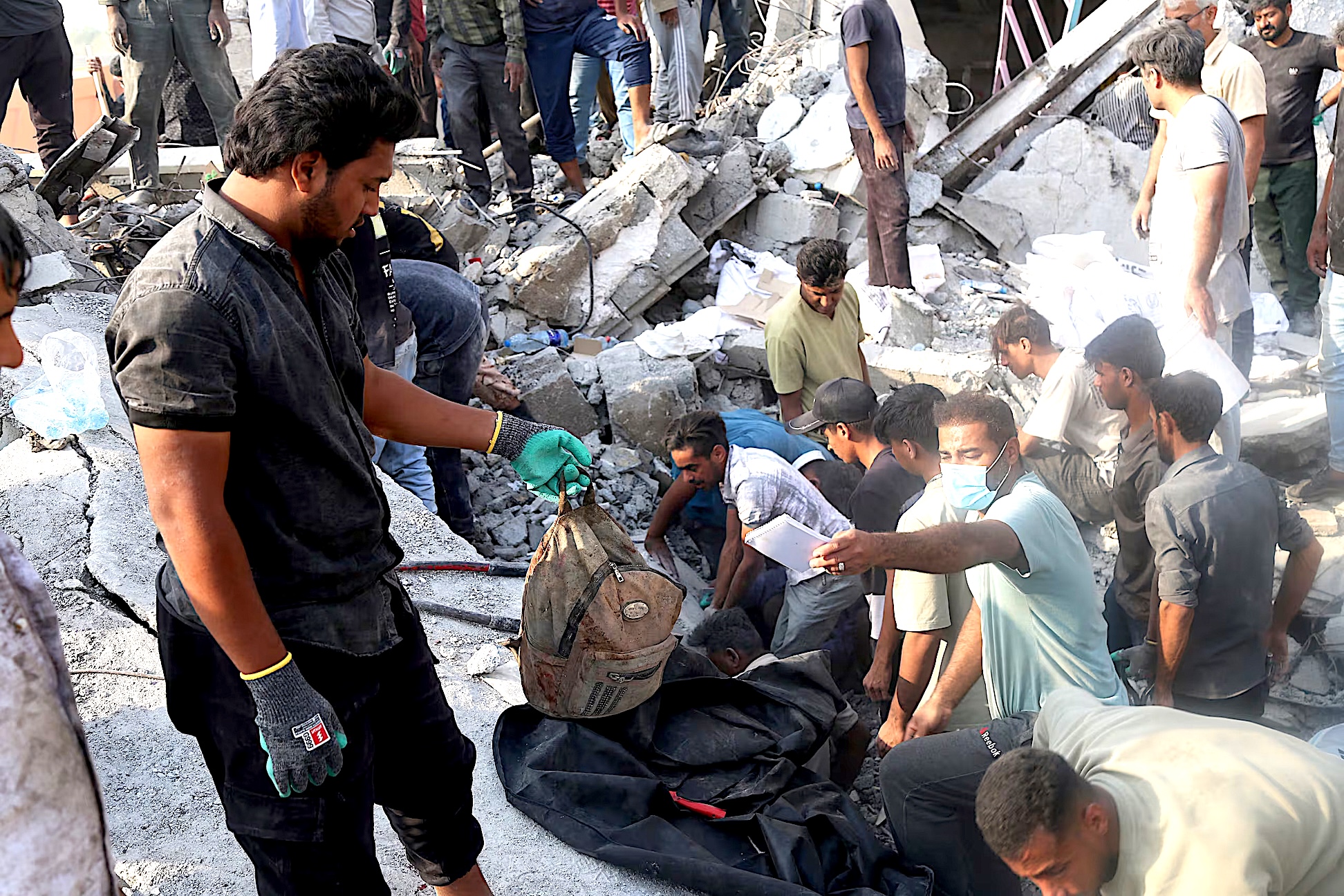
Recovery workers in the rubble of the Shajareh Tayyebeh girls’ school in Minab after it was struck by U.S. forces on Feb. 28 during the outbreak of U.S.-Israeli aggression on Iran. (Mehr News Agency /Wikimedia Commons/ CC BY 4.0)
 No one can say with certainty, at this writing, how Iran’s defense against U.S.–Israeli aggression will turn out. Except that anyone who thinks carefully about this knows very well the Islamic Republic and its 93 million people will come out the victors.
No, it is not yet clear what victory will look like — not if one is looking for the immediate terms of a settlement in this latest phase of the long war the American and Zionist terror machines continue to spread across West Asia.
Over the weekend President Donald Trump ostentatiously rejected Iran’s latest peace proposals, delivered per usual via Pakistan, as “TOTALLY UNACCEPTABLE!”
This is mere posturing of the sort we have seen for months in the Trump regime’s relations with Russia. And just as the United States has failed over many years to impose its will on the Russian Federation, neither the United States nor Israel has any chance of breaking Iran and Iran, turning the thought upside down, runs little risk of breaking.
History, so often a reliable guide to what is out our windows, is clear on this point. This is a war between a strong nation and another that, even with a vicious client in the region, is merely powerful. There have been various confrontations of this kind over the past century, and probably longer than that, and they almost invariably turn out the same way.
B–52s and B–2s dropped 30,000–pound “Massive Ordnance Penetrator” bombs, commonly known as “bunker busters.” F–18s, F–22s and F–35s fired “Joint Air–to–Surface Standoff Missiles.” Naval vessels launched Tomahawk cruise missiles and “Precision Strike Missiles.”
MOPs, PrSMs, JASSMs — and you have to love the Pentagon’s techno-speak: All of this and more rained down on the Iranian people, their apartment buildings, their hospitals, their schools, their universities.
This was Operation Epic Fury once the aggression began Feb. 28. The figure going around is that the United States and the Israelis struck 13,000 targets before the current ceasefire — if it counts as one — took effect a month ago last week.
Arleigh Burke-class guided-missile destroyer USS Winston S. Churchill firing a Tomahawk Land Attack Missile (TLAM) during operations in support of Operation Epic Fury on Feb. 28. (U.S. Navy Photo)
And through it all you saw Iranians, by way of videos posted daily on social media, crowding the streets and squares of Tehran, gathering on the bridges the aggressors were targeting, or simply going about their business as best they could — stirred but unbroken so far as one could make out.
Before the world’s eyes, Iranians have turned Operation Epic Fury into Operation Epic Desperation.
The Islamic Republic has neither an air force nor a navy to speak of. Its missile programs are advanced, but it is otherwise no match for the Americans and Israelis as measured by its military capabilities.
How to account, then, for the prevalent certainty among Iranians, evident from the streets on up to their diplomats and senior officials, that they will survive this nightmare — that Iran will go on being Iran?
“A whole civilization will die tonight, never to be brought back again,” Trump threatened, out of some upside-down version of “shock and awe,” as the Iranian Revolutionary Guard Corps controlled the Strait of Hormuz with nothing more than cheap drones, speedboats and primitive mines. This was last month, just before the ceasefire was agreed.
What did Trump mean by this? What would be the point of destroying not any kind of strategic asset but a civilization? Why did the Americans and Israelis deploy all that high-technology weaponry against so many civilian targets?
My answer is simple. The military planners in Washington appear to have concluded that the ultimate objective is not the destruction of missile silos or airfields or drone factories: The ultimate objective must be the destruction of what makes Iranians Iranian — their shared spirit, their common identity, however great their differences.
Parenthetically, the Israelis have long understood this. As they finish leveling the Gaza Strip and attack one village after another in the West Bank, they know very well that what they must destroy apart from hospitals, houses, flocks of sheep and olive groves is the consciousness of Palestinians.
Two years after the Vietnamese drove the Americans out of their country, Wilfred Burchett published Grasshoppers and Elephants (Urizen, 1977), the on-the-ground story of the final 55 days before the American defeat.
Burchett, famously enough, reported the war from “the other side” and left behind, in voluminous journalism and numerous books, the most penetrating account of the war now residing in the record.
Burchett began by quoting from a speech Hô Chi Minh delivered in 1951, midway in the Viêt Minh’s fight against the French colonial forces:
“Because of the imbalance of forces, some people compared our resistance to a fight of grasshoppers against elephants. To a certain extent, for those who saw only the material and transient aspect of things, the situation really seemed like that.
Against enemy planes and artillery, we had only bamboo spears…. We look not only at the present but also the future; we place our trust in the strength and morale of the people. Thus we resolutely reply to the waverers and pessimists:
French troops seeking cover in trenches from Viet Minh shelling from the hazy hills in the distance during the battle of Dien Bien Pho, 1954. (Unknown photographer/ Stanley Karnow: Vietnam: A History, 1983, Wikimedia Commons/ Public Domain)
I do not know whether the Iranians have ever studied the Vietnamese experience, although many non–Western nations have made it a point to do so over the years. And Iran is greatly more advanced today than Hô’s Vietnam was in the 1950s and 1960s. They have a lot more than bamboo spears in their inventory.
But the principle Hô articulated, and that runs all through Burchett’s exceptional accounts of the war against the Americans, holds for the Iranians today as it held for the Vietnamese back then.
Prof. Seyed Mohammad Marandi, a former adviser to the Tehran government and now a frequent commentator on Iran’s foreign relations, said something simple but thought-provoking during one of his frequent commentaries the other day.
“The Americans do not understand Iran,” he remarked. “Everything they say about Iran is the opposite of true.”
Marandi goes to the core of the question in two sentences, and I cannot be at all surprised: He was born in Richmond, Virginia, and spent his first 13 years in the United States.
There are many ways to characterize America in the early 21st century, and very high among them is its incoherence — its lapsed faith in itself and more or less everything it once purported to stand for, its profound post–Sept. 11 anxieties, its incessant abuses of its citizens and its consequent disunity and disorder, its obsession with consumption and appearances, its indifference to its own public space — and what I call international public space — its lawlessness, its rampant egotism and narcissism, its preoccupation with frivolous “entertainment,” its studied ignorance of others, and on and on and on.
America reenacts a consciousness of its history but evinces no regard for it. Somewhere in the not-so-distant past — in inverse proportion to the ubiquity of lapel pins on public figures, I casually venture — America stopped believing in itself and lost all sight of its professed purpose.
It is not difficult to account for this. Those who purport to lead the United States have long entertained an obsession with power. And this obsession — very directly as measured by the defense budgets — has rendered America as we find it today: It is powerful but weak.
This is Marandi’s point, if I read the above-quoted observation properly. How could a nation as wayward as the United States, as hollowed-out, understand another with a living awareness of its history, its culture, its public space, its civilizational achievements, altogether its confidence in what it is and who its people are?
It is the difference between what the ancient Greeks termed techne and telos. The former refers to method, means, the “how” of whatever matter is to hand. Telos denotes purpose, the “why” of things, one’s objective, one’s North Star.
Americans have been preoccupied with techne since the early settlers exhausted themselves clearing forests and laying corduroy roads into the wilderness. Lately this preoccupation has turned into a deleterious obsession. And in mistaking techne for telos, as Americans have, they have rendered themselves powerful at the expense of their strength.
In his straight-to-the-point manner, the ever-interesting Simplicius put the case this way in a May 2 piece on his Substack newsletter. I will quote the pertinent passage at length:
“Victory is won by the nation with the greatest moral-spiritual alignment and unity, not the nation with the most gizmos, gadgets, and fancy ‘cheap’ toys. In fact, if you did a study you’d likely find there is an inverse correlation between higher technological fetishization of the military-industrial apparatus and an attendant lower moral-spiritual fiber of its people.
This process is not an ‘accident,’ but a natural self-evolving feedback loop between a people and their culture’s slow detachment from unifying cultural principles toward the void-filling materialism that naturally sprouts like weeds in a patch of dead lawn.
The West is in serious cultural decline, and must increasingly rely on gimmicky ‘techne’ to prop up the diminishing and depleted ‘passionarity’ (to borrow Gumilev’s term, from his concept of ethnogenesis) which can no longer move the world by its own sheer cultural inertia and vitality, and must now resort to heavy-handed force using a crude and limited set of technical instruments. [Lev Gumilev, Soviet anthropologist and theorist, 1912–1992.]”
Doesn’t this suggest what we witness today in West Asia — an exhausted nation in confrontation with another with no aircraft carriers or B–2 Stealth bombers, no MOPs, PrSMs or JASSMs, but possessed in full of its vitality and its purpose?
Uncle Hô and the Vietnamese showed the world a half-century ago how grasshoppers are bound to fare against elephants. Are not the Iranians doing the same once again as we speak?
Patrick Lawrence, a correspondent abroad for many years, chiefly for the International Herald Tribune, is a columnist, essayist, lecturer and author, most recently of Journalists and Their Shadows, available from Clarity Press or via Amazon. Other books include Time No Longer: Americans After the American Century. His Twitter account, @thefloutist, has been restored after years of being censored.
The views expressed are solely those of the author and may or may not reflect those of Consortium News.
Comments
No comments yet. Be the first.
Sign in to leave a comment.