Trump–Xi Summit: Expert Perspectives on the Stakes and Strategic Outlook
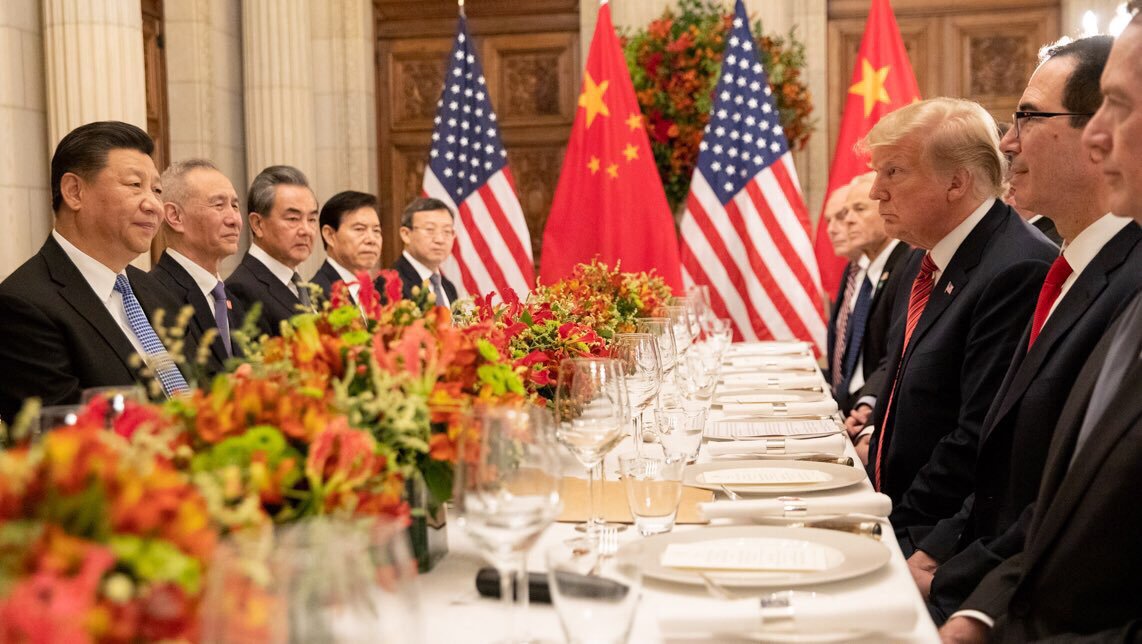
This Stimson Center analysis centers expert and policy-establishment perspectives on Trump-Xi dynamics, employing balanced, measured language that acknowledges competing concerns (Taiwan worries vs. Trump's strategic awareness) without ideological edge. The framing is cautiously analytical rather than alarmist or dismissive; it treats Trump's decision-making as deliberate rather than incompetent, while still flagging China's rhetorical strategy risks.
Primary voices: academic or expert, elected official, international body, media outlet
- This article does not address Beijing's or New Delhi's public statements or strategic logic directly.
- This article does not provide economic data on U.S.-India trade flows or tariff impacts.
- This article does not examine Trump administration officials' own framing of Taiwan or China policy.
Framing may shift significantly depending on actual summit outcomes and whether any rhetorical changes on Taiwan occur, which would validate or undermine the article's confidence in Trump's restraint.
Think-tank-citedAcademic-sourcedEstablishment framing
One issue to watch in the Trump-Xi summit is whether — and how — Taiwan is mentioned. The talks will primarily focus on economic and trade matters, and more pressing issues in the bilateral relationship will likely leave limited space for substantive discussion of Taiwan. Nevertheless, Chinese interlocutors have been clear that they would like Trump to at least adjust declaratory policy in ways that favor Beijing’s claims over the island. Many in Washington and Taipei worry he may do so — for example by saying the US “opposes,” rather than merely “does not support,” Taiwan independence.
Such a rhetorical shift might appear minor, but there are reasons Beijing is pushing for it. While the White House would certainly clarify that U.S. policy hasn’t changed, China could exploit even a subtle change in wording to pressure Washington to adopt a more restrained approach toward Taiwan. It could also use the adjusted language as a precedent, pressuring other countries and future U.S. administrations to adopt similar phrasing and adjust their policies accordingly. This would risk eroding the legitimacy of U.S. engagement with Taiwan, further isolating the island internationally and depressing morale within an already divided Taiwanese society.
Much of the speculation about what Trump might say regarding Taiwan rests on the assumption that he lacks nuance on this issue or has little interest in the island. Both assumptions are likely overstated. Trump may not feel a strong ideological affinity for Taiwan’s democracy, but he understands its importance to Beijing and recognizes its geopolitical value. It’s hard to imagine him knowingly conceding ground on such a significant issue.
As for nuance, Trump may not be a regional expert, but his advisors understand the stakes and have almost certainly prepared him to navigate this issue carefully. Moreover, the extensive discussion of these concerns in policy circles and the media makes it unlikely that a president as sensitive to media narratives as Trump could be unaware of the risks. U.S. allies — particularly Japan, whose Prime Minister visited Trump at the White House in March — are also likely reinforcing these concerns directly.
Accordingly, if Trump were to alter U.S. declaratory policy toward Taiwan, it would probably be a deliberate choice rather than an inadvertent misstep. Given the stakes, however, the likelihood of such a shift is lower than many fear.
More likely, both Trump and Xi will reinforce their existing positions on Taiwan. If Trump reaffirms long-standing U.S. policy, it will help calm nerves in Taipei and allied countries.
Will the Summit be a “Third Strike” in Trump’s Relations with India?
The Trump-Xi summit comes at a precarious moment in US-India relations. The past year was among the worst for US-India ties in recent memory. This deterioration was especially jarring for New Delhi, which initially viewed Trump’s return to office with confidence and expected that India — more than other U.S. allies and partners — could navigate the president’s transactional approach to international affairs.
Two major points of contention shook New Delhi’s confidence in Washington. The first was trade. After extended, sometimes acrimonious negotiations, the two finally inked a framework agreement in February, just in time to be thrown into limbo by the U.S. Supreme Court’s ruling against Trump’s tariff scheme. The second was Trump’s embrace of Pakistan. In an infuriating turn of events for New Delhi, Pakistan’s leaders have successfully ingratiated themselves with the White House. Worst of all, when India and Pakistan fought last May, Trump’s ceasefire played to Pakistan’s advantage. The president’s incessant credit-taking for that move continues to rankle Indians.
In short, Trump already has two strikes against his relationship with India. Beijing could bring a third.
China has always been central to the logic of US-India strategic partnership. For India, the United States is the only country that can counter China’s expanding influence in Asia and offer access to technological (including military) means to turbocharge India’s rise to great power status. However, the United States will only pursue this path if it continues to believe that China is its principal adversary and India has the potential to become a vital strategic counterweight.
India thus craves a credible U.S. commitment to counter China in Asia. If Trump comes away from the Beijing summit declaring the need to redouble competition with Beijing, India could regain some confidence in its strategic partnership with the United States. The positive momentum would carry naturally into a ministerial-level meeting of the Quad — India, Australia, Japan, and the U.S. — scheduled for later this month in New Delhi.
If, however, Trump signals — as he has in the recent past — a softening U.S. competition with China or suggests he might leave Beijing to its own devices in Asia, it will inspire additional doubts in New Delhi. To be sure, US-India ties will not collapse: The two share too many mutual interests for that. However, team Trump will have struck out as a reliable strategic partner for India; New Delhi will back away from major new initiatives and deals for the next several years.
Trump-Xi Meeting in Beijing Follows Trump-Takaichi Meeting in Washington, By Design
Trump’s personal approach to diplomacy and tendency to seek to break through long-standing logjams by bold action creates the possibility for a significant change in the nature of US-China relations as a result of the upcoming Trump-Xi summit. This concerns Japan – which, like the United States, relies on China as a significant trading partner while harboring growing security concerns about China across a wide range of issues. That this upcoming summit is widely reported to be less choreographed than is usual for such a high-level leaders’ exchange exacerbates concern among Japanese that the nature of US-Japan relations could be negatively impacted by a bold move by President Trump vis-à-vis China, similar to the so-called “Nixon shocks” that rattled US-Japan relations after President Nixon’s bold new direction with China.
Trump’s upcoming meeting with Xi Jinping follows Japan’s Prime Minister Sanae Takaichi’s visit to the White House on March 19, a date that was timed to precede the original Trump-Xi summit plan. This offered Takaichi an opportunity to emphasize to Trump Japan’s concerns vis-à-vis China and the importance of the US-Japan relationship to the United States. The topics covered at that March meeting overlap significantly with what Trump is expected to discuss with Xi – including tariffs, the Iran war and related energy and supply shocks, a range of security concerns vis-à-vis China (AI, access to critical minerals, and China’s disruptive gray zone actions, among them), and the Taiwan issue.
In the week leading up to the planned Trump-Xi summit, Takaichi as well as her foreign minister, defense minister, and other cabinet ministers traveled the globe to advocate for Japan’s alternative-to-China approach to international order, the Free and Open Indo-Pacific (FOIP) strategy, with a notable focus on regional states that have their own concerns about China – including Takaichi’s own visits to Vietnam and Australia and her defense minister’s visits to the Philippines and Indonesia, all countries that are deepening defense cooperation with Japan while watching China’s expanding regional security role with concern. Much of Japan’s expanded military cooperation in the region is tied to similar U.S. outreach to these states and coordinated through the deepening US-Japan military alliance, a topic of the Trump-Takaichi meeting in Washington in March.
Still, despite a growing closeness between the U.S. and Japan in the military arena, as well as a generally cooperative management of the tariff issue, Japan – like all US allies – harbors concerns about Trump’s devaluing of alliances broadly. Japanese leaders and the Japanese public will pay close attention both to the substance and the personal relationship between Trump and Xi that is reported from the upcoming summit for signs of unexpected and unfavorable shifts in US-Japan relations to come.
Seoul's Quiet Calculus at the Trump-Xi Summit
Among those watching the high-stakes summit between Donald J. Trump and Xi Jinping this week will be South Korea, whose economy and national security are closely tied to the United States and China. As of March 2026, for instance, South Korea’s annual trade in goods with the U.S. and China accounted for nearly 40% of its total (approximately $1.3 trillion). There is also evidence suggesting that the security climate in and around the Korean Peninsula has been impacted by the dynamic between these great powers. While Seoul is likely to exercise caution and refrain from moving too hastily on matters having to do with both countries regardless of the immediate outcome from this meeting, even a temporary reprieve in tension will allow Seoul to score some practical short-term gains and tactical benefits on matters related to trade, supply chain, freedom of navigation across the Strait of Hormuz, and regional security (i.e., Taiwan and North Korea). There are certain issues that may have greater implications for South Korea, however, such as any changes to the suspended Section 301 investigation of Chinese shipbuilding by USTR, as well as Chinese sanctions on US-linked subsidiaries of a South Korean shipbuilding company, which would directly impact the US-ROK MASGA (Make American Shipbuilding Great Again) effort.
The Trump-Xi summit could also shape South Korea’s broader approach to regional engagement. Recent developments have allowed Seoul to constructively reengage with Beijing, most notably through President Lee Jae Myung’s state visit to China in January. South Korea has also emerged as a preferred venue for US-China diplomacy more broadly: The two sides held their initial engagement last October on the sidelines of APEC, and most recently, Treasury Secretary Scott Bessent and Chinese Vice Premier He Lifeng met in Seoul for a final round of negotiations ahead of the summit.
As President Trump prepares to head to China for a summit, North Korea has inevitably come up as a point of interest. One former U.S. government official observed that Trump could ask for Xi’s suggestions on engaging Pyongyang, while mainstream South Korean media outlets have noted that a Trump “surprise proposal” to meet with Kim Jong Un during his Beijing trip “cannot be ruled out.”
If North Korea figures among the myriad priority issues the two presidents need to address, and if any meaningful progress is to be made, one key precondition is that Beijing has both sufficient influence over North Korea and the willingness to serve as a broker between Pyongyang and Washington.
This raises the question of where China stands with North Korea. The bilateral relationship had been strained since fall 2023, but the two countries began taking initial steps toward restoring ties when Kim Jong Un visited Beijing in September 2025 to take part in “Victory Day” celebrations and held his first summit with Xi Jinping in more than six years. Though the precise reasons for the 2023 cooling are unknown, it coincided with North Korea’s warming relations with Moscow, and if that relationship holds, Pyongyang may have limited incentive to fully rehabilitate ties with China. Given these constraints, it is unlikely that Beijing will be able to play a meaningful brokering role in US-North Korea engagement, even if it were willing to do so.
A second major hurdle is North Korea’s hardening of conditions to engage Washington. At the Ninth Party Congress in February 2026, Kim said, “There is no reason why we cannot get on well with the U.S.” if “the U.S. respects the present position of our state specified in the Constitution of the DPRK” — a reference to its nuclear-armed status — and “withdraws its hostile policy.” Where Pyongyang once asked the United States to drop the denuclearization demand, it is now calling for recognition of North Korea’s nuclear status and the withdrawal of what it calls “hostile policy” — a term that is broad and vague enough to cover everything from U.S. attention to North Korean human rights to joint US-South Korea military exercises.
Adding to this picture, one of most striking stories from Moscow over the weekend was North Korean troops’ participation in Russia’s Victory Day parade for the first time. The symbolic images of their march through Red Square underscored both the deepening entrenchment of the North Korea-Russia partnership, and the limited means available to curb it.
Among topics that could come up at this week’s summit, arms control is perhaps the wildest of wild cards. Trump has been pushing for dialogue with China on nuclear arms control since his first term and was clear when he allowed the New START treaty with Russia to expire earlier this year that he envisioned something more comprehensive taking its place. Nevertheless, China has been clear that as a distant third to the United States and Russia despite rapid growth in the size of its arsenal, it sees little point and has no interest in such discussions. Proponents of engaging China say, however, there could be much more to such discussions than mere numerical limits, and that they should start at the most basic level to build confidence and trust before moving on to transparency, risk reduction measures, and novel capabilities and domains including space and cyber. This summit could provide a step in that direction in a best-case scenario.
One issue that is causing significant friction in this portfolio, however, is nuclear weapons testing. Although the United States and China have both signed (but not ratified) the Comprehensive Test Ban Treaty and instituted voluntary unilateral moratoria on nuclear tests, the United States asserts that China has conducted secret nuclear weapons testing. While the U.S. Stockpile Stewardship and Management Plan encompasses a range of measures designed to maintain confidence in the weapons arsenal under its own testing moratorium, the administration has issued frequent threats over the past several months to resume testing “on an equal basis.” Following through on that threat would likely only further set back any prospects for renewed engagement on arms control.
The AI race may eclipse the tech-related dimensions at the Trump-Xi Summit, but cyber is not inconsequential. In fact, concerns about online espionage underpin many of the other security issues up for debate.
Cyber espionage has long been a thorny topic between the two countries, one that has evolved from being largely about IP and commercial information theft to more recent concerns about prepositioning for a future disruptive attack. Progress has historically been difficult to sustain; a promising bilateral agreement between former U.S. President Obama and Xi unraveled after just a few years, for example. Recently developments have brought the threat more sharply into public consciousness. In 2024-2025 Salt Typhoon, an advanced persistent threat actor linked to China’s Ministry of State Security, broke into major telecom providers including Verizon, AT&T, and T-Mobile in what then-FBI Director Christopher Wray called “the most significant cyber espionage campaign in history.” Volt Typhoon, another China-linked threat actor discovered in 2024, infiltrated networks linked to critical and military infrastructure in Guam and the United States. Relevant U.S. agencies assessed at the time that Volt Typhoon’s targeting and behavioral patterns were not consistent with traditional cyber espionage or intelligence gathering. Instead, the intention was to potentially preposition cyber assets for a more disruptive attack in the event of a crisis or conflict with the United States.
The 2026 U.S. cyber strategy does not name China as an adversary, breaking from earlier such strategies, but does pledge to “unveil and embarrass online espionage” and includes pillars focused on modernizing and securing federal networks and critical infrastructure, as well as on shaping adversary behavior.
On its own, cyber espionage — or cybersecurity more broadly — is unlikely to be a focus of discussion at the summit. But the issue sits at the heart of other pertinent topics, from semiconductor controls and AI rivalry to critical infrastructure vulnerability because of dependence on information that can be stolen, manipulated, or held at risk. The White House recently accused China of conducting “industrial-scale” theft of American AI models, raising the stakes further as artificial intelligence becomes central to both economic competitiveness and national security, for example. Any agreements reached at the summit will only be as durable and secure as the digital infrastructure underpinning it.
Comments
No comments yet. Be the first.
Sign in to leave a comment.