Closing the Gap? Italy Sets New Rules for Its First National Security Strategy Amidst Old Obstacles
The article centers academic experts (Nina Silove, Colin Gray, Liddell Hart, Edward Luttwak) and think-tank analysis while incorporating government sources and policymaker interviews. Language is measured and technical—describing obstacles and institutional mechanisms without advocacy rhetoric. The framing acknowledges both enablers (Meloni's government stability) and structural constraints (Italy's historic institutional fragmentation), presenting a substantive policy analysis rather than partisan positioning.
Primary voices: academic or expert, elected official, state or recognized government, media outlet, anonymous source
- This article does not address potential opposition or alternative perspectives on whether Italy should pursue a national security strategy.
- This article does not discuss how this strategy might affect Italy's relations with non-NATO regional partners or potential strategic trade-offs.
- This article does not address the content or specifics of what the strategy is expected to contain regarding threats or priorities.
Framing may shift once Italy's actual national security strategy is published; current assessment reflects pre-publication analysis of institutional positioning and likelihood.
Academic-sourcedThink-tank-citedGovernment-sourced
Italy may finally be about to publish its first-ever national security strategy, a striking development for the only G7 country that has never had one.
For decades, a mix of government instability, competition between institutions, a relatively permissive international environment, and the perceived reliability of U.S. security guarantees in Europe and the Mediterranean reduced incentives to produce a strategy. Recently, however, domestic political consolidation and external pressures have appeared to align in a way not seen before. Until recently, limited news articles and confidential interviews with policymakers, diplomats, and military officials pointed to a forthcoming publication that could address what military experts Coticchia and Mazziotti di Celso have described as a serious shortcoming for the world’s eighth-largest economy. That expectation — despite uncertainty over whether the current political conditions enabling progress will hold — has now been partly confirmed: Rome is moving closer to the finish line. Yet, four obstacles stand in the way.
National Security Strategies and Grand Strategy
National security strategies are connected to what strategists Colin Gray and Liddell Hart defined as grand strategy — the coordination and use of a state’s resources to achieve political objectives. As Center for International Security’s expert Nina Silove argues, this can take the form of deliberate designs, guiding principles, or consistent patterns of behavior over time. In this sense, even states without an explicit strategy may still exhibit strategic coherence in practice. However, as political scientist Edward Luttwak noted in Strategy, the organization of modern states often complicates this task, as bureaucratic fragmentation and institutional interests can hinder coordination. More specifically, a national security strategy is a government’s attempt to formalize and coordinate the instruments of state power in pursuit of national interests. They typically identify threats, set priorities, and align political, military, and economic tools. At the same time, the need to build consensus often leads to compromise and, at times, to deliberate ambiguity, which may limit their practical impact.
A Window of Opportunity for Italy’s First National Security Strategy
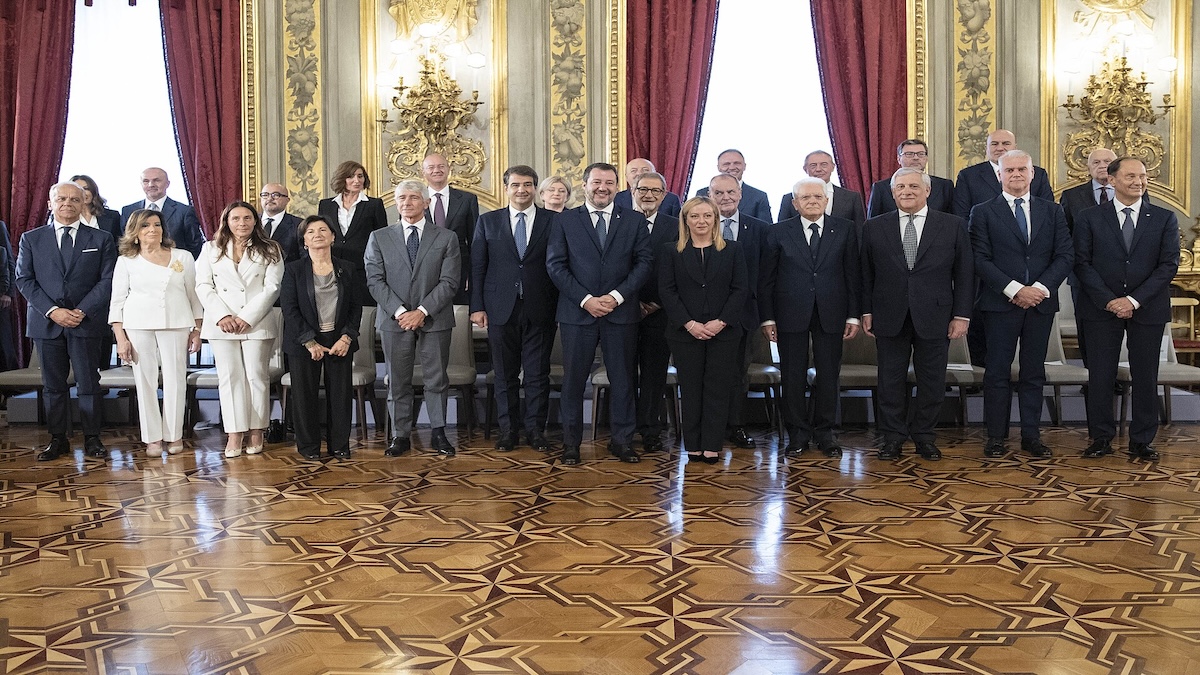
With its more than 1,200 days and counting in office, the Italian government under Prime Minister Giorgia Meloni is already the second-longest democratic government in the country’s history. This has profound national security implications: Meloni has a large majority that makes her authority less vulnerable to opposition pressures as well as to intragovernmental strong-arming, mainly from the two minor parties clashing over several critical issues. We don’t know yet how the recent defeat in the justice referendum will impact the government, but so far her leadership has been resolute and firm enough to overcome factionalism, institutional competition, and jealousy. For the first time in the recent past, Palazzo Chigi, the Italian executive, has the leverage to assemble — and hold together — the different branches of government while it drafts a document intended to align them along a unitary and coherent line of action.
Even so, Meloni has inherited the institutional historic problem every previous government had national security-wise: the absence of a single, streamlined body providing guidance and ensuring coherence, or in other words, an Italian National Security Council. However, from a secure government comes firm delegation: The prime minister has now formalized a process that runs through the Comitato interministeriale per la sicurezza della Repubblica, rather than through a newly created National Security Council. Under a new decree, the Comitato formulates proposals to the prime minister for the adoption of the National Security Strategy (art. 5) and exercises high-level oversight over its implementation. The preparatory work is entrusted to a subordinate body — the Comitato tecnico — a permanent collegial body chaired by the director general of the Dipartimento delle informazioni per la sicurezza, this one serving as its secretariat. A weaker government would not have been able to do such a thing. As in the past, institutional jealousy from military officers, diplomats, and domestic security agencies would have jettisoned the process: better no national security strategy than someone else’s.
What makes this moment different is the Presidency of the Council’s unusual — in the Italian context — ability to impose coordination and discipline across competing bureaucracies, made possible by the absence of meaningful contestation to Meloni’s leadership within the governing coalition. This capacity to steer and sequence the process is further borne out by our interviews, indicating that an unclassified version of the National Military Strategy, drafted by the Italian Joint Staff, has been ready for release but is being deliberately held back until the National Security Strategy is published — effectively granting the overarching document clear primacy. The Ministry of Defense, for its part, is also reportedly considering a follow-on National Defense Strategy. The National Security Strategy will not require parliamentary approval. The decree provides instead for a narrower form of parliamentary involvement: The strategy is to be adopted by the prime minister on a proposal from the Comitato interministeriale, after consulting the Comitato parlamentare per la sicurezza della Repubblica – the parliamentary committee overseeing national intelligence – and is then communicated to that committee. The prime minister, or some delegate acting on the prime minister’s behalf, must also periodically report to Comitato parlamentare on initiatives adopted under the strategy.
Last but not least, international considerations have convinced Palazzo Chigi that the time is ripe for a strategy. First, prestige has historically played a key role in shaping Italian foreign policy. Under the current center-right government, which has placed the notion of “national interest” at the core of its political narrative, this is a big concern. As a result, being the only G7 country without a national security strategy is no longer merely an anomaly, but a reputational liability Rome is unwilling to tolerate.
Second, the combination of war in Eastern Europe and in the Persian Gulf, as well as instability in the Sahel, the Eastern Mediterranean, and the Horn of Africa, has effectively set Italy’s fundamental strategic theatre — the Enlarged Mediterranean — on fire. Originally developed within military circles at the end of the Cold War — and often associated with the so-called Martini Doctrine — the concept refers to a broad geopolitical space stretching from the Western Balkans and North Africa to the Middle East and the Red Sea and long identified by Italian policymakers as the country’s primary area of strategic interest. In recent years, official documents have increasingly adopted this concept to capture the interconnected security, political, and economic dynamics shaping Rome’s external environment.
Third, the Trump administration has put the last nail in the coffin of not having a strategic document. Not only has it said — and written — that European allies must take the lead against threats on NATO’s Eastern Flank and in its Southern neighborhood, but also that the United States will prioritize cooperation and engagement with so-called model allies, namely those who are visibly doing more to address threats in their regions. Despite recent tensions between the White House and Palazzo Chigi over Italy’s lack of support for the U.S. war with Iran, Rome has been more eager than many of its European counterparts to signal alignment with Washington — positioning itself as exemplary and a preferred interlocutor within the European Union.
Fourth, Rome has proven particularly responsive to U.S. recommendations, expanding both the scale and scope of its military deployments, including through bilateral missions and U.S.-led coalitions. This has broadened not only its operational footprint but also its strategic responsibilities across the Enlarged Mediterranean, increasingly in formats that go beyond traditional multilateral frameworks and make exclusive reliance on NATO or EU strategic documents less tenable.
The decree makes the publication of Italy’s first National Security Strategy considerably more concrete. Yet it also shifts the terms of the debate. The key question is no longer simply whether Rome can create a formal framework for strategic coordination, but whether the document that emerges from it will matter in practice. Four interrelated risks could still undermine that outcome.
Avoiding a Strategy That Is Too Narrow
Entrusting the drafting process to an intelligence-centered procedural architecture has clear political advantages. It cuts through bureaucratic resistance, speeds up coordination, and increases the odds that the process will actually deliver, not least because Italian intelligence services ultimately report to the center of government. But this choice comes with a trade-off: It risks producing a strategy skewed toward internal and hybrid threats in a moment when intelligence is headed by Vittorio Rizzi, a policeman and former deputy director of domestic security.
Italy’s domestic security landscape is undeniably shaped by organized crime, terrorism, irregular migration, and illicit networks. These are enduring and politically salient challenges, and any serious strategy should address them. Yet, an overemphasis on internal issues risks crowding out a far more consequential shift: Italy’s external environment is shifting. The return of great power competition, violence across the Enlarged Mediterranean, and the mounting challenge of China are reshaping the country’s strategic horizon. Countries are increasingly weaponizing economic interdependence, technological competition is accelerating, and alliance expectations are rising. In this context, a national security strategy that leans too heavily on domestic threats will offer, at best, a partial diagnosis. It may be coherent, but it will be incomplete — reflecting the logic of the drafting institution more than the geopolitical realities Italy must navigate.
Avoiding a Strategy That Is Too Vague
The more consequential risk is not bias but ambiguity. Once the decision to publish a strategy is made, governments inevitably face difficult trade-offs and multiple audiences. As a result, they often hedge by producing documents that sound strategic while saying very little. The outcome is a text that signals commitment without setting priorities and invokes principles without making choices.
This outcome is not accidental. In many cases, vagueness reflects the need to accommodate competing institutional preferences and build broad political consensus. This is likely to be particularly true in the Italian context, where interministerial rivalry and unclear allocation of responsibilities have long hindered the emergence of a unified strategic voice.
Italy should nevertheless seek to resist this instinct, even within these structural constraints. The risk is that a strategy that is overly cautious, diplomatically neutral, or reliant on generic references to international law and multilateralism may be politically comfortable, but strategically weak. What is lacking in Italy is not strategic behavior or guiding principles — such as Atlanticism, Europeanism, and a focus on the Enlarged Mediterranean — but their formalization into a coherent and publicly articulated framework. In the absence of a strong strategic culture and clear institutional hierarchy, compromise-driven ambiguity becomes the default outcome.
This dynamic is visible, for instance, in the German case, where the need to accommodate multiple political and institutional constraints has produced a strategy that is deliberately cautious and at times ambiguous. Against this backdrop, an Italian strategic document should spell out how Italy sees the world and where it intends to stand.
That means moving beyond declaratory language and confronting concrete dilemmas, from distant theaters to immediate neighborhoods. Italy’s relationship with China, for example, cannot be reduced to abstract support for a rules-based order. It rests on dense economic, commercial, and investment ties that will not simply disappear under external pressure. A credible strategy should acknowledge this and define how engagement and risk management will coexist. The same applies closer to home. In Libya, the issue may not be which actor to back, but what outcome to prioritize. If stability is the goal, the strategy should say so clearly. Without that clarity, policy risks drifting between tactical adjustments and reactive choices.
The aim is not to eliminate ambiguity altogether, but to discipline it. Without parallel efforts to address underlying coordination problems, however, there is a risk that a national security strategy would remain largely symbolic — more a repackaging of existing practices than a driver of strategic change. At the same time, a strategy should set out the kind of international environment Italy seeks to preserve or shape, the partnerships it values most, and the tools it is willing to use. In other words, it should outline a preferred vision of the world and Italy’s place within it — not in abstract terms, but as an exercise in political pragmatism.
Avoiding Institutional Fragmentation and Dispersion
Italy’s problem has rarely been a lack of documents — or even a lack of strategic thinking. Successive governments have produced white papers, defense guidelines, and sectoral strategies for years. Some would argue that Italy already operates with a de facto strategy, emerging from the accumulation of these documents alongside NATO’s Strategic Concept and the EU’s Strategic Compass. The persistent weakness lies elsewhere: coordination.
A national security strategy will raise expectations of coherence. It will be read as an attempt to bring together diplomatic, military, economic, and internal security instruments under a single framework. But without a mechanism to hold that framework together, expectations may quickly outpace reality.
The choice not to establish a formal national security council reflects political pragmatism. A new coordinating body would likely trigger bureaucratic pushback and reopen entrenched rivalries. Delegating the process to the existing Comitato and, below that, the Dipartimento is a workable compromise, but it leaves the core question unresolved: Who arbitrates once the strategy is published?
If Comitato interministeriale per la sicurezza della Repubblica is not substantially empowered to follow through, even a well-crafted strategy will lack the backbone to shape decisions. While now the Comitato has been formally tasked, what remains less clear is how far this oversight will reach in practice. Informal solutions are possible — a more assertive role for the prime minister in convening and steering coordination, for instance, or tighter, personal control over intelligence oversight. But informal arrangements rarely endure beyond changes of government. Formal mechanisms matter, and the new decree is a significant step in that direction. It establishes a procedure for adopting the strategy, gives the Comitato high-level oversight over its implementation, assigns preparatory and monitoring functions to the Comitato tecnico, and requires periodic reporting to the parliamentary committee. Yet it does not fully settle the deeper problem of arbitration. The decree repeatedly preserves the existing competences of ministries, administrations, and interministerial bodies. As a result, it creates a coordination framework without completely resolving who will prevail when institutional preferences diverge.
Ultimately, the effectiveness of the document will depend less on how it reads than on what it does. Without an institutional anchor, even the most carefully drafted document risks remaining just that.
Avoiding Anything Less Than a Whole-of-Government Strategy
Over time, the concept of “security” is widely recognized as having evolved, both in its theoretical and empirical dimensions, necessitating a more comprehensive and systemic approach to national security. Insiders suggest that the drafting process may not have fully brought in all the institutional actors with a stake in Italy’s national security — diplomats apparently — which would constitute a big mistake. Whether or not that is the case, the risk it highlights is real: A strategy that reflects only a slice of national power rather than the whole of it. If so, the publication of a national security strategy would risk becoming a missed opportunity to foster coherence around shared objectives across the many institutions that, in different ways, contribute to Italy’s national security.
Avoiding this outcome requires more than formal coordination. A national security strategy cannot be written from a single vantage point. It should bring together not only the traditional pillars of security — foreign affairs, defense, intelligence, and the armed forces — but also the broader Italian foreign policy community, which includes economic actors as well as experts in security and defense.
In today’s geopolitical environment, economic security is no longer a side issue. Hybrid threats can target critical infrastructure, exploit structural vulnerabilities, and undermine public trust as much as they inflict material damage. Foreign direct investment, industrial policy, supply chains, data governance, energy networks, and technological competitiveness are now core national security concerns. Ministries and agencies responsible for economic governance and industrial strategy are therefore not peripheral players, but central ones. They help define what counts as a strategic asset, what should be protected, and where vulnerabilities lie, all of which should feed directly into the country’s strategic posture.
As important would be the involvement of the broader community of academic experts and think tanks. In a country where public debate on security and defense remains limited and often polarized, their role goes beyond analysis. They help frame the conversation, translate strategy into accessible terms, and reduce the risk that a document of this kind is misunderstood or politically weaponized. In the context of renewed great power competition and increasing domestic political polarization, a national security strategy can easily be portrayed as either overly nationalistic or unnecessarily militarized. Anchoring it in a credible analytical framework helps defuse that risk and supports broader public buy-in.
Excluding key actors from the drafting process would not only narrow the perspective of the strategy but also weaken its implementation. A document that is not collectively owned is far less likely to be carried through in practice. A whole-of-government approach requires more than box-ticking consultation. It demands real integration — the ability to bring together diplomatic, military, economic, industrial, and analytical perspectives into a shared framework.
Yet, even as our interviews reveal that the drafting process is at an advanced stage, two recent developments risk pulling the rug out from under it. The first is domestic. While the government remains stable and early elections are not imminent, the outcome of the recent referendum has exposed limits to its broader public support. In a country where public opinion remains wary of rearmament and where debate on military affairs is often muted, the introduction of a first-ever national security strategy could provide the political opposition with a potent line of attack, framing it as evidence of a more assertive, even militarized, foreign policy. As Italy moves closer to the next general election, expected in autumn 2027 unless parliament is dissolved earlier, this raises the political costs of publication. Faced with this risk, the government may well decide to delay the strategy to the next legislature, should it retain power. At the same time, however, the very same domestic pressures could push in the opposite direction: Delivering a long-overdue strategic document would allow the government to claim a tangible policy achievement and demonstrate its capacity to act decisively in a domain where innovation has been limited.
The second development is international. The U.S.-Israeli war with Iran has, for the first time since Meloni took office, introduced visible frictions between Rome and Washington. In the absence of a formal strategy, Italy retains a degree of ambiguity, allowing it to calibrate its responses and justify restraint as consistent with its national interest. A published national security strategy, by contrast, could narrow this room for maneuver. By setting out priorities, red lines, and strategic alignments, it could expose Italy to reputational risks should its actions fall short of its stated commitments in times of crisis. At the same time, however, the war in Iran underscores the risks of operating without a clear strategic framework. In this context, the case for a national security strategy becomes more compelling: Not as a constraint, but as a necessary “north star” to guide foreign and defense policy in an uncertain world.
These dynamics may still affect the timing, content, and political presentation of the strategy. But the decree has apparently changed the baseline. Italy has moved closer than ever to closing a long-standing gap in its national security architecture. The new decree provides the procedure, the institutional anchor, and the promise of periodic updating. What it cannot provide on its own is strategic clarity. That will depend on whether Rome uses its first National Security Strategy not merely to coordinate crisis management, but to define how Italy understands its interests, ranks its priorities, and intends to act in an increasingly contested international environment.
Lorenzo Termine is a Max Weber Fellow at the European University Institute, adjunct professor at the University of International Studies of Rome, and president at Geopolitica.info. He is also nonresident senior fellow at the Atlantic Council’s Europe Center.
Gabriele Natalizia is an associate professor of international relations at the Department of Political Science, Sapienza University of Rome and director at Geopolitica.info. He is also adjunct professor at the Centro Alti Studi della Difesa of Rome and nonresident senior fellow at the Atlantic Council’s Europe Center.
Laura Donnini is a master’s student in international relations and global security at Sapienza University of Rome and a student of the Sapienza School for Advanced Studies. She received her bachelor’s degree in political science and international studies from the Cesare Alfieri School, University of Florence.
Comments
No comments yet. Be the first.
Sign in to leave a comment.