Pakistan’s New Logic of Limited War May Not Keep War Limited
The article centers expert and think-tank analysis (War on the Rocks is a Defense Department-adjacent publication) with language emphasizing strategic rationality and doctrinal adaptation. The framing presents Pakistan's military decision-making as a calculated risk management exercise ('strategic recalibration') rather than defensive or aggressive in moral terms. Sourcing is indirect—no on-the-record interviews, relying instead on inferred institutional logic and publicly stated doctrines.
Primary voices: academic or expert, think-tank analysis
- This article does not address civilian casualties or humanitarian impact of the May 2025 strikes or Iran war mentioned.
- This article does not include direct statements from Pakistani, Indian, or Iranian officials defending or explaining their decisions.
- This article does not examine international diplomatic efforts or third-party mediation during the crisis.
- This article does not discuss public or domestic political pressure on either government during the escalation.
This article references speculative future events (May 2025 crisis, 2026 Iran war) presented as historical, suggesting framing may require significant re-evaluation if actual timelines or outcomes dif
Think-tank-citedHawkish framingEstablishment framing
In May 2025, as Indian BrahMos missile strikes hit Pakistani air bases — targeting runways, parked aircraft, and critical infrastructure — Islamabad faced a choice. It had the capability to respond with its own long-range systems, but it chose not to. Pakistan deliberately withheld the Babur cruise missile, not because it lacked options, but because using a dual-capable system risked signaling nuclear escalation.
That moment captures the changing logic of conflict in South Asia. The four-day crisis was intense but contained, defined less by what was used than by what was held back. Yet, almost a year later, the sustained air campaign in the Gulf during the 2026 Iran war demonstrated the other side of this equation: how quickly modern conflicts can expand once missiles, drones, and economic disruption interact across domains and regions. These crises also suggest that limited war under the nuclear shadow is becoming more operationally viable.
Unlike Cold War conceptions of limited war, which assumed distant theaters and extended timelines, South Asian crises unfold under conditions of immediate proximity and compressed decision-making. In contrast, the Iran war has exposed the systemic pressures, equally applicable to future India-Pakistan crises: supply chain vulnerability, maritime insecurity, proxy risks, and the erosion of managed escalation and crisis management.
While much of Pakistan’s military doctrine remains opaque, the institutional reforms and capability choices following the May 2025 conflict suggest a serious effort to internalize its lessons. The result is not a doctrinal revolution but a strategic recalibration. Five shifts explain how Pakistan is adapting toward a model of warfare that emphasizes integration, speed, and controlled escalation — while simultaneously preparing for a more unstable regional environment in which crises may overlap. But this adaptation carries a built-in contradiction as the same capabilities that make limited war more controllable also make it more usable. And the more usable limited war becomes, the harder it may be to keep it limited.
Conventional Strike Is Now the Core of Escalation Control
Prior to the May 2025 crisis, Pakistan’s strategic posture relied on two elements: a calibrated conventional response to aggression and nuclear signaling to limit the scale of hostilities. In May 2025, once India expanded its conventional strikes following the first night of aerial combat, Pakistan had to adapt quickly. Drone incursions to probe air defenses, along with suppression and destruction of enemy air defense operations, placed Pakistan’s air defenses under heavy stress. Moreover, India’s reliance on the BrahMos supersonic missile for conventional strikes severely challenged Pakistan.
Under the “full spectrum deterrence” posture, Pakistan had avowed to respond to any aggression on its territory with nuclear options. In other words, Islamabad had lowered the nuclear threshold to deter New Delhi. This posture held until India launched Operation SINDOOR on May 7, 2025. The next day, faced with a wider geographic drone onslaught, Pakistan deployed its missiles and drones to target Indian air defense and military infrastructure. Two rounds of drone incursions prompted India to employ BrahMos missiles to target Pakistan’s air bases, aiming to destroy parked air force jets, refueler tankers, and surveillance planes.
In response, Pakistan held back and did not employ its Babur cruise missiles to target assets on Indian air bases. The decision to withhold the Babur reflects the constraint of conventional-nuclear entanglement, as all Babur cruise missiles are in the inventory of the Strategic Plans Division, Pakistan’s nuclear custodian. Any move to ready the Babur for deployment would have been interpreted by New Delhi, Washington, and other regional capitals as a signal of imminent nuclear use.
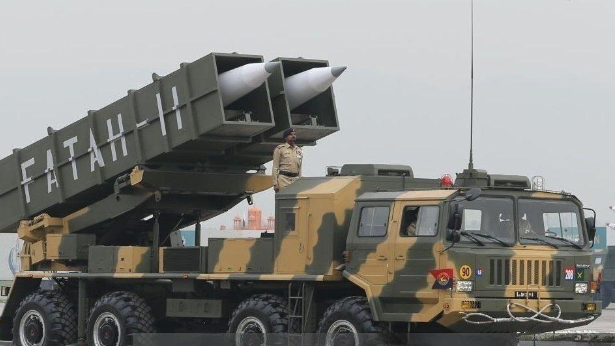
For Pakistan, the conflict revealed a central constraint: the entanglement between conventional and nuclear forces limits usable options in a crisis. Pakistan has chosen to address this constraint institutionally. The development of a dedicated conventional rocket force — the Army Rocket Force Command, under the direct command of the Pakistan Army’s General Headquarters and separate from nuclear command structures — signals an effort to build credible long-range strike options below the nuclear threshold. For example, systems like the Fatah-series rockets are designed to hold Indian military targets at risk without triggering a nuclear alarm.
While nuclear forces remain operational under the commander of the National Strategic Command and operate via the National Command Authority, the Army Rocket Force Command — with its separate command channels, manpower, and dedicated inventory — is Pakistan’s way of controlling escalation in future crises through conventional firepower. This is evidenced by the testing and induction of Fatah-II rockets and Fatah-IV subsonic cruise missiles with a range of up to 700 kilometers. These long-range rockets now enable Pakistan to target India’s military assets, air bases, and ammunition depots without raising the nuclear threshold.
The Iran war underscores this shift. Iranian retaliation — through missiles, drones, and proxy networks — demonstrated that states can impose costs on adversaries without crossing nuclear thresholds. At the same time, the conflict showed how quickly such actions can escalate horizontally, targeting energy infrastructure, shipping, and regional partners. Notably, Iran does not have nuclear weapons, raising questions about the kind of deterrence nuclear weapons offer to states facing existential threats.
For Pakistan, the lesson is twofold: conventional strike capabilities are essential for escalation control, but they must be carefully calibrated to avoid triggering wider regional spillover. This is a subtle but important shift. Although Pakistan has never threatened nuclear use during a conflict with India, the shift matters because it indicates that Pakistan is not relying on nuclear signaling to deter escalation. Instead, it is building the tools to manage escalation conventionally.
Multi-Domain Warfare Is the Baseline
The 2025 crisis showed that future India-Pakistan conflicts will not be sequential or domain-specific. Airpower, drones, cyber operations, and information campaigns unfolded nearly simultaneously. For example, during the four-day conflict, India and Pakistan employed beyond-visual-range capabilities across air-to-air missiles and precision-guided munitions. Drones played a central role, with both sides using them for offensive and defensive purposes, including limited strikes and intelligence gathering. The Iran war has reinforced this lesson at scale. By combining ballistic missiles and one-way attack drones, Iran demonstrated that cross-domain integration and technological synchronization can impose costs without triggering an immediate full-scale escalation.
Pakistan’s response has been to prioritize multi-domain integration — not as an aspirational concept but as an operational necessity. The emphasis is on integrating artificial intelligence, electronic warfare, cyber capabilities, and precision-strike systems into a unified battlespace. This is partly a response to asymmetry — Pakistan cannot match India’s conventional mass. Instead, it seeks to offset this imbalance through speed, coordination, and cross-domain disruption. But the Iran war adds a second layer: even states with significant capabilities struggle to control escalation once multiple domains are engaged simultaneously. Therefore, for Pakistan, multi-domain integration is not just about winning battles — it is about preventing them from spiraling out of control.
To this end, while the 27th Amendment formalized the Pakistan Army’s influence in constitutional governance, it only entrenched the military’s existing command system, in which the chief of army staff held the ultimate veto over deployments and operations, even in crises. For instance, during the 2019 and 2025 crises, even though the chairman of the joint chiefs remained functional for de-escalation, third parties spoke directly to the chief of army staff, who later ensured that all military operations were halted in sync, demonstrating escalation discipline.
Jointness Is About Escalation Discipline, Not Just Efficiency
If wars are fast and multi-domain, fragmented command structures become dangerous. The 2025 crisis exposed the risks of desynchronized operations, where actions in one domain could outpace political control. Pakistan’s answer has been structural centralization. The move toward a Chief of Defence Forces, combining operational authority across services, reflects an attempt to reduce decision latency and align military actions with political intent, indicating that the new structure is not simply about interoperability but also about escalation discipline.
The Iran war reinforces the stakes. One of its clearest lessons is how quickly conflicts can expand beyond their initial theaters through maritime disruption, proxy activity, and regional spillover. Pakistan has already had to respond to these risks, including deploying naval assets to protect shipping lanes and manage energy flows.
In this context, jointness serves a different purpose. It is less about fighting together and more about escalating coherently — and with discipline. By centralizing command, Pakistan aims to ensure that actions across domains and theaters remain aligned with political objectives. However, this comes with trade-offs. Centralization can reduce internal miscalculation, but it can also compress decision-making timelines. In nuclear environments, faster decisions are not always safer decisions.
India is Not the Only Strategic Focus
Historically, Pakistan’s force planning has remained overwhelmingly India-centric, with the bulk of conventional capabilities — particularly strike formations and airpower — configured for rapid, high-intensity conflict along the eastern front. However, the Iran war has exposed Pakistan to two vulnerabilities that it did not have to contend with when dealing with just India.
First, the conflict has exposed Pakistan’s overreliance on energy imports from the Persian Gulf. The disruptions and periodic closure of the Strait of Hormuz threaten to erode Pakistan’s military readiness over time. For example, the uncertainty surrounding energy supplies from the Persian Gulf has impacted the availability of aviation fuel, naval diesel, and ground transport fuel, which may reduce air force flying hours, limit naval deployments, and slow force mobilization, ultimately lowering operational tempo. Pakistan’s limited strategic petroleum reserves restrict its ability to sustain prolonged high-intensity operations, forcing prioritization between peacetime readiness and wartime endurance. The burden also shifts to the Pakistan Navy, which has already diverted resources toward securing sea lines of communication and protecting commercial shipping, pulling attention away from India-focused contingency planning. These pressures are compounded by broader economic shocks — rising oil prices, fiscal strain, and currency instability — that weaken defense spending and modernization efforts.
Second, the Iran war has revived a long-standing strategic nightmare: the possibility of a three-front contingency. Pakistan has already been contending with a “two-front” contingency, which refers to the prospect of facing simultaneous security pressures on its eastern border with India and its western flank involving Afghanistan. Pakistan’s February 2026 airstrikes on Taliban-controlled targets in Kabul and Kandahar marked a shift from indirect pressure to overt military coercion, following months of failed attempts to compel Taliban action against the Tehrik-e-Taliban Pakistan. This escalation reflects a broader pattern: Pakistan is increasingly willing to use cross-border force to manage western threats, even as it maintains conventional deterrence against India. Similarly, earlier assessments of Pakistan’s 2024 airstrikes in Afghanistan highlight a shift from proxy-based strategies to more direct, state-on-state signaling, driven by frustration with persistent militant sanctuaries and limited diplomatic leverage. Even though there is currently a ceasefire between Pakistan and Afghanistan, the ongoing U.S. war on Iran increases the possibility of instability along the Iran-Pakistan border.
As the ceasefire continues between the United States and Iran, Pakistan has prioritized maritime security operations, diversified energy routes, and pursued active diplomacy to prevent escalation. It has also positioned itself as a mediator in talks between the United States and Iran — reflecting both opportunity and necessity. The lesson is not that Pakistan is shifting away from India, but that India can no longer be the only strategic focus.
Recurring developments in Iran — from nationwide protests in January to war in March–April — have a direct impact on internal security, border economy, and political stability in Pakistan, which makes continuous monitoring of the western border a permanent strategic priority. Still, these developments should not be overstated. Pakistan’s evolving posture reflects a growing recognition of multi-front pressures, but translating this awareness into sustained planning, force allocation, and institutional capacity remains uneven.
Crisis Management Is Now External as Much as Internal
A final lesson emerging from both crises is that escalation control is no longer purely bilateral — it is shaped by external actors, global markets, and information flows. The Iran war has made this explicit. Energy markets, maritime chokepoints, and escalation dynamics have all influenced the trajectory of the conflict. Pakistan itself has become part of this external layer: acting as a mediator while simultaneously managing domestic economic and security pressures.
This externalization of crisis management has two implications. First, it increases uncertainty. States no longer control escalation solely through bilateral signaling. Third parties — whether allies, proxies, or economic actors — can shape outcomes in unpredictable ways. Second, it raises the premium on narrative control. In both 2025 and 2026, information control was central to shaping perceptions of restraint, credibility, and legitimacy. In short conflicts, perception can influence escalation as much as capability.
For Pakistan, this means that credibility is no longer just about what it does, but how those actions are interpreted — by India, by external powers, and by global audiences.
A New Model of Deterrence in South Asia
Taken together, these shifts point to a new model of deterrence in South Asia. Pakistan is moving away from a static framework where nuclear weapons simply cap escalation and toward a more dynamic approach centered on managing instability. Multi-domain integration, conventional strike capabilities, joint command structures, and external crisis management are all tools designed to operate in this environment.
But this model has limits. It assumes that escalation can be controlled through better organization, clearer signaling, and more precise capabilities. The Iran war suggests otherwise. Even with significant military capability, states struggle to contain conflicts once they expand across domains and regions. The central paradox remains unresolved: the more usable conventional options become under the nuclear shadow, the more likely they are to be used, and the harder it becomes to prevent escalation.
Pakistan’s evolving approach reflects a rational response to a changing battlespace. It is an effort to create space for controlled conflict below the nuclear threshold. But in doing so, it may also be contributing to a more permissive environment for limited war itself. The central paradox, then, remains unresolved. The more effectively states prepare to fight limited wars under the nuclear shadow, the more likely those wars become, and the less certain it is that they will stay limited. For Pakistan, the lesson of 2025 was that limited war is possible. The lesson of 2026 is that limited war may not stay limited.
Muhammad Faisal is a doctoral candidate at the University of Technology Sydney. Previously, he was a research fellow at the Institute of Strategic Studies Islamabad and a visiting fellow at the Stimson Center. His research focuses on Pakistan’s regional relationships at it navigates intensifying great-power competition across South Asia and the Indian Ocean region.
Sahar Khan is a 2026 nonresident fellow at the Institute of Global Affairs and a co-host of a new podcast focused on South Asia in the new nuclear age called “Beyond the Lines of Control.” Previously, she served as the deputy director and senior fellow of the South Asia program at the Stimson Center, a research fellow in Defense and Foreign Policy at the Cato Institute, and managing editor of Inkstick Media. Her research focuses on restraint, deterrence, and South Asian regional security and politics.
Haleema Saadia is co-host of the “Beyond the Lines of Control” podcast and a doctoral candidate at the Centre for International Peace and Stability at the National University of Sciences and Technology in Islamabad. She is a 2024 Civilian Research and Development Foundation global nuclear security fellow, an alumna of the Arms Control Negotiation Academy, and a former South Asia visiting fellow at the Stimson Center. Her research focuses on deterrence, nuclear diplomacy, and arms control.
Comments
No comments yet. Be the first.
Sign in to leave a comment.