The problem with the US power-sharing plan for Libya
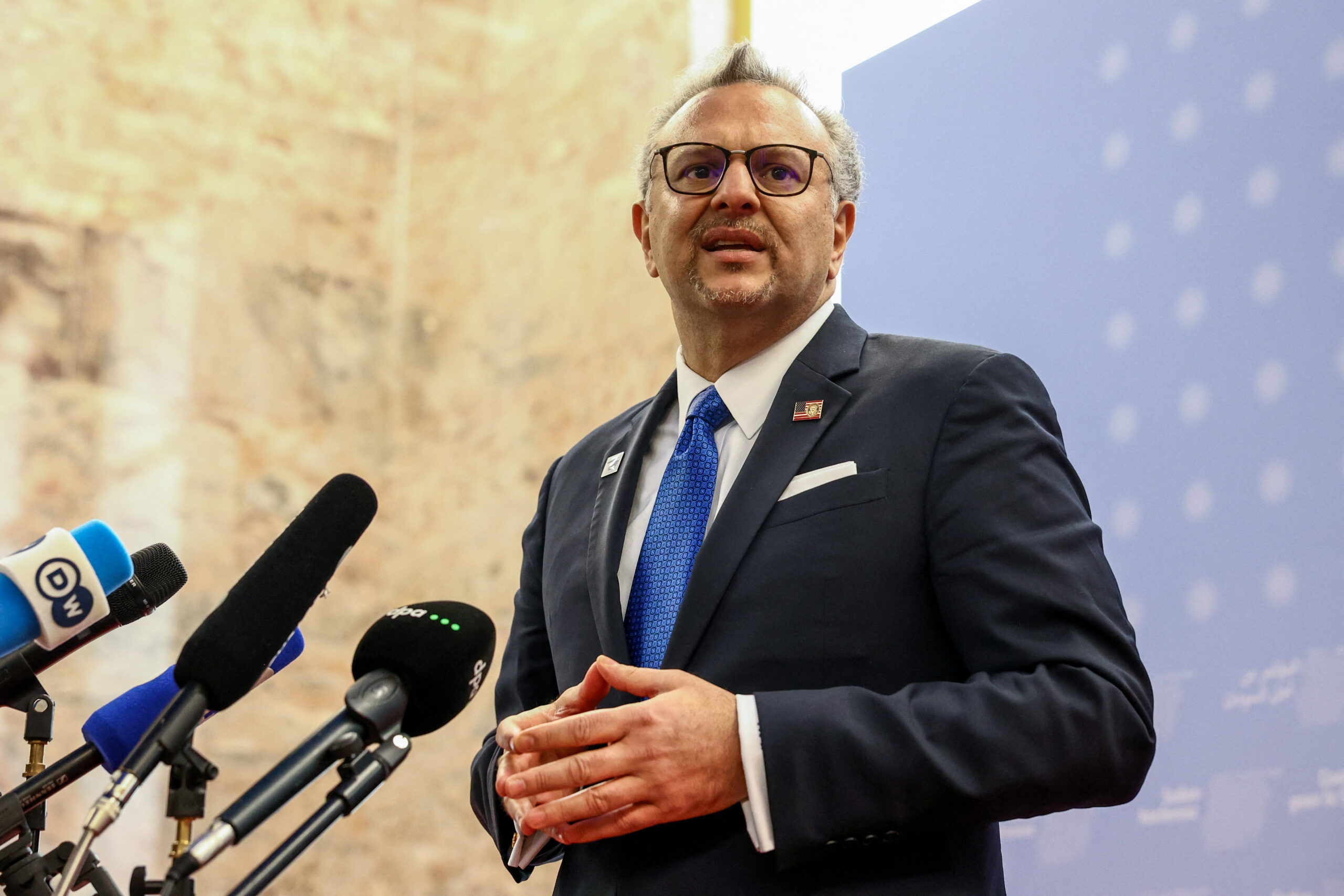
Even as it continues negotiations over the Iran war, Washington has also been—somewhat surprisingly—at the forefront of diplomatic efforts to end another, albeit low-intensity, conflict: the one in Libya. As noted by Frederic Wehrey and Jalel Harchaoui, US involvement in Libya has long oscillated between neglect and fleeting moments of attention for decades, but the second Trump administration has shown a strong interest in the oil-rich country. Yet this renewed activism is less the result of a coherent institutional strategy than of the initiative of one individual: Massad Boulos, US President Donald Trump’s senior advisor for Arab and African affairs.
Indeed, Trump himself—alongside major figures within his administration from Secretary of State Marco Rubio to Vice President JD Vance, Secretary of War Pete Hegseth, and Secretary of Energy Chris Wright—has shown limited direct engagement with the Libyan dossier. Paradoxically, Libya’s relatively low strategic priority within the administration created the conditions for Boulos to operate with a degree of autonomy rarely seen on other foreign policy matters.
Since July 2025, Boulos has increasingly focused on Libya after achieving early diplomatic successes in the Great Lakes region, particularly between the Democratic Republic of the Congo and Rwanda. As his momentum elsewhere began to stall, especially on Sudan, Libya emerged as a possible arena in which a tangible diplomatic success could still be achieved. This activism also aligned with the broader economy-first logic of the Trump administration, especially toward resource-rich countries seen primarily through the lens of energy, infrastructure, and investment opportunities.
But by essentially brokering a power-sharing agreement among entrenched interests, Boulos’s initiative—if it comes to pass—will not solve Libya’s deeper problems.
Geopolitical shifts
Shifting international dynamics have added to the momentum behind this initiative. By late 2025, many outside countries traditionally involved in Libya were displaying signs of political fatigue. Turkey, after years as the principal military and political patron of Tripoli, cautiously began reaching out to the Haftar family, which leads the rival eastern faction. Ankara’s calculations were driven both by Turkey’s desire for Libya’s eastern authorities to also recognize the 2019 maritime memorandum signed with the former Government of National Accord, and by broader economic interests tied to Turkish business expansion in Libya.
At the same time, regional geopolitical alignments were shifting. Divergences between Saudi Arabia and the United Arab Emirates, first visible in Yemen and Sudan and later amplified by the war with Iran, pushed the UAE to have a more cautious approach toward Libya. Egypt also started reassessing its strategy amid concerns regarding warlord Khalifa Haftar’s alleged support for the Rapid Support Forces in Sudan and Cairo’s urgent need for a functioning Libyan economy capable of absorbing Egyptian labor and investments and exporting energy to Egypt.
Even countries historically divided on Libya, such as Italy and France, gradually converged around the need for stabilization, particularly because of migration management and energy security concerns. China and Russia also appeared broadly supportive of this momentum, albeit for different reasons. Beijing is seeking to expand its geoeconomic footprint in Libya, while Moscow, under pressure from its failures in Ukraine and Mali, increasingly appears at least interested in not spoiling this process. According to Russian Foreign Minister Sergei Lavrov, Russia is ready to assist Libya in “restoring unity and national reconciliation.”
The Boulos roadmap
Against this backdrop, Boulos and other officials have laid out in their public statements a new roadmap structured around four pillars: a unified national budget, the unification of military institutions, the formation of a unified government, and presidential and parliamentary elections within six months of reaching an agreement on a new executive structure.
The approval of Libya’s first unified state budget in more than a decade represented the most visible achievement of this process. The agreement sought to align parallel spending structures, reduce corruption, and allocate additional resources to the National Oil Corporation in order to boost production.
Yet the primary objective behind this initiative remains fundamentally, and immediately, economic. The current US push is aimed less at politically transforming Libya into a democracy than at creating the minimum degree of stability necessary to reopen the country to business and foreign investment, in the expectation that economic stabilization might eventually help stabilize the Libyan polity as well.
The growing activity between Washington and Tripoli illustrates this logic clearly. Delegations from the Tripoli-based government have met officials from the US Treasury Department, the Department of Energy, and the US Geological Survey to discuss financial reforms, strategic minerals, and energy cooperation. Major American companies, including Chevron and Boeing, have also signed agreements with Libyan entities.
However, the reality on the ground remains far more complicated. Despite recent optimism, Libya’s business environment is still deeply fragile with no easy solution in sight. Foreign companies continue to face severe structural obstacles linked to widespread corruption, international payments, customs procedures, contractual uncertainty, and legal insecurity. Persistent difficulties often force businesses to rely on indirect financial channels and triangulated transactions through outside countries, increasing costs and risks alike.
These dynamics suggest that institutional agreements alone are insufficient to stabilize Libya’s economic environment. More importantly, they reveal the limits of the broader political logic underpinning the Boulos initiative.
The problem with “familistic consociationalism”
The roadmap promoted by Boulos is ultimately based on what could be described as a form of “familistic consociationalism”: a power-sharing arrangement centered on formalizing existing political, military, and family networks. According to this logic, stability can be achieved by institutionalizing the current balance of power between those who are currently dominant actors in the two Libyas: the rival camps of Haftar and Prime Minister Abdulhamid Dbeibah.
Yet this assumption appears dangerously simplistic. Libya’s recent history suggests that elite bargains and transactional arrangements have often deepened corruption and fragmentation rather than reduced them. The worsening socio-economic conditions experienced by ordinary Libyans are themselves partially the product of earlier agreements between rival elites over institutions such as the National Oil Corporation and the Central Bank.
Moreover, widespread opposition to this roadmap has already emerged within the country, particularly in western Libya and especially in Misrata, Dbeibah’s hometown. Once considered a symbol of post-revolutionary unity after the overthrow of Muammar al-Qaddafi, Misrata is increasingly fragmented between pro- and anti-Dbeibah factions. Many political and security leaders in western Libya reject both the idea of sharing power with the Haftars and the broader logic of externally brokered settlements.
At the same time, internal tensions are also emerging within the Haftar camp itself. Rumors and reports from eastern Libya suggest growing dissatisfaction among some of Khalifa Haftar’s sons regarding the concentration of power in the hands of Saddam Haftar, the youngest son. These dynamics reveal the core weakness of the entire project: it assumes that family and clan structures are naturally cohesive and capable of guaranteeing long-term stability.
A well-known Arabic expression captures the reality: al-aqārib ʿaqārib—“relatives are scorpions.” Rivalry, mistrust, and toxic competition often emerge within family networks, especially when power and wealth are involved. Once Khalifa Haftar, the family patriarch who is eighty-two years old, is no longer present, it is far from certain that cohesion within his family will survive intact. The same applies to the Dbeibah camp, where Ibrahim—Abdulhamid Dbeibah’s nephew and a figure expected to play a central role in the new political arrangement—may ultimately lack the authority, charisma, and political acumen necessary to maintain cohesion within the broader network.
In the short term, the Boulos initiative may succeed in reducing tensions and creating a slightly more predictable environment for foreign businesses, although a structural transformation of the Libyan business environment remains a chimera. However, the idea that a familistic consociational agreement can first stabilize Libya’s economy and, on that basis, stabilize the Libyan polity appears, at best, overly ambitious and unlikely to resolve Libya’s deeper structural crisis. Without broader legitimacy, institutional accountability, and a genuinely inclusive political process, the current roadmap risks becoming not a durable solution to Libya’s fragmentation, but merely its latest temporary management mechanism.
Karim Mezran is the director of the North Africa Initiative and a resident senior fellow with the Rafik Hariri Center and Middle East Programs at the Atlantic Council.
Further reading
Three lessons from Libya for the war in Iran
Any outside power using force to attain a political outcome must define the end state it seeks, align coalition partners around a shared strategy, and establish credible escalation controls.
Image: US Senior Advisor for Arab and African Affairs Massad Fares Boulos speaks to the media during the Third International Sudan Conference at the Foreign Ministry in Berlin, Germany, April 15, 2026. REUTERS/Liesa Johannssen
Comments
No comments yet. Be the first.
Sign in to leave a comment.