Netanyahu’s aid phaseout pitch reflects fears of weakening US support for Israel
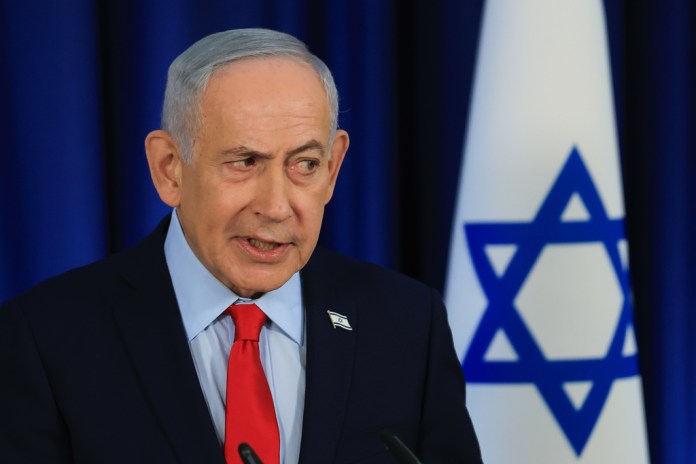
The article centers Netanyahu's strategic repositioning and quotes a former Obama diplomat to explain the geopolitical logic, treating the aid relationship as a pragmatic recalibration rather than a moral or ideological question. Language is measured and procedurally focused (explaining Arms Export Control Act mechanics, congressional holds, financing programs), avoiding charged characterizations of either Israeli policy or U.S. scrutiny.
Primary voices: elected official, state or recognized government, academic or expert
- This article does not address Palestinian or Arab perspectives on U.S. military aid to Israel.
- This article does not discuss humanitarian or civilian casualty figures from Gaza in detail.
- This article does not include voices from Democratic or progressive lawmakers who have called for conditioning aid.
- This article does not examine the financial or economic impact of aid shifts on Israel's defense budget or economy.
Framing may shift if Congress renegotiates the 2028 aid agreement, if Democratic control of Congress changes, or if regional escalation alters the political calculus for U.S. support.
Government-sourcedEstablishment framingBoth-sides framing
Prime Minister Benjamin Netanyahu is preparing Israel for a future in which U.S. military aid is no longer politically untouchable in Washington, signaling the country may eventually shift toward a more transactional weapons-purchase relationship with the United States.
In a 60 Minutes interview that aired Sunday, Netanyahu said he hopes to draw down American military assistance to zero over the next decade, arguing Israel should transition “from aid to partnership.”
“We’ve come of age,” Netanyahu said, adding that Israel should “wean” itself off the remaining U.S. assistance.
The remarks come as Israel faces intensifying political scrutiny in the U.S. following the war in Gaza, growing Democratic criticism over civilian casualties, and rising skepticism about foreign intervention among parts of the Republican Party’s America First wing.
Israel currently receives roughly $3.8 billion annually in U.S. military assistance under a 10-year agreement negotiated during the Obama administration that expires in 2028. According to the Congressional Research Service, Israel has received more U.S. foreign aid than any country since World War II.
Brett Bruen, a former Obama administration diplomat, said Netanyahu’s comments suggest Israeli leadership increasingly believes the current political structure underpinning U.S. military aid may not be sustainable long term.
“I think Netanyahu is a realist and understands the extent to which he has burned bridges, particularly on Capitol Hill,” Bruen told the Washington Examiner. “It’s going to become increasingly difficult for Democrats as well as Republicans to back the current relationship and subsidies for Israel’s military campaigns.”
Bruen said Netanyahu appears to be recalibrating the alliance toward a more conventional buyer-seller defense relationship in hopes of reducing some of the political backlash tied to direct U.S. aid.
But he argued that changing the structure of the relationship would not eliminate political scrutiny.
“Support for Israel’s military has become political kryptonite here in Washington,” Bruen said.
Under the current system, Congress appropriates military assistance for Israel through foreign military financing programs, making it difficult politically and procedurally for administrations to halt weapons transfers once funding has already been approved.
That dynamic became a major point of contention during the Biden administration, when delays to certain weapons shipments triggered fierce backlash because the aid had already been appropriated by Congress.
Bruen said a system based more heavily on direct weapons purchases rather than foreign military financing could give presidents greater flexibility over approving or delaying transfers, particularly if Democrats regain power in Congress.
“Putting it on a path that sits outside of foreign military assistance offers more independence,” Bruen said, though he added that Congress would still retain oversight authority over arms sales.
Under the 1976 Arms Export Control Act, presidents must notify Congress 15 to 30 days before finalizing weapons sales totaling more than $14 million for equipment and $50 million for defense systems. The law specifies chairmen and ranking members of the House Foreign Affairs Committee and the Senate Foreign Relations Committee sign off on weapon sales. Any of the four lawmakers can put a hold on a sale and thereby delay it.
While often informal, the hold system has been honored by both Republican and Democratic presidents and can amount to an informal veto. Presidents can blow through holds by citing emergency authority, like Secretary Marco Rubio did in March to sell weapons to the United Arab Emirates, Jordan, and Kuwait during the Iran war.
Critics of moving away from direct aid argue the shift could ultimately weaken Israel’s political position in Washington by replacing long-term congressional commitments with a system increasingly dependent on the preferences of whichever administration occupies the White House.
Israeli analysts say Netanyahu’s comments do not signal that Israel intends to stop purchasing American weapons systems or scale back military cooperation with Washington.
Avishay Ben Sasson-Gordis, a senior researcher at the Institute for National Security Studies at Tel Aviv University, said much of the debate surrounding U.S. aid to Israel oversimplifies how the assistance actually works.
Most of the funding, he noted, must be spent on American-made defense products, meaning much of the money ultimately flows back into U.S. defense companies and manufacturing jobs.
“This is mostly, you can think about it as vouchers that Israel can spend in the U.S.,” Ben Sasson-Gordis said.
He also argued the security relationship has historically benefited both countries because Israel’s battlefield use of American systems helps refine and improve military technologies later used by the U.S.
Israel, he said, is not envisioning a future where it stops buying weapons from companies such as Lockheed Martin, Boeing, and Northrop Grumman.
“The question isn’t whether Israel does or doesn’t buy American arms,” Ben Sasson-Gordis said. “It’s about what is the form of reciprocity or payment that goes into it.”
Still, he acknowledged Israeli officials increasingly believe the political environment in the U.S. is shifting in ways that could threaten the long-term future of direct aid.
“The public opinion and political underpinnings of a relationship that we have come to take for granted over the last three decades are shifting,” he said.
Ben Sasson-Gordis said Israeli concerns are no longer limited to progressive criticism from Democrats. Increasingly, he said, Israeli officials are also paying attention to declining support among younger Republicans and factions aligned with the America First movement.
Recent polling from the Pew Research Center found growing negative views of Israel among younger Republicans, trends that Israeli analysts increasingly view as warning signs for the future of the alliance.
He said Netanyahu likely believes Israel should begin preparing now for a future in which direct American assistance gradually declines, rather than waiting for a sharper political rupture later.
“The idea for some time has been that maybe toward Israel’s hundredth year in 2048, Israel will entirely shift into a more reciprocal relationship,” he said, describing a model centered on industrial, research, and defense partnerships rather than direct financial assistance.
Despite the discussion around reducing aid, Netanyahu also emphasized during the 60 Minutes interview that he expects military cooperation between Washington and Jerusalem to remain close. The prime minister said he hopes to expand joint projects involving missile defense, intelligence-sharing, and weapons development, arguing Israel has become a global leader in military technology.
Earlier this year, the U.S. approved roughly $6.7 billion in arms sales to Israel, including Apache attack helicopters and other military equipment. Both Bruen and Ben Sasson-Gordis said the debate over aid ultimately reflects broader uncertainty about the future trajectory of the U.S.-Israel relationship itself.
“There are going to be demands from key politicians and pundits in the next few months for a recalibration in our relations with Israel,” Bruen said.
Ben Sasson-Gordis said many Israelis still hope the alliance can evolve without fundamentally weakening.
“It would be a shame to move to a world where we’ve gone from having this close relationship to having none at all,” he said. “The challenge for all of us is to think about how we get past the differences to a point where that special relationship can take on a new form.”
Comments
No comments yet. Be the first.
Sign in to leave a comment.