In Rejecting God, Leftism Renders Us Less Human
This article is a book review promoting Carl Trueman's theological-conservative thesis that rejects secularism and progressive social movements as inherently dehumanizing. The framing relies heavily on Trueman's authority as a theologian-philosopher while employing charged language (equating LGBT activism, BLM, and support for Hamas/Hezbollah as unified "desecration"). Word choice like "cultural pathology" and "ecstatic destruction" carries strong normative judgment.
Primary voices: academic or expert, media outlet
- This article does not address secular or progressive ethical frameworks that might justify boundary-transgression as liberation rather than pathology
- This article does not include perspectives from LGBTQ+ scholars, BLM organizers, or others grouped under 'desecration' who might contest the framing
- This article does not distinguish between Hamas/Hezbollah (violent actors) and LGBT/BLM activism (civil rights movements) or justify their conflation
As cultural and political debates around gender identity, sexuality, and religious authority continue to shift, this framing may become more or less resonant depending on policy developments and publi
Think-tank-citedEstablishment framingCharged language
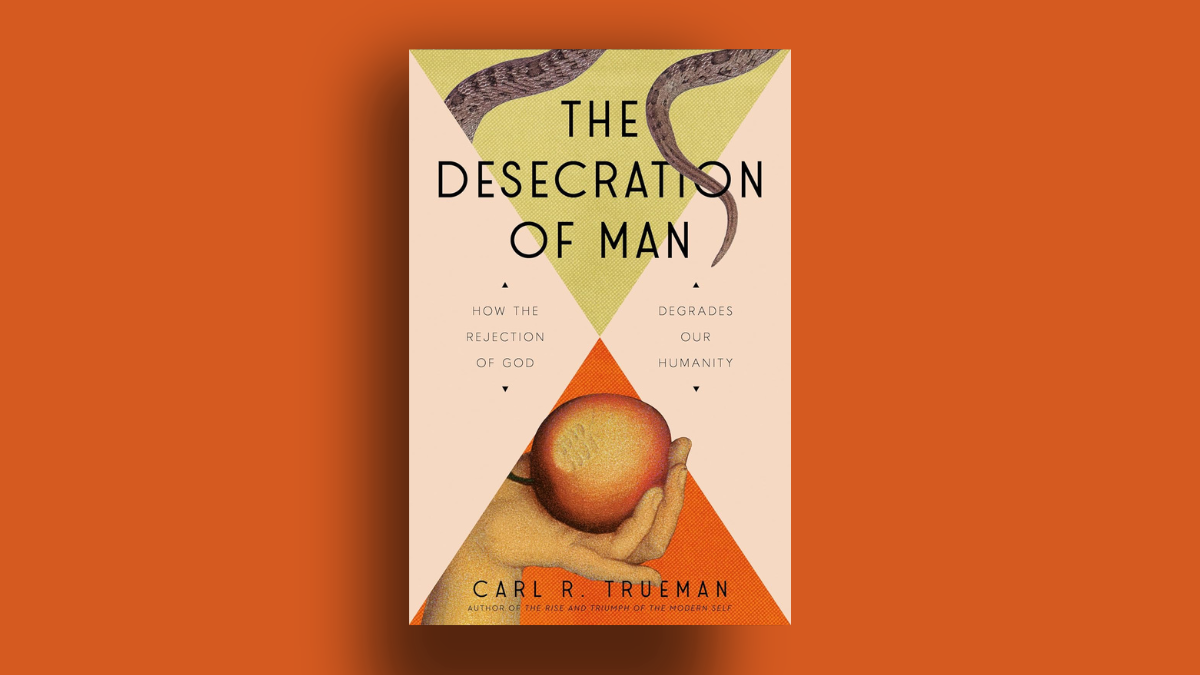
What unites queer theorists, LGBT radicals, BLM activists, and supporters of terrorist groups such as Hamas and Hezbollah? It’s an oddly relevant question, given that these seemingly disparate groups have in recent times served as strange bedfellows. According to theologian and popular philosopher Carl R. Trueman, the answer can be summarized in one word: desecration. All of those disparate groups, writes Trueman in his excellent new book, The Desecration of Man: How the Rejection of God Degrades our Humanity, share “the desire to overthrow what is and to demolish what previous generations considered authoritative, even sacred,” whether that be political, cultural, or religious.
“Our world is not characterized by a disillusioned indifference to values originally grounded in religious faith,” writes Trueman. “Rather, it often seems to revel in an ecstatic destruction of all that was once considered sacred.” Our contemporary culture “glories in transgression, and transgression is exhilarating.” Desecration, per Trueman, is “the denial of sacred boundaries, the profanation of all that is holy.” It is a “cultural pathology” that gives us a sense of being god-like, “the creators of our own meanings and our own selves.” In a biblical context, it is the sin of Adam.
As he summarizes in an excellent introduction that tells the reader precisely what he plans to argue, Trueman charts this desecration across seven chapters that cover, among other things, sexuality, artificial reproduction, and death. Those familiar with Trueman’s insightful analysis — which always exhibits an admirable respect for his intellectual adversaries — will not be disappointed.
Desecration in Action
What is man? It’s a question every civilization must answer. Our increasingly post-religious one, Trueman observes, implicitly answers this way: “the one who transgresses what was formerly considered sacred and thereby demonstrates his own godlike status.” This stems, he believes, from the realization of Nietzsche’s “hour of the madman” as described in The Gay Science, in which a prophet of sorts announces that God is dead. After more than a century defined by the residue of Christianity, that hour has arrived, and the result is that modern man sees himself as a god, an expressive, individualistic self-creator.
Trueman identifies three forms of this self-creation defined by desecration. These include eliminating human exceptionalism by defining humans as merely animals; treating humans as things or objects; and creating our own ends in an absolute and final way. Two metanarratives underlie this iconoclastic “social imaginary,” a phrase Trueman borrows from the philosopher Charles Taylor: “liquefaction of the world via changes in technology, and the move inward to find the authentic self.” Yet far from empowering us, our transgression of boundaries once considered sacred in order to realize freedom and autonomy reduces and desecrates us.
Consider, for example, the sexual revolution, which posits that destroying sexual codes of behavior results in our liberation. Trueman observes that sex used to be a public concern, with social disapproval of those having children out of wedlock or engaging in certain sexual behaviors, such as homosexuality. Sex is still a public concern, but now in the sense of self-expression and individual rights. As sex shifted from something we do to something we are, society has necessarily come to accept whatever someone says about his sexual identity, because it is a core component of the very self. Drag, meanwhile, is an art of desecration of all that once defined cultural mores about sex. Pornography, too, both objectifies and desecrates, as demonstrated in its tendency toward progressively pushing every social boundary.
Yet in practice, the sexual revolution has turned us into objects, things that exist for the sexual pleasure of other people. “When sex is about what we can get out of it, then the other person is instrumentalized,” writes Trueman. In one sense, we still inchoately understand this, given our cultural aversion towards rape as something that uniquely represents an attack on the human person’s dignity, one categorically different from, say, unwanted hugging or tickling.
We can perceive another example of desecration in how technology has changed the way we understand the creation of new life. Technology such as IVF, says Trueman, “has transformed a mysterious creative event, normally grounded in the context of a deep, ongoing relational unity, into something that is a question of technique, formally separable from any kind of relationship beyond that of the union of raw materials.” Surrogacy, in turn, downgrades a woman to a “service provider.” As some feminists are recognizing, once women are separated from pregnancy and gestation because they are viewed as only accidentally related to the concept of being female, it becomes much harder to answer the question of “what is a woman?”
A Powerful, if Incomplete Discussion
Those hoping for the rhetorical brilliance typically found in Trueman’s writings will not be disappointed. “Can the term ‘dehumanized’ even have a meaning if human nature itself is an abstraction, an empty cipher, or the net result of technology?” he poignantly observes. Elsewhere, he asks: “Once the individual artist becomes the center of attention, and transgression becomes the hallmark of the artist, what kind of art will emerge?” I think we all know the answer: increasingly banal forms of art that try to “out-transgress” what came before.
For those familiar with his work, Trueman’s solution is not surprising. “The answer is consecration,” he declares. “But consecration, like the desecration to which it needs to respond, has a specific shape. Only by the true consecration of man can his desecration be overcome. And that requires a return not simply to the alleged cultural benefits of Christian belief and practice but to actual Christian belief and practice.” This, unfortunately, is where the author leaves the reader unsatisfied.
Early in The Desecration of Man, Trueman, refers to something he calls “orthodox Christian traditions.” But what, exactly, are these? Toward the end of the book, Trueman urges readers to consider such early creeds as the Apostles’ or Nicene Creeds: “The Apostles’ Creed may be brief, but it captures rather beautifully the essential claims of the Christian faith.” Of course, such creeds were hotly debated in the early church and are far from accepted among self-identifying Christians today. So why accept them? Trueman offers no answer.
Similarly, Trueman urges readers to consider “the church as a worshipping community.” But which church? Presumably, there is some lowest-common-denominator version of Christianity that Trueman views as acceptable and representative of true Christianity, but what is it, and on what grounds should the reader accept it rather than some other definition? Trueman argues that the antidote to contemporary nihilism is a church, a creed, and a code — but which ones, and why? Presumably, his own Orthodox Presbyterianism is better than Mormonism, and Catholicism better than Unitarianism or Jehovah’s Witnesses. But again, why?
Trueman, who is arguably the most perceptive and important Protestant thinker in America today, has offered us a valuable critique of our contemporary distemper, one that even (rightly, if provocatively) takes issue with those thinkers such as Richard Dawkins and Roger Scruton who praise a certain “cultural Christianity.” Those who seek to “maintain the perceived cultural benefits of Christianity without a commitment to the creed, the dogmas of the faith,” Trueman writes, are still “guilty of nihilism as Nietzsche defines it.” Such persons seem to think, incoherently, that one can preserve a Christian-informed civilization without Christ.
Undoubtedly, Trueman has effectively diagnosed the problem. Yet, the reader is left to wonder, has Trueman presented a solution that will persuade anyone not already inclined to agree with him? Those still invigorated by their deluded idolatrous worship of the self will likely require a stronger tonic and a more coherent vision of truth, goodness, and beauty before being willing to contemplate a return to Christ.
Casey Chalk is a senior contributor at The Federalist and an editor and columnist at The New Oxford Review. He is a regular contributor at many publications and the author of three books, including the upcoming "Wisdom From the Cross: How Jesus’ Seven Last Words Teach Us How to Live (and Die)" (Sophia Institute Press, 2026).
Comments
No comments yet. Be the first.
Sign in to leave a comment.