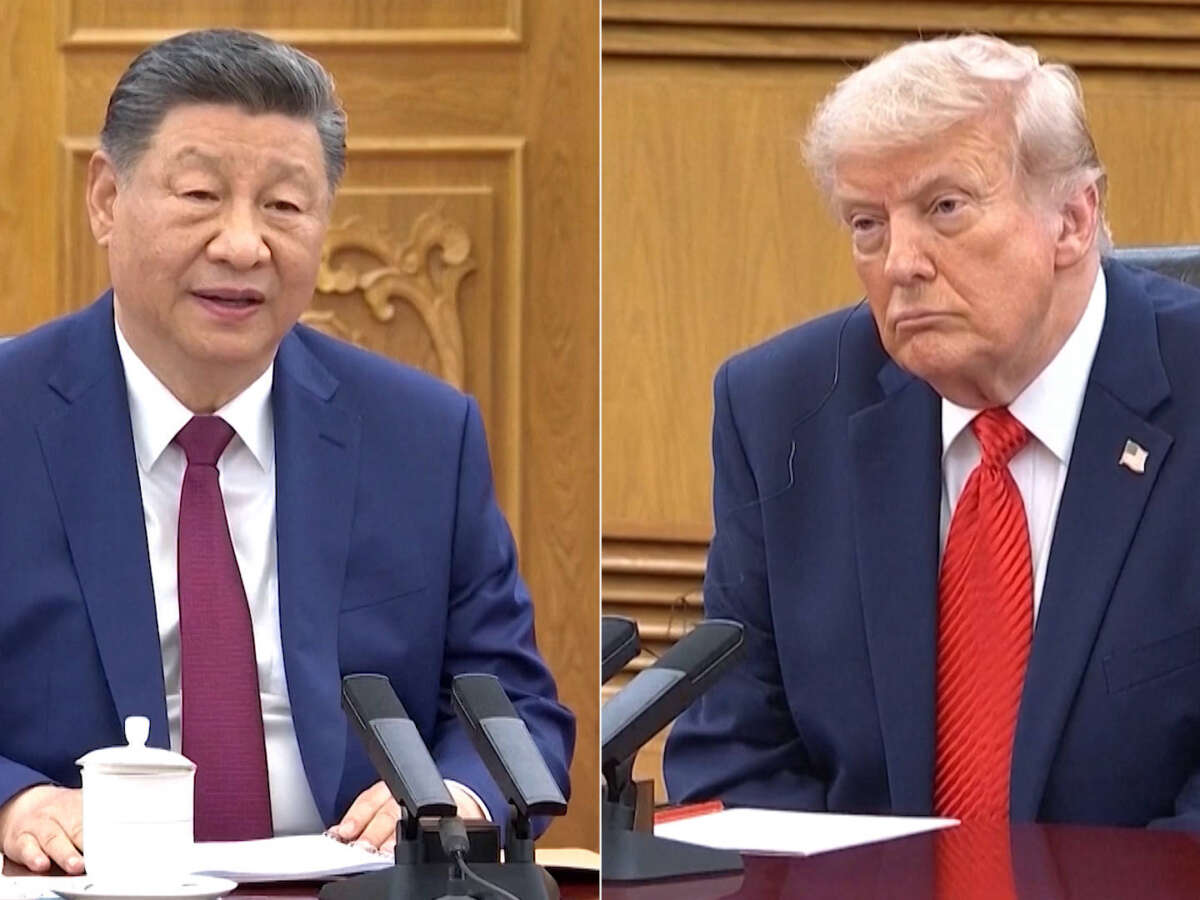
US President Donald Trump is in Beijing for a highly anticipated summit with his Chinese counterpart President Xi Jinping. It is the first U.S. state visit to China since 2017, during Trump’s first administration. Trade, the Iran war, artificial intelligence and the fate of Taiwan are some of the issues being discussed, although it’s not clear if any new agreements are likely. Trump traveled to China with Secretary of State Marco Rubio, Defense Secretary Pete Hegseth and Treasury Secretary Scott Bessent, along with a delegation of top U.S. executives including Apple CEO Tim Cook, Elon Musk of Tesla and Jensen Huang of Nvidia.
The summit comes after years of rising hostility between the two superpowers, but leaders recognize the importance of improving the bilateral relationship, says Zhao Hai, director of international political studies at the Institute of World Economics and Politics in Beijing. “This is a very critical historical moment [at] a crossroad, and both sides now are working together to establish a stable relationship that will have a global ramification,” he says.
We also speak with Jake Werner, a historian of modern China and director of the East Asia Program at the Quincy Institute for Responsible Statecraft. He says the U.S.-Israeli war on Iran and the resulting economic chaos have strengthened China’s position.
“China has ties to all the countries in the region. It has acted in the past to help broker the normalization of relations between Saudi Arabia and Iran,” says Werner. “So it has some experience in this realm, sort of acting as a broker towards peace.”
TRANSCRIPT
NERMEEN SHAIKH: We begin today’s show in Beijing, where Chinese President Xi Jinping and U.S. President Donald Trump are holding a two-day summit focused on the war on Iran, trade, technology and Taiwan. The meeting comes two-and-a-half months after the U.S. and Israel launched an unprovoked war on Iran, triggering what’s been described as the worst energy crisis in history, according to the International Energy Agency. Last week, Iran’s Foreign Minister Abbas Araghchi visited Beijing to meet with his Chinese counterpart. China has repeatedly called for the war on Iran to end and for the Strait of Hormuz to reopen.
AMY GOODMAN: During their meeting, Chinese President Xi Jinping reportedly warned Trump U.S. support of Taiwan could lead to conflict between China and the U.S. China has condemned a proposed U.S. plan to send Taiwan a new arms package worth around $14 billion. Congress approved the arms deal, but Trump has not yet formally moved ahead with it. In public remarks, Xi Jinping called for greater China-U.S. cooperation.
PRESIDENT XI JINPING: [translated] The common interests between China and the United States outweigh our differences, and each country’s success represents an opportunity for the other. A stable China-U.S. relationship benefits the entire world. When we cooperate, both sides benefit. When we confront each other, both sides suffer. We should be partners rather than adversaries, achieving mutual success and common prosperity, thereby forging a correct path for major powers to coexist in the new era.
AMY GOODMAN: In his remarks, President Trump praised the Chinese President Xi Jinping.
PRESIDENT DONALD TRUMP: You and I have known each other now for a long time, in fact, the longest relationship of our two countries that any president and president has had. And that’s, to me, an honor. We’ve had a fantastic relationship. We’ve gotten along. When there were difficulties, we worked it out. I would call you, and you would call me. And whenever we had a problem — people don’t know — whenever we had a problem, we worked that out very quickly. We’re going to have a fantastic future together. Such respect for China, the job you’ve done. You’re a great leader. I say it to everybody. You’re a great leader. Sometimes people don’t like me saying it, but I say it anyway, because it’s true. I only say the truth.
NERMEEN SHAIKH: President Trump traveled to China with Secretary of State Marco Rubio, Defense Secretary Pete Hegseth and Treasury Secretary Scott Bessent, along with a delegation of top U.S. executives, including Apple CEO Tim Cook, Elon Musk of Tesla and Jensen Huang, the CEO of the chip maker Nvidia. Forbes reports the billionaires and President Trump’s entourage have a combined net worth of $870 billion.
AMY GOODMAN: We’re joined right now by two guests. Jake Werner is historian of modern China, director of the East Asian Program at the Quincy Institute for Responsible Statecraft. His new piece for Quincy is headlined “An Opening for a New US-China Economic Relationship.”
Zhao Hai is director of international political studies at the Institute of World Economics and Politics in Beijing, China, opinion writer for the China Daily, frequent commentator for the China Global Television Network, CGTN, and China Radio International.
We welcome you both to Democracy Now! Let’s begin with Zhao Hai. You’re right there in China’s capital, in Beijing, where President Trump and President Xi Jinping have just had their state dinner. Can you talk about the significance of this meeting, the first of an American president in nine years, when President Trump last went there in his first term?
And secondly, to answer your question, I think this is a very important bilateral summit, because we’ve all seen what happened in the last year and also the first Trump administration. China, the United States have been going through trade war, tariff war, all kinds of technology disputes, and also going to a geopolitical confrontation. So, now I think both sides realize, since last year, the Busan Summit, that we need to pursue stability and stable relationship, and this summit is the confirmation of that pursuit.
So, President Trump was scheduled to visit China at the end of March, early April, and because of the war in Iran, he delayed his trip, and China still welcomed him. So, this is a sort of a long time coming, and we have put in a lot of preparation for President Trump’s visit.
And we all see that today the visit was quite successful, and both sides have reached agreement that, looking forward, looking into the future, both sides will build a constructive strategic stability relationship. And that is very much a paradigm shift, from a unilateral defined strategic competition relationship between U.S. and China by the U.S. side. So, I think this is a very critical historical moment as a crossroad, and both sides now are working together to establish a stable relationship that will have a global ramification.
NERMEEN SHAIKH: Well, Zhao Hai, could you also speak about the significance of the Trump delegation including 17 CEOs of the U.S.’s most powerful companies, and the fact, as we mentioned earlier, that the head of Nvidia, Jensen Huang, did join the delegation, though initially he was not expected to? If you could respond to that?
ZHAO HAI: Yeah. You mentioned that the combined worth of those CEOs is like $870 billion U.S. dollars. If you plus Jensen Huang, who jumped on the plane in the last minute, the top with a capital — you know, capitalization of those people probably even higher.
And if you look at these companies, these companies have deep interests in China. They want market access. They want to sell products, agricultural products, airplanes and also chips to China. And also, they want other financial operations, for instance, Masters, Visa card and also Blackstone, BlackRock, both, are all in his team. So, altogether, you can see a landscape in which all these multinational companies have vested interests and want to maintain and expand their interests in China. That’s why they’re coming to China with President Trump. And the summit will send a very strong signal of the future direction of where the two countries are going. And I think those top leaders, the CEOs, wanted to know that firsthand. And we can see that Elon Musk was quite relaxed, and also Jensen Huang would be happy, because now he can sell to 10 Chinese companies with the chips that — you know, particularly modified for Chinese market.
But for China also, we want something in return, which is U.S. to open its market for Chinese access and investment. And hopefully, I think, down the road, two sides will negotiate and try to open up more markets, provide more opportunities and, in particular, create more jobs, you know, for workers in both countries.
NERMEEN SHAIKH: And, Zhao, in fact, Xi Jinping said that China would only make its economy — open its economy wider and wider. And just to go back to Jensen Huang, Nvidia is the largest company, not only in the U.S., but in the world, by market capitalization. Why would he — Jensen Huang is, of course, raised in Taiwan and Taiwanese American. Why wouldn’t he have been automatically included in this delegation?
ZHAO HAI: Well, because we all know what happened before. There was a back-and-forth between U.S. and China. On the one hand, U.S. wanted to impose more, stricter export control, particularly during the Biden administration, and Trump wants to change that policy somewhat and sell some of the modified chips to China, so, on the one hand, they can maintain a certain advantage over China, but at the same time also making money. But it’s very hard to get both, because in the United States, on the issue of national security, there’s a lot of people opposed the export of Nvidia chips, even though it’s sort of a watered-down version of those chips sold to China. Within China, there’s also very strong advocacy for using domestic chips instead of using Americans’, because they suspect there is backdoor of those chips. So, the last minute of Jensen Huang on the airplane means that, finally, both sides find some kind of pragmatic solutions, that China will import some of those chips at the same time the U.S. will open up doors for those exports.
AMY GOODMAN: So, let’s go to Jake Werner, joining us from Quincy Institute. Jake, can you talk about the significance of this meeting in the midst of the U.S.-Israeli war on Iran? You’d hardly know that that was happening if you just watched the toasts at the state dinner. We understand that China is most concerned about what they call the three T’s — trade, technology, Taiwan is major. And Xi Jinping, at this point, Trump needs him. You had the Iranian foreign minister just going to China last week. What does President Trump need from China around the U.S.-Iran war? He put off that first meeting because it was happening. It’s still happening.
JAKE WERNER: Yeah, it’s a big question, what he can get. And I think it might be different, what he needs, from what he wants. Trump has asked publicly that China join other countries in helping him open the strait in the past, has sort of stepped back off of that request, and I don’t think China has any interest in involving itself deeply in security matters in the region. But what China has done is it has backed up some of the negotiations that have been happening, has supported Pakistan, has had the prime mediating role. And China can give Iran a sense that its interests might be respected through the negotiation process, because China has a relationship with all actors in the region. So, as much as the China-Iran relationship is highlighted in the U.S. foreign policy establishment, China’s relationships with other regional countries, like Saudi Arabia or United Arab Emirates, are at least as important. In terms of the economic relationship, they’re significantly more important than those with Iran.
So, China has ties to all the countries in the region. It has acted in the past to help broker the normalizations of relations between Saudi Arabia and Iran. So it has some experience in this realm sort of acting as a broker towards peace. And I think we can — we can hope for China to bolster that role. What we’re not going to get, I think, from China is a sort of one-sided backing of the U.S. position that asks for complete capitulation on the Iranian side. So, I think what we need the U.S. to understand is that it needs to come up with a way to achieve stability in the region, and China can be a part of that, if the U.S. can get to that kind of a settlement.
NERMEEN SHAIKH: And, Jake, what about the fact — I mean, according to the White House, the two sides — that is to say, China and the U.S. — agreed that the Strait of Hormuz must remain open to support the free flow of energy. And at the same time, China said that it’s interested in increasing its oil imports from the U.S.
JAKE WERNER: Yeah, China’s energy policy has been to diversify its import sources for security reasons. So, it still relies significantly on exports through the Strait of Hormuz, and so it does have a very real interest in maintaining the openness of the strait. At the same time, it has sourced oil and other energy imports from an increasing range of places, from Africa, Latin America, increasingly from Russia, as Russia’s markets have closed after it invaded Ukraine. And so, China is looking to diversify.
And if there is a stable relationship with the United States, then it feels like it can draw on American energy. And that would give us a stake, on the part of the United States, in maintaining that stability in the relationship. Ultimately, the overriding concern on the Chinese side is whether there can be a stability in the U.S.-China bilateral relationship. And if the United States is economically invested in that relationship, it becomes more likely.
AMY GOODMAN: Let’s talk more about Taiwan. This is Guo Jiakun, a spokesperson for the Chinese Foreign Ministry, speaking today.
GUO JIAKUN: [translated] In his talks with U.S. President Donald Trump, President Xi Jinping pointed out that the Taiwan question is the most important issue in China-U.S. relations. If it is handled properly, the bilateral relationship will enjoy overall stability; otherwise, the two countries will have clashes, and even conflicts, putting the entire relationship in great jeopardy. Taiwan independence and cross-strait peace are as irreconcilable as fire and water. Maintaining peace and stability across the Taiwan Strait represents the greatest common ground between China and the U.S. The U.S. side must handle the Taiwan issue with the utmost prudence.
AMY GOODMAN: So, Jake Werner, your perspective now on Taiwan? That’s the Chinese Foreign Ministry spokesperson. You have Republicans and Democrats calling on President Trump again to move forward with the multibillion-dollar, $14 billion and more, trade deal with Taiwan. You have the U.S., though, wanting Iran to, in a sense, mediate between the U.S. and Iran — wanting Xi Jinping to do that. Talk about what happens with Taiwan right now.
JAKE WERNER: The question is whether the status quo can be maintained in a stable fashion. And in recent years, as the U.S.-China relationship has deteriorated, both sides have started to doubt whether they can trust the other side on this question, whether the other side respects the status quo and basically wants to maintain this kind of ambiguity over the status of Taiwan. The question is whether, as we stabilize the bilateral relationship, can we get back to a sense that both sides are invested in maintaining that form of stability or not. And so, the big question for Trump, really, is how to manage that. I don’t expect the Trump administration to kind of push towards increasing independence on the part of Taiwan.
It seems like the China-Taiwan relationship is going in a more stable direction in — over the course of recent months, as the opposition lawmaker Cheng Li-wun, the Taiwan opposition leader, came to Beijing and visited with Xi Jinping. So, I think Beijing has some confidence that things are moving in a stabilizing direction. And so, then the question is: Can the improving relationship between the U.S. and China bolster that and give a sense that the ambiguous status quo is not further eroding?
NERMEEN SHAIKH: And, Zhao Hai, to go back to you, just earlier today, a few hours ago, the Kremlin announced that Putin, Russian President Vladimir Putin, would be visiting China very soon. If you could comment on the timing of that announcement and when this summit is expected to take place?
ZHAO HAI: Well, first of all, President Putin is a regular visitor to China. He visits China every year once or twice, or even more. And he has much more face-to-face talking with President Xi than President Xi with President Trump. It’s been 30-some times. So there’s a close tie between the two sides.
And I think this time around, President Putin is coming right after President Trump’s visit. There is some strategic intentions here. I think, other than what we’ve been talking about, the Iran issue, the Ukraine issue will also be in focus, because I think right now both sides need to come back to the negotiation table and try to find more common ground. And for that particular matter, I think President Putin needs to talk with President Xi and also get a picture of how China-U.S. relationship is moving forward.
And I think in this triangle, you can see that, previously, some of the American thinkers thinking that they can drive a wedge between China and Russia. And so far, that hasn’t been realized. China has stand firm with Russia on its normal economic relationship and strategic cooperations. So, I think, for both sides, that’s still a very much important bilateral relationship.
I want to add something to what Jake just said about energy. I think China has a policy of diversifying its energy needs and also accelerating its transition toward green energy. And from Phase One trade deal, China has already agreed to purchase more energy from the United States, not starting from the Strait of Hormuz incident. And China will continue to purchase American energy, if the energy is at a normal price and without, you know, the barrier of more and more trade disputes and added tariffs. So, I think that’s an area in the future should be promising for both sides.
AMY GOODMAN: Zhao Hai, we want to thank you for being with us from Beijing, director of international political studies at the Institute of World Economics and Politics in China’s capital. And we want to thank Jake Werner, director of the East Asia Program at the Quincy Institute for Responsible Statecraft, talking about this China-U.S. summit taking place in Beijing. President Trump just announced that he’s invited Xi Jinping to Washington, D.C., September 24th for a state visit.
Coming up, artist and writer Molly Crabapple, author of the new best-selling book Here Where We Live Is Our Country: The Story of the Jewish Bund. Stay with us.
Media that fights fascism
Truthout is funded almost entirely by readers — that’s why we can speak truth to power and cut against the mainstream narrative. But independent journalists at Truthout face mounting political repression under Trump.
We rely on your support to survive McCarthyist censorship. Please make a tax-deductible one-time or monthly donation.
Comments
No comments yet. Be the first.
Sign in to leave a comment.