Federal gas tax: What it is, and whether Trump’s suspension could help
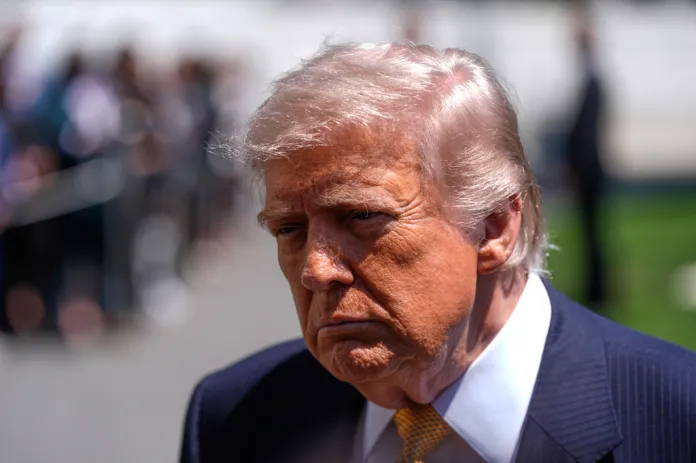
President Donald Trump‘s latest effort to curb soaring gas prices caused by the war in Iran is to call for a suspension of the federal gas tax.
Since the war started in late February, gas prices have risen nearly 50%, with the national average sitting at $4.50 per gallon as of Tuesday.
It is unclear, though, whether suspending the federal gas tax of 18.4 cents per gallon on gas and 24.4 cents per gallon on diesel would bring a meaningful reduction in prices for consumers.
Here’s what to know about the federal gasoline tax.
What is the federal gas tax?
The federal gas tax was first introduced during the Great Depression as part of the Revenue Act of 1932.
The law was enacted by President Herbert Hoover as a temporary 1 cent per gallon tax to help reduce the federal budget deficit. It was scheduled to expire in 1934, but budget issues caused the tax to stay, and it became permanent in 1941.
Today, the tax is 18.4 cents per gallon on gas and 24.4 cents per gallon on diesel. It generates around $36 billion per year, which primarily goes to pay for federal highways and public transit programs.
What did Trump propose?
In the Oval Office on Monday, Trump said he would “reduce” the tax “until it’s appropriate.”
“It’s a small percentage, but it’s still money,” the president said. He later told CBS News that he wants to pause it “for a period of time.”
The president noted that he would phase the tax back in when prices go down. The proposal comes ahead of the summer season when gasoline prices typically peak due to increased travel.
Trump during his 2024 campaign vowed to lower gas prices to below $2 per gallon. The Trump administration has attempted to ease the high prices by reducing regulations, adjusting sanctions, and emphasizing domestic production.
Despite these efforts, gasoline prices remain high.
The Bureau of Labor Statistics updated its consumer price index on Tuesday and revealed that gasoline prices increased by 28.4% over the past 12 months and 5.4% month over month.
Still, Trump could not unilaterally suspend the gasoline tax. Doing so would require an act by Congress.
Has it ever been done before?
Congress has never suspended the federal gas tax.
Former President Joe Biden called for a three-month pause in the federal gas tax in 2022 as prices soared due to Russia’s invasion of Ukraine. But Democrats and Republicans showed little interest in enacting legislation.
However, states have taken matters into their own hands to lower gasoline prices.
In April, Georgia became the first state to suspend its gas tax. It temporarily suspended the state’s $0.333 per gallon tax on regular gas and $0.373 per gallon tax on diesel until May 19. Gov. Brian Kemp (R-GA) has not indicated whether he would suspend the gas tax again.
Other states, such as Indiana, Kentucky, and Utah, have also temporarily suspended the gas tax to curb prices.
Would it work?
The suspension of the federal gas tax would lower prices, but not significantly, with consumers seeing a reduction of only 10 cents to 16 cents per gallon, according to an analysis from the Bipartisan Policy Center.
Instead, producers might reap some of the benefits of the tax suspension. That is, instead of lowering the price by the full amount of the tax, they might reduce it by only a fraction. That’s because demand for gas is “inelastic,” meaning it does not change much in response to price changes. People generally do not reduce their driving as prices rise, and, similarly, do not add trips as prices fall. Many household trips are not discretionary, but rather are drives a family has to make every day, especially if it is to get to work or take children to school. Retailers, then, may not need to cut prices at the pump by the full amount of the suspended tax to keep drivers coming back and filling up.
According to a 2022 report by the University of Pennsylvania, about 80% of the tax burden falls on consumers, resulting in 80% of a tax decrease being passed on to consumers in lower prices in the case of a tax suspension. The report added that gasoline demand would likely increase because of these lower prices.
Is there support in Congress?
Republican leaders in Congress gave a mixed reaction to Trump’s statement.
“I mean, you have to look at any unintended consequences and evaluate all that,” House Speaker Mike Johnson (R-LA) said. “So I’m not yet ready to project it, but I certainly find it to be an intriguing idea.” Senate Majority Leader John Thune (R-SD) noted that he opposed suspending the tax when Biden proposed it, as did most congressional Republicans.
“I’ve not in the past, obviously, been a fan of that idea,” Thune said. “But I know I’ve got some colleagues out there who think it’s a good idea, and so we’ll hear them out.”
“President Trump has proposed to suspend the federal gas tax and he’s exactly right,” Hawley said in a press release. “American workers and families deserve immediate relief and this legislation will do just that.”
The Missouri senator’s bill would suspend the federal tax on gasoline and diesel for 90 days. It would also allow the president to extend the suspension for another 90 days.
Sen. Mike Lee (R-UT) expressed support for Hawley’s proposed legislation suspending the tax. Lee also went further, stating Congress should repeal the federal gas tax and allow states to maintain their highway systems with their own revenue.
“The federal gasoline tax was introduced to build the interstate highway system. That system is now built,” Lee posted on X.
“We should now repeal the federal gasoline tax and let each state maintain its portion of the interstate highway system — with its own revenue — as was the plan from the beginning,” he added.
Comments
No comments yet. Be the first.
Sign in to leave a comment.