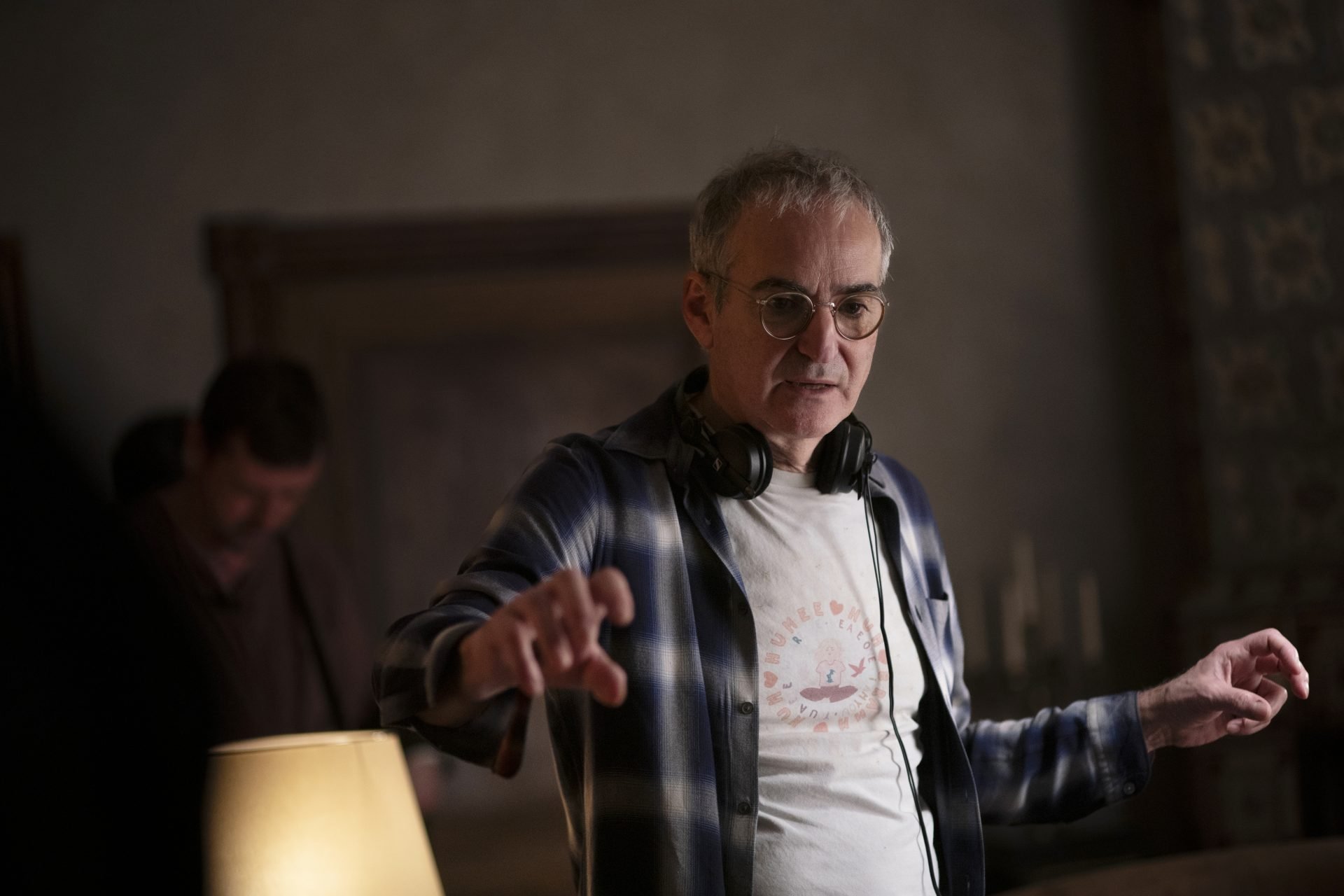
There’s not much room nowadays for movies that are merely pretty good, even—especially—coming from great directors. Olivier Assayas’ CV has fortified his great-director status for so long that it’s sometimes hard to square his brilliance with the films that offer just a bit less than that (and it doesn’t help when one of his pantheon works, the new Irma Vep, wasn’t quite a film). The Wizard of the Kremlin strikes me as a pretty good movie. I also understand why, for others, it wouldn’t: this is a political thriller in name only, walking a strange, frankly precarious line between satirical and serious, breezy and chewy, with a lead performance from Paul Dano that asks we find something in a cipher serving one of the world’s most ruthless leaders. I can sympathize with grievances lodged in our Venice review—one that still found reason to praise Jude Law’s uncanny performance as Vladimir Putin, which dispenses with heavy make-up and theatrical voice work to instead rely on a well-dispensed pout and the tough-guy import of a British accent—all while I reflect fondly on Yorick Le Saux’s chilly approximation of Russian aesthetics.
As is, that review does not reflect what North Americans will see. The Wizard of the Kremlin arrives here 20 minutes shorter than its initial iteration and with another 10 minutes removed since a successful international release. The latter is Assayas’ preferred cut, and when we spoke a couple months ago he was forthright about distaste for the contractual requirement that engendered needless edits. Being one of the few who’s seen both theatrical versions, though, I can’t point to how the film’s changed materially or spiritually.
Neither can Assayas, with whom I talked again on the occasion of Wizard’s U.S. release this Friday. Our many conversations over the better part of 15 years have made him an effortless conversation partner. As our Zoom call began, I noted his poster for Philippe Garrel’s The Inner Scar and bulging shelf of books.
The Film Stage: Is that your home office I’m looking at?
Olivier Assayas: It’s my home office, yeah. That’s where I keep my movie library, which I want to get rid of. It’s just too many books. I mean, it’s going to explode.
I admire and envy it. We spoke a couple months ago and talked a bit about Wizard, which I had just seen, and which I’ve since rewatched in the new, 135-minute cut that’s being released in the US. You were pretty honest expressing unhappiness about cutting 10 minutes for this stateside release. Watching it again a couple months apart, I can’t honestly say I spotted what was missing. I’d love to know what’s been lost.
I think the version that’s being released works. I’m not unhappy with it, to be honest. I thought that, just in terms of pace, there was something that was just a little bit more satisfying with the longer version, but I don’t think there’s honestly any major difference worth discussing. I basically tweaked stuff here and there, which is not that relevant. It’s something that I learned how to do since I made Les Destinées sentimentales. When I made Les Destinées sentimentales, it was three hours and 15 minutes, and I knew I could never sell that to my producer, so I had to cut 15 minutes out of a perfectly satisfying cut. I kind of used every single tool in the box, and I’ve learned to do that, so I know how to trim down a film and make it painless.
But to be perfectly honest: I would have been slightly happier having the one version, the regular version, opening in the States, because honestly it doesn’t genuinely make a difference. I don’t think that the audience who’s ready to watch a two-and-a-half-hour movie about modern Russian politics will be turned off by the slightly longer version. I don’t think that’s the issue; I can’t see a serious issue there.
Watching it again, I keyed in more to the opening scene, which does a great job setting out what this film will be.
It starts in a slightly more conventional way, even if I’m super-happy with the scenes and the shots, but still: it’s not exactly the movie you’re going to see. The movie you’re going to see is just a little bit more thrilling, hopefully—it has more energy, it depicts something that has to do with youthful energy, which is something we don’t see in the early scenes.
In that scene he’s talking about the telephone that they have—a one-way receiver—and he makes the crack about how it’s gray like so many things in Russia. The movie itself seems very true to the drab, oppressive Russian aesthetics, but is still quite texturally pleasing—not stiff or plastic or depressing. I’d like to know a bit about organizing and capturing that in a way that’s authentic, but still of basic visual interest.
Well, I think you need to keep on the side of life. Even if you’re representing a lifeless world—and Soviet Russia was a lifeless world—people have hopes, they have feelings, they have emotions, and ultimately it’s about the way of representing things. Obviously cinema needs some sort of energy, and you need to keep in touch with that energy and not lose touch with that energy. So even if you’re representing the repressive state which wishes to turn its population into zombies, you still have to find a way of making that exciting and interesting. I think modern history… the very notion of life is something that’s necessary. You can’t represent the modern world if you don’t have some sense of spotting where the liveliness of it is located.
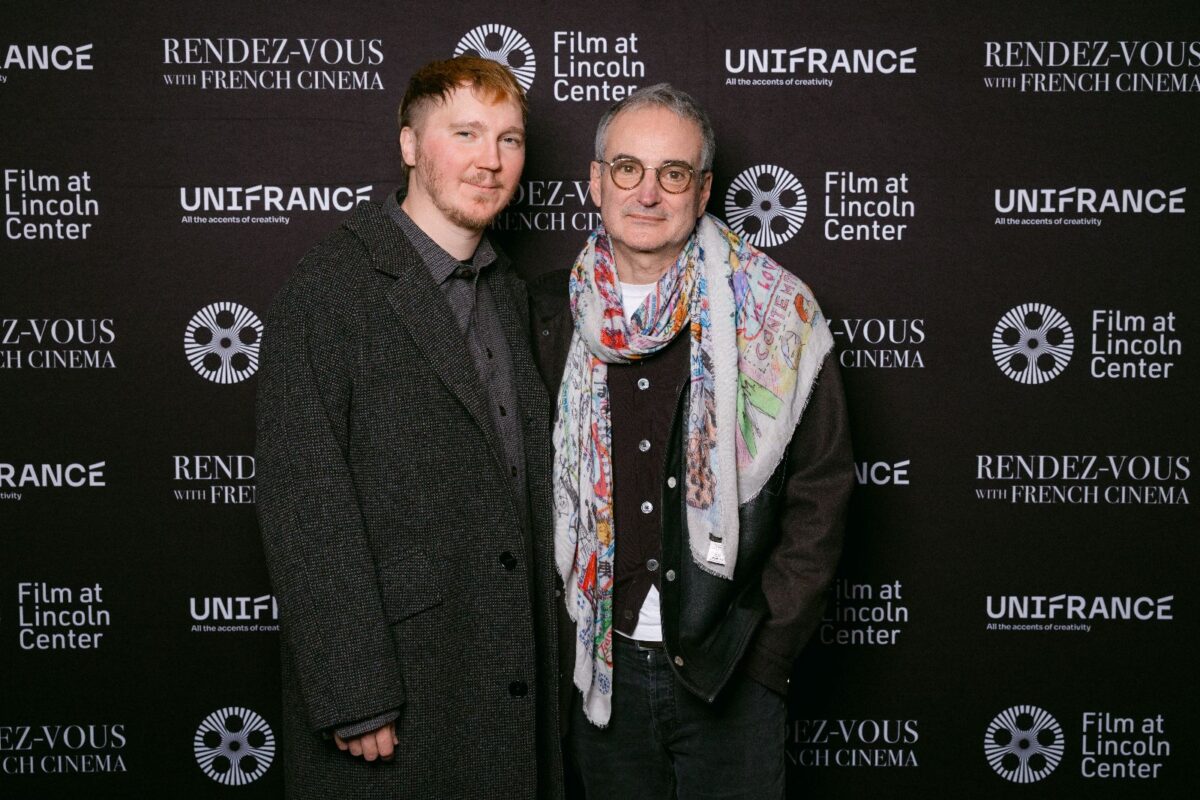
Photo by Arin Sang-urai. Courtesy of Film at Lincoln Center.
Part of what maintains interest and the sense of life is that the film’s so ruthlessly peripatetic, setting-wise. I felt sort of dizzy watching it and thinking about the work that goes into the location-scouting and set-building.
There was really no built set. We couldn’t really afford that. The closest would be the Putin office, but it’s not on a stage studio; we redecorated a big hall. That’s the closest to something we’ve built. Otherwise we didn’t really have the budget for that. And also, you get a sense of kaleidoscopic movement, of changing from one set to the other. That’s not exactly how we felt when we were making the film, because we were shooting everything in Latvia, which is not a big country. It’s a pretty small country, so we really tried to erase the sense of claustrophobia we had—would be a more correct way to phrase it.
It doesn’t feel claustrophobic as a film, even when the rooms themselves are tight—because it’s so often a new room, a new person, a new conversation. Obviously you’ve made films like Carlos, which are extremely long and globe-spanning, or the Irma Vep miniseries, which is more contained but even longer. While you’re not a stranger to ambitious productions, I wonder if, as you’re writing the script and you type “INT. Putin’s office,” then “INT. Vadim’s office”—spaces we might see only once—if there’s sometimes the sense of: “I am giving myself more work, I am not making it easy on myself.”
I think it came with Carlos. It’s something that dawned on me when I was shooting the scenes with Wadie Haddad in Carlos because, you know, I realized: if I can make—if I can imagine—how Wadie Haddad speaks and thinks and his worldview, I can do anything. [Laughs] Really because, the further from me and from my own experience—it just doesn’t exist. Creating a believable Wadie Haddad and having him speak with Carlos and have a conversation and make it believable, to me, opened wide the doors to doing very daring things. Obviously when I’m making Wizard of the Kremlin using real-life characters, using real-life situations, I am just a little bit less shy than I was when I was making Carlos. I mean, I’m much more confident. Much more confident because I know it does work.
It does work. The issue, the main issue, is: is it actually representing real life or does it bring something more universal to the narrative? My hope— and I’m crossing my fingers—is that it brings more reality, in a certain way. Meaning: something more reality, something more universal. The same way as Wadie Haddad is not really Wadie Haddad. I mean, he’s a character I reinvented here; I’m reinventing the character based on real-life facts.
Vadim is a great cipher. As far as Wizard’s sense of the real world and reality, there is a funny bit of unreality to it too, because you have him as a young man, albeit played by Paul Dano, who is also playing him quarter-century later. I found it very amusing, in a positive sense. Were you excited at all by that kind of unreality of Dano playing him when he’s 20, and also playing him when he’s middle-aged?
Yeah. [Pause] I’ve done that before. I’ve done that before. Again, mostly when I was making Les Destinées sentimentales, where we used a lot of prosthetics, make-up techniques, whatever to show aging, to emphasize the aging and make the aging believable—giving the notion of time passing. I thought it was important when I was making Les Destinées sentimentales—and I was very happy with the way we dealt with it; I think it functioned perfectly well—but at the same time, to be honest, I think it’s a convention. I don’t think that Paul changes that much between a young man and a middle-aged, retired politician. To me, it works because I don’t think that the focus is there. I mean, that’s not what I’m watching and that’s not what I have in mind.
When I was making Les Destinées sentimentales, I had in mind the notion that you must have a sense of time passing, of people changing, physically changing. When I’m making Wizard of the Kremlin, I don’t care that much anymore. That’s not vital; that’s not essential. I think it’s more interesting to capture universality. I’m not interested in having time passing. What I’m looking for is how, ultimately, we don’t change—time passes and we don’t change that much.
Which is something that I kind of learned from Bergman. It’s something when I did this book of interviews with him and I remember him explaining that he still was the same person—I mean, as the kid playing with his toy stage and with cut-out paper, cut-out characters, and feeling perfectly happy doing that. When he’s doing it in real life—even as an old man—he feels he’s the same person. So I don’t think it relates that much to Baranov, but yes: in a certain way it’s just… again, the important thing is to capture the essential, to be focused on the essential, on the vital, and try to have the lightest possible touch dealing with what’s secondary.
As a young man you were a Cahiers critic, you were a painter, you wrote films for André Téchiné and Laurent Perrin. Here you are now, in your office, some decades later. Do you still feel like that same person, the way Bergman felt like the kid playing with the stage?
Oh, yes. Yes. But the thing is: I think you always have to reconnect with the teenager you’ve been. I think it’s wrong to be… I mean, I’ve never really wanted to be a serious adult. I think I stopped evolving when I was a teenager or something like that. [Laughs] I think I’ve tried—through everything I’ve done and in every single possible situation—I kind of protected the childhood, the teenagehood in me. I think it’s what gives you a certain distance from things and a certain humor, also. None of this is completely serious.
Making movies should be a pleasure, it should be a game, it should be a trip, it should be many things. I mean, when I was growing up, my father was a screenwriter and he would have his friends visit us at home and I met all of the classic French filmmakers of that of that generation and they were, like, really serious with their tweed jackets and pipe-smoking, whatever. [Laughs] It never was a blueprint for what I wanted to do. I mean, you know, when I grow up and I can make movies, I will not make that kind of movie. Filmmaking will be closer to rock and roll than to whatever they were doing, even if I respected them and loved them.
Maybe that explains why I’ve never been bored of your films.
You know, I’ve never considered myself a filmmaker. I’m an individual who makes films. It’s a huge difference.
But the old Sam Fuller quote about how you can’t make a truly anti-war film came to mind a bit with the photographing of military equipment: helicopters, jeeps, uniforms, guns. There’s still a kind of excitement to it.
Yeah, once in a while this kind of boy-toy thing comes to the surface. That’s the kid within me that likes to play with toys. But it’s more present in Carlos than in Wizard of the Kremlin. Wizard of the Kremlin has more to do with strategy; it’s much more abstract.
I don’t know if you’re much familiar with the works of Hideo Kojima and Metal Gear Solid. That has a terrifying, oppressive military tech that’s also fetishizable.
That answers the question. It’s something one of your Vincent Macaigne analogues might explain to his girlfriend, if that helps. The last time we talked, you said you were about to finish writing a Something in the Air sequel, while a Suspended Time follow-up could happen. But neither will be your next movie. Do you have a sense of what that might be?
Oh, yes. Yes, yes, totally. I wrote, the year before we shot Wizard of the Kremlin, something that’s more in the vein of Personal Shopper.
You know, the movie I keep thinking about—and I don’t think it’s something that I would be able to do or even interested in doing—is Magellan by Lav Diaz. I mean, the film really impressed me. I had seen a couple of his other movies, but this one is something else. And I realized that it has some kind of dreamlike quality, which is something I’ve always been looking for in movies, and I think it’s a very profound and very ambitious and fascinating film. I kind of loved it when I watched it, but now I realize—if I’m trying to think of recent movies that have struck me—I mean: that’s the one.
The Wizard of the Kremlin opens on Friday, May 15.
Comments
No comments yet. Be the first.
Sign in to leave a comment.