Guns, ghosts, and gambits: Trump’s blaming of the Kurds for missing arms
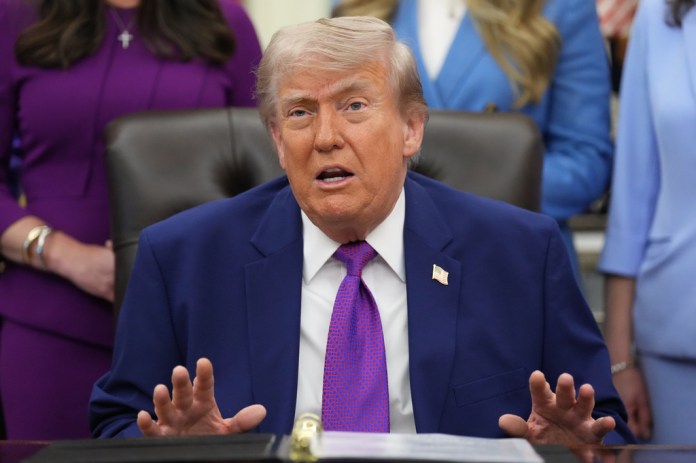
In a characteristically blunt Oval Office assessment on Monday, President Donald Trump described the ceasefire with Iran as being on “massive life support.” However, the most explosive detail of his remarks was not the failing diplomacy, but his repeated frustration regarding an allegedly failed covert operation to arm Iranian protesters.
Trump confirmed once again that the United States had sent “a lot of guns” to Iranian protesters earlier this year, only to claim that Kurdish intermediaries intercepted them, expressing deep disappointment.
The Kurdish caution
Some believe the administration’s frustration stems from more than just “missing” rifles — it reflects a deeper disappointment that Kurdish groups did not commit ground troops to the war against the regime. Interestingly, this contradicts the president’s own earlier rhetoric. In March, after reports suggested Kurdish forces were ready to move across the border, Trump explicitly stated he did not want the Kurds to “get hurt” and ruled out their involvement to avoid making the war “more complex.”
This perceived “about-face” has led some to believe the president is now lashing out because the Kurds, specifically those in Iraq, declined to be foot soldiers in a broader American campaign. For the Iraqi Kurds, the stakes are existential. Unlike the Iranian Kurdish dissidents, who have less to lose, the Kurdistan Regional Government manages a semi-autonomous state, a fragile economy, and a complex relationship with Baghdad. They have far more to lose by entering a hot war with Tehran, and their refusal to act as a proxy force may be the true source of Trump’s public grievances.
The logistics of a ghost operation
Beyond the finger-pointing lies a fundamental question: How does one safely funnel lethal aid into a police state? To do so under cover requires an immense intelligence infrastructure. Yet, the administration has failed to clarify which organizations were entrusted with this task, how they were trained, or how they planned to navigate the right channels. If, in fact, guns were sent, U.S. intelligence maintains the sophisticated capability to track and retrieve them; Americans would know exactly who possesses the hardware and where it is located. The lack of such a recovery effort casts doubt on whether the shipment ever truly existed.
Furthermore, openly discussing the arming of protesters is a dangerous game. For decades, Tehran has delegitimized dissent by branding protesters as “foreign agents.” By claiming the U.S. sent weapons, the administration inadvertently handed the regime a propaganda victory, providing a “justification” for the slaughter of thousands, massacres the president himself estimated at over 30,000 lives. This rhetoric directly feeds the regime’s narrative at a time when dozens of protesters have already been executed and many more remain on death row on false accusations of aiding the “enemy.” To protect the integrity of the movement, the administration’s more diplomatic voices should clarify this confusion and pitch the U.S. position with more political tact.
Strategy or decoy?
Many believe the talk of arming the Kurds was never a genuine humanitarian effort, but rather a strategic decoy or a high-stakes political pressure campaign. This maneuver was likely designed with two goals in mind: either to act as a broader push to force the regime to the negotiation table under extreme duress or to serve as a tactical diversion. By leaking reports of an impending “Kurdish offensive,” the U.S. likely hoped to force the regime to reorient its security forces toward the northwest, thereby creating a critical window for intelligence operations to strike high-value targets or retrieve uranium buried in the center of the country.
If the guns were never intended to reach the protesters, then the “Kurdish theft” narrative is a convenient scapegoat for a plan that was never meant to materialize. It is fundamentally unjust to disparage the Kurds, who have consistently served as the U.S.’s strongest allies and a bastion of freedom and democracy in a volatile landscape. They remain, by far, the most pro-Western people in this hostile region.
The fact that Kurds on both sides of the border deny receiving any arms suggests the transfer was a phantom, serving as a convenient political excuse for a strategy, one that many regional actors had cautioned against from the start, that ultimately failed to produce the desired submission from Tehran.
Sharif Behruz is the managing editor of Kurdistan Agora, the English-language platform for the Tishk Center for Kurdistan Studies, where he also serves as a contributor. A political science graduate from the University of Western Ontario, Behruz has a distinguished career in human rights advocacy and international diplomacy. He has collaborated with various human rights organizations, specifically focusing on the rights of Kurds in Iran, and spent several years representing Kurdish interests in the U.S. and Canada. His work offers a critical vantage point on the intersection of Western foreign policy, decentralization, and the struggle for a federal, democratic Iran.
Comments
No comments yet. Be the first.
Sign in to leave a comment.