Trump moves quietly to counter Chinese pressure on Taiwan
China’s pressure on Taiwan is growing. In addition to naval bullying in the Taiwan Strait, the Chinese government is leveraging its influence over poor countries to apply indirect pressure.
In a recent example, the president of Taiwan, Lai Ching-te, was forced to cancel a scheduled trip to Africa after Beijing pressured three Indian Ocean nations to bar his plane from crossing into their airspace. He could not reach his destination without their overflight permission. Simple, yet effective.
The cancellation is part of a troubling trend. With Washington’s attention focused on the Middle East, Beijing smells an opportunity to put the screws to the democratically governed island.
China explicitly considers Taiwan to be part of its territory and holds a policy of “reunification” with the island. This has only accelerated under Chinese President Xi Jinping and his policy of “national rejuvenation.” As with all communist regimes, “reunification” means “hostile takeover.”
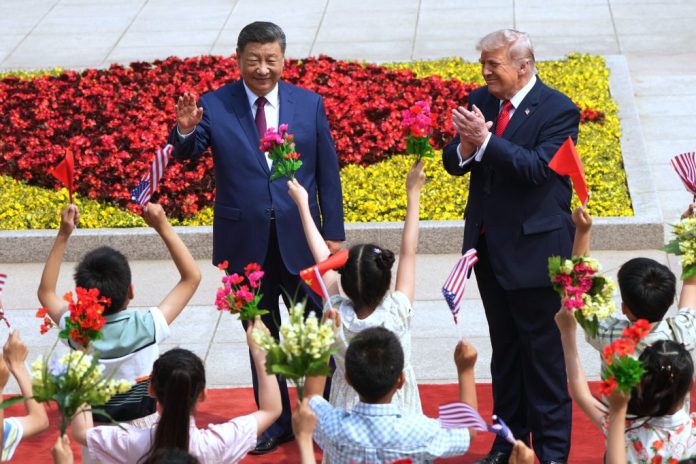
Xi recently welcomed the leader of Taiwan’s opposition party, Cheng Li-wun, to Beijing. Cheng and Xi huddled for hours, even though beforehand Xi had declared that Taiwan was an “inseparable” and “inalienable” part of China.
It was a power play, a finger in the eye of Lai, and a clear effort to weaken Taiwan by exploiting internal political divisions. Cheng’s party had been holding up a badly needed increase in Taiwanese defense spending, likely another reason Xi welcomed her so warmly.
China has also been putting pressure on Japan, a historic friend of Taiwan. Beijing recently sent stealth fighters and attack drones to menace a Japanese destroyer transiting through the Taiwan Strait, and aired the footage on China state TV.
The ship might have gotten off easy. After Japanese Prime Minister Sanae Takaichi suggested that a Chinese blockade of Taiwan could draw a response from Japan, a Chinese diplomat threatened on social media to cut off her “filthy head.”
This pattern of heightened Chinese belligerence spells trouble not just for East Asia but the United States. America acknowledges but does not endorse China’s claims to Taiwan, and maintains diplomatic ambiguity toward this One China policy. In practice, America maintains a “pseudo-embassy” in Taipei, sends military equipment to the island, and has troops there training Taiwanese forces.
The United States also has a close military alliance with Japan and an extensive troop presence and network of bases there. The entire American tech economy, including the data centers that power the AI revolution, depends on semiconductors made in Taiwan. If China were to invade Taiwan, the United States would almost certainly be drawn into the conflict.
South Korea could prove a problem too, because it hosts a significant U.S. troop presence. A Taiwan invasion could see Seoul issue its own military response, come under Chinese attack itself, or fall victim to a North Korean invasion; all three scenarios would draw in the U.S. military.
The situation is fraught with danger, and President Donald Trump has taken an appropriately nuanced approach. He’s talked tough against China while calling for calm and meeting with Xi. He has heaped praise on the kindred spirit Takaichi while reportedly asking her to tone down the rhetoric over Taiwan.
Trump’s approach to Taiwan has emphasized soft power. In addition to diplomacy, earlier this year the president signed a sweeping trade deal with the island that limits or abolishes most tariffs between the two parties.
The agreement will ease Taiwanese economic dependence on China. It also mandates that Taiwanese tech companies make investments in the U.S., especially including building semiconductor factories here.
In the same vein, last year Taiwan tightened restrictions on the Chinese tech giant Huawei, the global leader in 5G and a major player in AI. Shortly afterward, the U.S. approved a merger between Hewlett Packard Enterprise and Juniper Networks, creating a new, globally scaled U.S. competitor to Huawei that can influence markets in East Asia. A senior national security official told Axios that concerns with China were a big reason why the Justice Department allowed the merger to move forward — to “[strengthen] domestic capabilities” and “[counter] Huawei and China.”
What Trump understands is that deterring China from invading Taiwan isn’t just about military might; it’s about diplomacy and market power too. And sometimes it’s about restraint if an ally goes too far.
A Chinese invasion of Taiwan would be disastrous for East Asia and the United States. As China steps up the pressure, Trump is moving to neuter their ability to harm us. He is also taking steps to isolate America from the results of any potential crisis. It’s what he means by putting America first.
Bart Marcois is a retired career diplomat. He was the Principal Deputy Assistant Secretary of Energy for International Affairs and has extensive private-sector experience in commercial intelligence and international business development. He produces daily political and diplomatic analysis at youtube.com/AMinuteWithBart.
Comments
No comments yet. Be the first.
Sign in to leave a comment.