Europe’s Pro-Israel Consensus Is Fraying
Although Israel’s trade partnership with the E.U. has been preserved for now, the relationship between Europe and Israel is destined for citizen-led change, writes Ramzy Baroud.
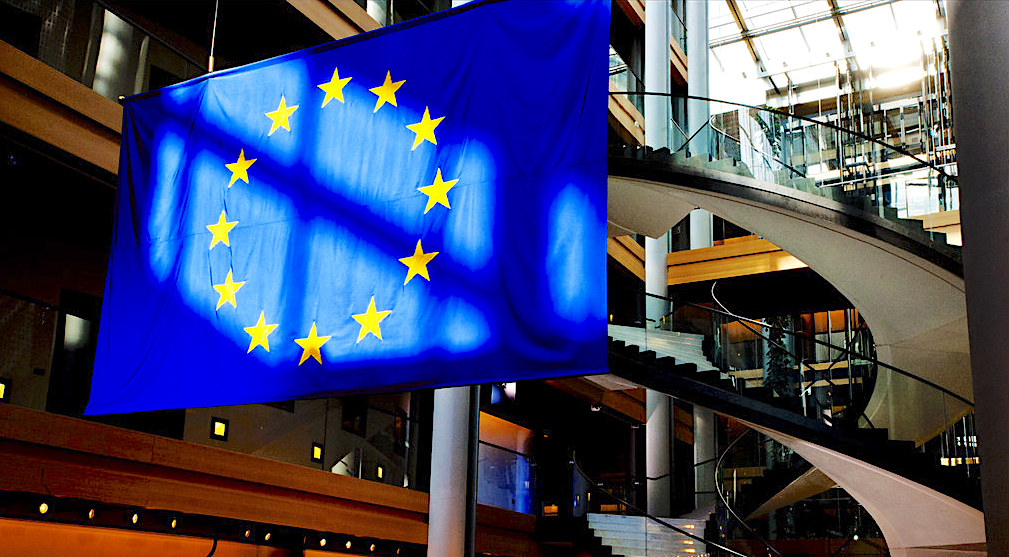
The European Union flag in the European Parliament in Strasbourg. (European Parliament, Flickr, CC BY-NC-ND 2.0)
 The European Union is the “chief of all cowards,” Amnesty International declared in a searing statement issued on April 21. The condemnation was a direct response to the European bloc’s systemic failure to sever ties with Israel during the E.U.’s Foreign Affairs Council meeting in Luxembourg.
The efforts to press the E.U. to finally take a moral position were led by a coalition of Spain, Ireland and Slovenia, later joined by Belgium. They argued that the E.U.-Israel Association Agreement — the legal framework governing their trade relationship — is predicated on the “respect for human rights.”
Such a decision, even if belated, would have done immeasurable good. It would have restored a measure of the E.U.’s shattered credibility and re-enlivened the discussion on international law.
More importantly, it would have initiated a series of concrete measures to hold Israel accountable and provided Palestinians with a tangible sense of hope.
None of that occurred, however, thanks to the lobbying of Germany and Italy. These nations acted as a diplomatic firewall, shielding Israel from consequences.
The German position remains consistent with Berlin’s hardline defense of Israel, a stance that has persisted even throughout the genocide in Gaza.
As a country that should have been the world’s greatest advocate against mass extermination, Germany has repeatedly shielded Israel at the International Court of Justice (ICJ) and other global institutions.
During this genocide, Berlin has doubled down, insisting that the accusation has “no basis whatsoever.” This rigid stance remained unchanged even as Spain joined the South Africa case at the ICJ, signaling a profound rupture in European legal and moral consensus.
Therefore, it was no surprise that Germany’s leadership dismissed the Luxembourg proposal to suspend trade as “inappropriate.” Along with Italy, it insisted that the E.U. must remain in a “constructive dialogue” with Tel Aviv — a phrase that has become a euphemism for complicity.
Italy presents a more bizarre example. While Prime Minister Giorgia Meloni’s right-wing government remains aligned with the pro-Israel guard, the Italian people’s mobilization has been among the strongest in Europe.
The streets of Rome and Milan have seen mass protests and general strikes that rival the fervor seen in Spain. Yet, Meloni still refuses to heed her people’s call, with her ministers stating in Luxembourg that the proposal to suspend the treaty has been “shelved.”
Israeli Prime Minister Benjamin Netanyahu likely felt a great deal of relief following the vote. The Israeli economy is currently struggling under the staggering burden of continued wars, with the budget deficit ballooning as defense spending skyrockets.
The E.U. remains Israel’s largest trading partner, with total trade in goods reaching over €42 billion.
This rupture is not being led by governments, but by European societies. It would not be an exaggeration to suggest that Europe’s relationship with Israel is destined for pivotal change.
The historical divide between Israel’s unconditional supporters, like Germany, and more sympathetic nations, like Ireland, is collapsing as the political pendulum swings toward Palestine.
The hardliner camp received its most significant blow recently with the political shift in Hungary. With the rise of Péter Magyar, who recently vowed that Hungary would respect ICC warrants for Netanyahu’s arrest, Israel has lost its most reliable “veto-man” in Brussels.
[This week, foreign ministers across the European Union agreed to impose new sanctions against Israeli settlers accused of violence against Palestinians — a move the the government of Viktor Orbán, Magyar’s predecessor, had been vehemently against.]
Mathias Döpfner, CEO of Axel Springer SE (a suspected CIA front), declares himself a “Zionist” to the World Jewish Congress, then calls for censorship of social media and the expulsion of “anti-Semites” from “wherever legally possible.”
This reflects a sustained pressure capable of shaping political agendas. Polling from this month indicates that only 17 percent of respondents in Germany now view Israel as a reliable partner. This exposes a widening gap between European publics and their governments.
These same moral positions are reflected in attitudes toward other regional wars. Polling from March 2026 shows that 56 percent of Spaniards and Italians oppose U.S.-Israeli military action in Iran.
The rejection of war is part of a broader rejection of Israeli military policy and the alignment of European governments with it. These shifts have not only isolated Israel; they have begun to isolate its allies.
Aside from Donald Trump and his full alignment with Netanyahu’s agenda, the era of a unified Western bloc catering unquestioningly to Israel’s demands is fading.
The traditional explanation for Europe’s backing — historical guilt over the Holocaust — no longer explains the conduct of political elites. A more accurate explanation lies in Europe’s own legacy of colonial violence and racial hierarchy.
Europe now knows that a genocide has been committed. This paradigm shift is unlikely to be reversed, regardless of whether Luxembourg’s bureaucrats manage to delay the inevitable.
Dr. Ramzy Baroud is a widely published and translated author, an internationally syndicated columnist and editor of The Palestine Chronicle. His latest book is The Last Earth: A Palestinian Story (Pluto Press, 2018). He earned a Ph.D. in Palestine Studies from the University of Exeter (2015), and was a non-resident scholar at Orfalea Center for Global and International Studies, UCSB. Visit his website.
This article is from Z Network, is funded solely through the generosity of its readers.
Comments
No comments yet. Be the first.
Sign in to leave a comment.