The UK faces a dilemma over potential troop deployments to Ukraine. France can help.
WASHINGTON—As Ukrainian and Russian delegates take stock of resuming peace talks—temporarily on a “situational” hold amid the US conflict with Iran—there is growing agreement among Kyiv’s partners that, after an agreement is reached, Western troops will be needed in Ukraine to monitor and enforce it. Several Western states have already committed to contribute forces, with the United Kingdom and France recently announcing their willingness to deploy troops to Ukraine in a peacekeeping role following a ceasefire. While French and British officials did not offer specifics about the size of the potential deployment, Ukrainian President Volodymyr Zelenskyy suggested that each country would contribute a brigade of around five thousand troops.
It’s not clear if a deployment of that size is sustainable. Some analysts have warned that for the United Kingdom to sustain such a presence over time would require up to 20,000 personnel, once training pipelines, recovery cycles, logistics, and enabling functions are factored in. With its relatively limited number of around 147,000 full-time active-duty personnel, the British military could be stretched thin by such a deployment.
London has acknowledged its manpower pressures, including in its 2025 Strategic Defence Review, which called for faster recruitment, improved retention, and gradual increase in regular personnel. But these reforms will take time to produce operational effects and highlight the importance of deepened complementarity between allies’ contributions in the near term.
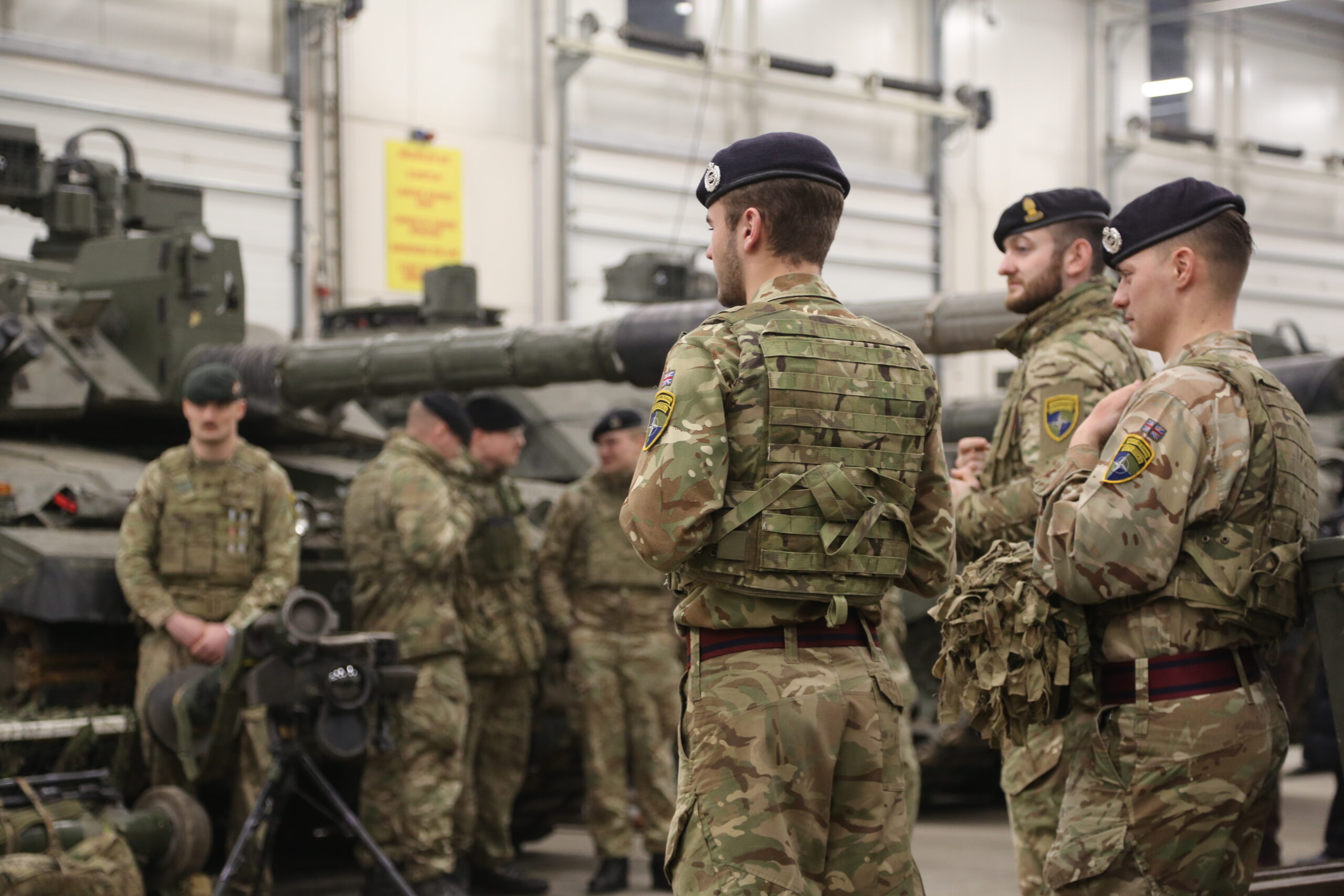
Likely in an attempt to get ahead of questions about future deployments to Ukraine, British defense officials have already raised the United Kingdom’s current military commitment in Estonia as a potential source of personnel to be redeployed to Ukraine. But shifting British troops from Estonia to Ukraine would itself carry risks. How Britain and its allies ultimately address this issue of manpower will have major implications for security on the European continent.
Russia must not sense a window of opportunity
Reducing NATO’s military footprint in the Baltic states to enable a Ukraine peace deal would contradict the broader objective of deterring any further Russian aggression in Europe. Deterrence is path-dependent: Adversaries adjudicate not only on stated intent but also on the observed continuity and credibility of presence over time. Even a temporary or partial reduction in NATO force posture could alter Russian threat perceptions and generate a perceived window of opportunity. NATO Forward Land Forces (FLF) were deliberately designed to remove ambiguity about whether allied forces would be present from the first day of a crisis.
As such, the current military framework in the Baltic states consists of three multinational, persistent, rotational battlegroups in Estonia, Latvia, and Lithuania, each led by a framework nation, with the goal of scaling up to brigade size. Germany is currently building up its brigade in Lithuania, and Canada is leading the NATO brigade in Latvia. Under Operation Cabrit, the United Kingdom has served as the framework nation in Estonia since 2017, with significant French contributions and close cooperation with Estonia’s national defense structure. Estonia, although a leader in defense spending and preparedness across the Alliance by most metrics, still seeks to have a robust allied presence in-country to deter potential Russian aggression.
France should expand its leadership in the Baltic theater
The United Kingdom’s posture dilemma could be solved by turning to its partner in Estonia’s FLF: France. France has long been a proponent of ramping up Europe’s will and means to take responsibility for its own stability. Amid strained transatlantic relations and mounting pressure on UK force-generation capacity, France has the opportunity now to step in and translate its strategic ambition into operational leadership. By reinforcing its presence in Estonia, Paris could both mitigate the possible risks created by London’s potential trade-offs and advance European defense responsibility in practice.
Beyond signaling, the Baltic theater offers concrete opportunities to strengthen European operational awareness and training while preserving the deterrent effect of a continuous allied military presence on NATO’s eastern flank. France has already shown its leadership capabilities as the framework nation of Romania’s FLF, created in 2022 after the Russian invasion, offering lessons to enhance its role in Estonia. Any increased French role in the Baltics should nevertheless avoid weakening NATO’s posture in the Black Sea region, where Romania remains a critical frontline state facing growing Russian military and hybrid pressure. The challenge for Paris is therefore not to shift attention from one flank to another, but rather to use its expanding force structure and modernization efforts to reinforce NATO’s eastern flank more coherently across both the Baltic and Black Sea theaters.
While France faces a presidential election in 2027, a stronger French role in the Baltics would not represent a major break with mainstream French strategic thinking. Support for NATO deployments in the region has historically extended across much of the French political spectrum, including parts of the far right, with the notable exception of segments of the far left. Notably, however, the current political window may offer the most favorable conditions for action.
France’s key advantage in responding to a potential force vacuum in the Baltic lies partly in its robust military modernization efforts. Its 2024–2030 military programming law prioritizes investment in air defense, long-range firing capabilities, and sustainment, which directly supports forward deterrence missions. With plans to significantly increase missile and drone stocks by 2030 and an additional €6.5 billion ($7.62 billion) allocated to the 2026 defense budget, France will soon be well-equipped to fulfill larger commitments in the region as a result of the modernization efforts. It currently boasts a nearly 200,000-strong active-duty military, with the military programming law aiming for 280,000 troops by 2030. As France considers using its increased budget and military size to strengthen NATO’s deterrence on its eastern flank, it can organize its lines of effort around both short- and long-term planning.
Operational plan for France to sustain Baltic deterrence
In the event of a revised or diminished British military presence in Estonia, immediate action would be needed to maintain deterrence on NATO’s eastern flank. France should take the following practical steps to reassure Baltic allies and sustain NATO’s deterrence against Russia:
- Conduct a public campaign to emphasize continuity of NATO’s forward posture. A clear statement by Paris can help to dissuade Russian aggression, reassure NATO allies, and raise public awareness within France of its contributions to regional stability. The recent speech by French President Emmanuel Macron at the Île-Longue submarine base sent shockwaves across the European security establishment and reframed the continent’s nuclear deterrence. A similarly grand gesture might be needed to demonstrate deterrence on NATO’s eastern flank.
- Provide visible military contributions to the FLF battlegroup to reinforce deterrence signaling. France could do this, for instance, through increased small-scale exercises with Estonian and British troops. The annual Exercise Hedgehog, a large-scale defense posture drill involving all levels of society and public support, offers a highly visible annual opportunity to demonstrate allied commitment to Estonia’s defense. Although the United Kingdom and France work hand-in-glove now, any transfers of British military equipment out of Estonia should be offset by increased French personnel and equipment contributions to avoid capability gaps. As a participant in the NATO presence in Estonia without a standing army, Iceland might support this transition by contributing to civilian strategic communications capabilities and financial support.
- Tighten command-and-control arrangements to deepen seamless integration with the UK-led battlegroup and Estonian forces. This adjustment should also reflect the highly advanced capabilities of the Estonian military, which has taken to heart the hard-earned lessons from Ukraine. France could embed more systematically within the battlegroup’s command architecture. In practice, this could include increasing the number of French officers in key staff roles, contributing to planning cells for contingency and reinforcement scenarios, and aligning more closely with UK and Estonian command procedures. France could also take a leading role in selected operational functions, such as logistics coordination; intelligence, surveillance, and reconnaissance; integration; or exercise planning, where it brings comparative strengths.
- Explore a dual-pillar framework arrangement with Estonia that complements rather than replaces UK leadership. Command, sustainment, and reinforcement architecture should be more equitably shared between France and the United Kingdom in Estonia. This could include bringing parity to UK and French troop numbers, equipment, and investments in the NATO FLF in Estonia. France and the United Kingdom already have a balanced relationship due to symmetries in capabilities and size, with the United Kingdom offering more heavy military equipment, including tanks, while France provides light-weight personnel transport. This complementarity will benefit deterrence over the long term by reducing single-point dependency and, in turn, increasing resilience.
Above all else, preserving deterrence continuity for the Baltic states is critical. Rebalancing the distribution of responsibilities and capabilities in Estonia to strengthen France’s role would institutionalize European leadership while giving the United Kingdom greater flexibility to address its current force-generation challenges. Such a shift would nevertheless require careful political management. Any expanded French role in Estonia should be framed not as a replacement for British leadership, but as a complementary burden-sharing arrangement designed to preserve NATO’s deterrence posture while allowing London to accelerate long-discussed force modernization and manpower reforms.
A credible Ukraine peace plan and a robust Baltic deterrence posture are mutually reinforcing strategic objectives. France is currently punching below its weight in the Baltic area and could shoulder more of the burden. Its presence does not yet reflect its force structure, budgetary trajectory, or stated strategic ambitions. The 2024–2030 military programming law creates a narrow but real opportunity to translate increased resources into leadership. The decisive question is not whether France has the capacity to be a more central team player for its Baltic partners, but whether it has the will and sufficient political backing to do so proactively.
Comments
No comments yet. Be the first.
Sign in to leave a comment.