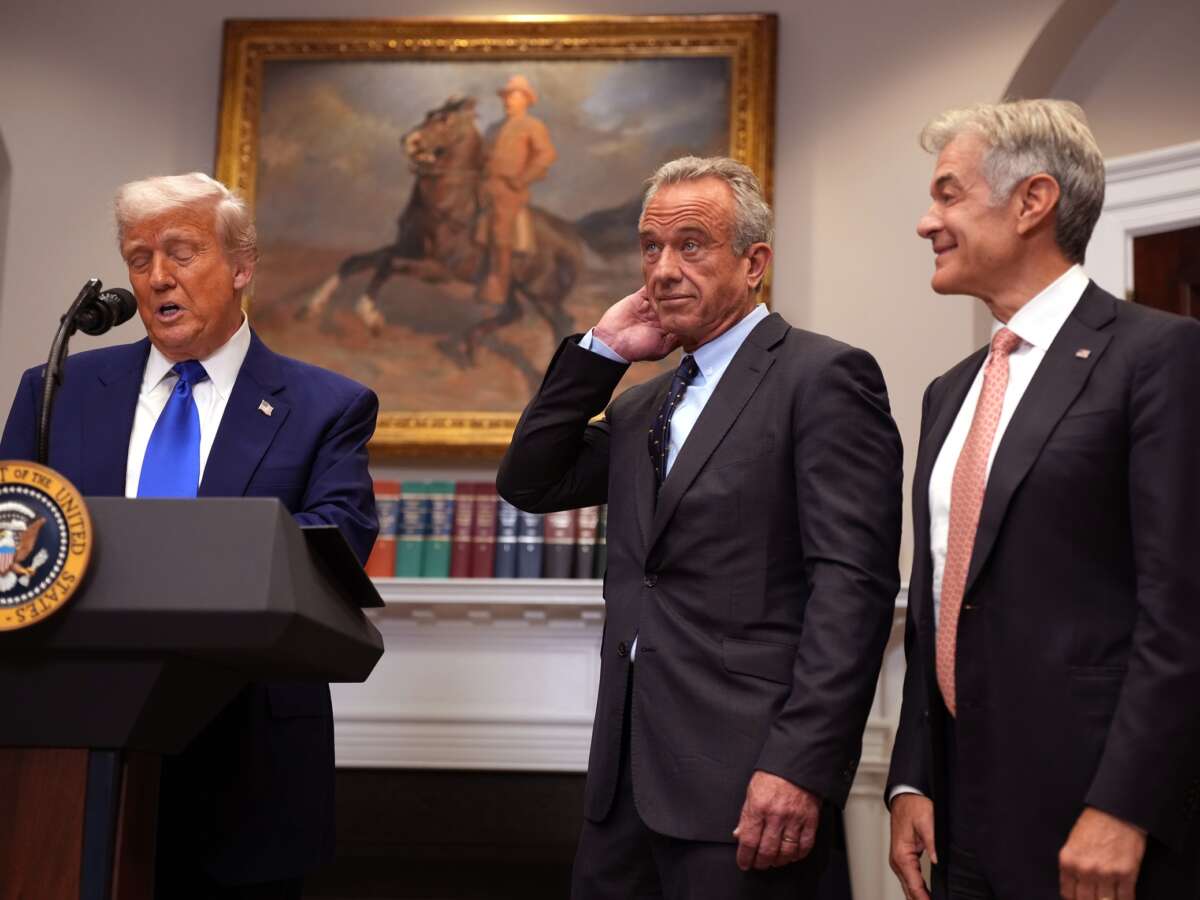

Speaking to reporters in the White House on Tuesday, President Donald Trump was asked about the potential spread of hantavirus in the U.S., following the return of over a dozen Americans who were on a cruise liner where the virus had infected multiple people.
The question specifically asked about infectious disease experts expressing concern regarding the lack of an adequate government response to the minor outbreak. Trump deferred to Mehmet Oz, the former television personality turned head of the Centers for Medicare & Medicaid Services.
Oz rejected the concerns of those experts. “It’s just not true,” he said, adding that Department of Health and Human Services (HHS) Secretary Robert F. Kennedy Jr. “is involved” in the response.
The hantavirus outbreak on a cruise ship near Argentina has led to 11 confirmed cases and three deaths among the 147 people who were on board. Eighteen Americans were on the ship, and have since returned to the U.S. They are currently under observation at medical centers in Nebraska and Atlanta.
Of the 18 Americans, one has tested positive for the virus, while another is showing symptoms of it. Notably, the virus has a long incubation period, with symptoms sometimes not appearing for up to six weeks.
The threat of these hantavirus cases sparking a widespread, nationwide epidemic is very small, with public health experts believing the general public faces little risk. The virus is primarily transmitted through the excrement of rodents, though person-to-person transmission is possible.
Still, several experts believe the Trump administration should have had a more proactive response to the hantavirus outbreak when it first appeared. Officials from the CDC should have been “deployed to the area” when it was discovered, Carlos del Rio, professor of medicine at Emory University’s School of Public Health, said to NPR regarding the situation. Government officials also should have issued an immediate health alert notice, del Rio said.
The lack of a rapid government response seems to be more troubling than the virus itself to some experts.
“We can see this as a sentinel event. It’s not limited to hantavirus. It’s really how well the country is prepared for a disease threat,” said Jeanne Marrazzo, head of the Infectious Diseases Society of America. “And right now, I’m very sorry to say that we are not prepared.”
Although the spread may not be as vast as what was seen during the COVID-19 pandemic, World Health Organization Director-General Tedros Adhanom Ghebreyesus warned that additional diagnoses should be expected.
Oz’s attempt to reassure the public by citing Kennedy’s involvement is troublesome, as the HHS director’s tenure has been marked by the spread of measles across the country.
Due to the use of vaccinations for children at a young age, measles was confined for many years to just a few hundred cases annually, and was considered essentially eradicated in the U.S. But while just 285 cases were documented in 2024, there were 2,243 cases identified in 2025. In the first four months of 2026, 1,842 cases have been documented.
Kennedy, a noted anti-vaxxer, has downplayed concerns about rising measles cases, falsely claiming at one point that outbreaks like these happen “every year.” He has also peddled lies about the efficacy of vaccines to protect against measles, claiming direct exposure to the virus yields better results.
Contracting measles can result in numerous lifelong complications, especially for children. In some cases, people can die of the virus.
“Measles is a dangerous disease and the vaccine is very safe,” an explainer from Johns Hopkins University’s website states. “The risks of severe illness, death, or lifelong complications from measles infection far outweigh the generally mild side effects some people experience following vaccination.”
Comments
No comments yet. Be the first.
Sign in to leave a comment.