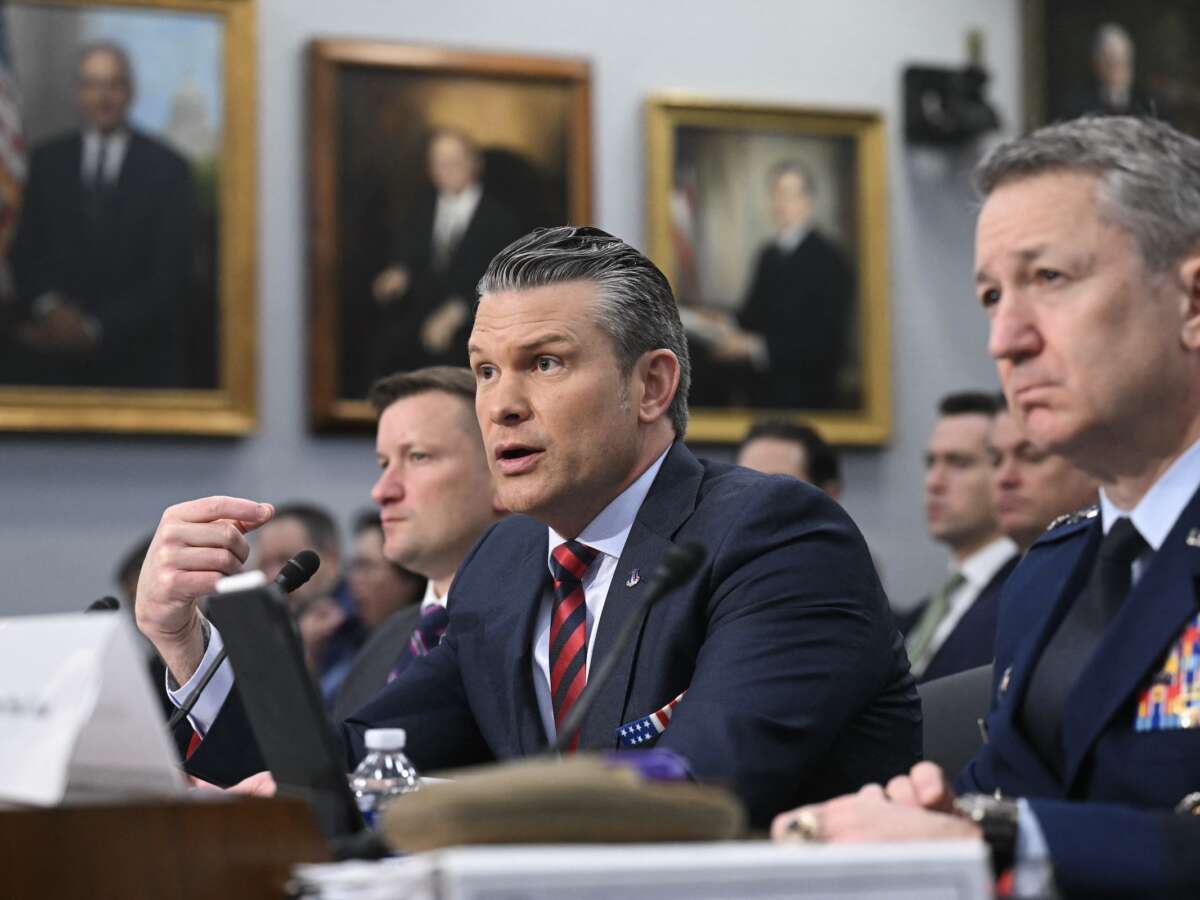
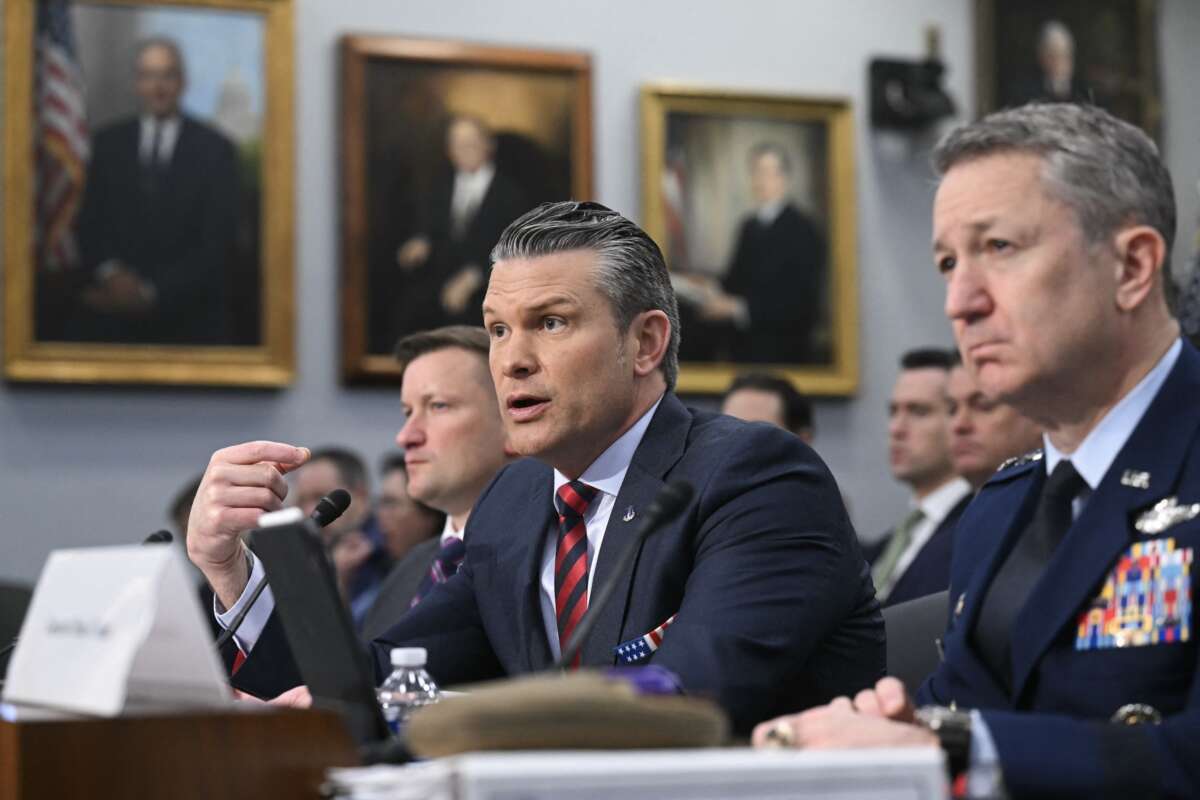
On Tuesday, May 12, Defense Secretary Pete Hegseth testified in back-to-back hearings before the House and Senate Appropriations Committees on the U.S.-Israeli war on Iran.
Throughout the hearings, Hegseth defended Trump’s defense budget request of $1.5 trillion.
Hegseth was joined by General Dan Caine, chairman of the Joint Chiefs of Staff, and Jules Hurst III, the Pentagon’s acting comptroller. During the first hearing of the day before the House Appropriations Committee, Hegseth began his speech by defending Trump’s $1.5 trillion budget request, saying, “The $1.5 trillion budget will ensure the United States continues to maintain the world’s most powerful and capable military.”
“President Trump inherited a defense industrial base that had been hollowed out by years of America-last policies,” Hegseth went on, adding that the Trump administration is “reversing this systemic decay and putting our defense industrial base back on a wartime footing.”
During this session, Rep. Pete Aguilar (D-California) asked Hurst for an updated estimate of the cost of the war. Hurst responded that the cost of the war has risen “closer” to $29 billion dollars, up from $25 billion from the previous hearing on April 29. Hurst claimed that the additional $4 billion dollars is due to “repair and equipment costs” and “general operational costs.”
Though Hurst is suggesting an additional $4 billion in costs from the previous estimate, this remains a gross underestimate of the costs of the war. Following Hegseth and Hurst’s previous testimony two weeks ago, analyst Stephen Semler estimated that the U.S. government had spent $71.8 billion over the first 60 days of the Iran war, or an average of $1.2 billion per day.
Later, as Hegseth began his opening speech at the Senate Subcommittee Hearing, an anti-war protester stood up and declared, “I am an Iranian American and against this war of aggression.” Security escorted the protester out of the room as she continued, saying, “The Iranian American community is against this illegal war. And if you approve this budget, you will be complicit in the war crimes of this administration.”
During the Senate Subcommittee Hearing, questions continued over the high costs of war with Iran and the 2027 fiscal year budget. Sen. Patty Murray (D-Washington) noted that the billions spent on the war “could be helping people perhaps get health care, but instead we’re paying for bombs dropped in a war that American people overwhelmingly oppose.” She also reiterated that “it seems quite clear that that cost estimate is suspiciously low.”
Murray noted that the extensive damage to U.S. military bases in the Middle East was not factored into that estimate, speaking to the Trump administration’s downplaying of the damage to these sites.
She then inquired about the 2027 fiscal year budget. “Is it your position that American families should be forced to give up child care and health coverage so you can have $1.5 trillion for this budget?” she asked Hegseth.
“The president has proposed a historic $1.5 trillion budget that will defend the nation and confront threats like Iran, which previous presidents allowed to happen,” Hegseth responded.
“As you know, for the most part a ceasefire means the fire is ceasing, and we know that has occurred as negotiations occur,” Hegseth replied.
Though Democrats harshly criticized the Trump administration on its spending on the war on Iran during the House and Senate Appropriations Committees, Democrats’ criticism at the onset of the war largely focused on questions of process. The Democratic Party focused on the lack of congressional authorization for the war rather than the fact that bombing Iran is unconscionable – after all, many Democrats helped pave the way for this war over the past 20 years.
Comments
No comments yet. Be the first.
Sign in to leave a comment.