There is a long history of members of Congress calling out Israel’s nuclear arsenal. It is now time to take action.
Last week, Rep. Joaquin Castro (D-TX), a member of the House Foreign Affairs Committee, led a Dear Colleague letter, signed by 30 Members of Congress, to Secretary of State Marco Rubio demanding that the Trump administration be transparent about Israel’s nuclear arsenal.
The letter forthrightly states that the “public record strongly and consistently supports the conclusion that Israel possesses nuclear weapons.”
Castro’s bold initiative takes place against the backdrop of the US-Israel war of aggression against Iran, in which the U.S. finds itself “fighting this war side by side with a country whose potential nuclear weapons program the United States government officially refuses to acknowledge.”
“The risks of miscalculation, escalation, and nuclear use in this environment are not theoretical,” these Members of Congress warned.
As Michael Arria wrote in The Shift, this letter signifies that Congressional discussion of Israel’s nuclear arsenal is “taboo no longer”.
No doubt that Castro’s letter is a significant step toward opacity on Israel’s nuclear capabilities. However, as the letter itself notes, this initiative is not quite so path breaking as it may appear. It cites a 1974 Special National Intelligence Estimate, declassified in 2008, in which the Executive Branch concluded that “Israel already has produced nuclear weapons.”
And it quotes Congressional testimony from former CIA Director Robert Gates delivered to the Senate Armed Services Committee in 2006, in which he explains that Iranian nuclear ambitions derive from the fact that “They are surrounded by powers with nuclear weapons — Pakistan to their east, the Russians to the north, the Israelis to the west and us in the Persian Gulf.”
Of equal note to these Executive Branch admissions of Israel’s nuclear arsenal is the little-known history of Congressional concern over and acknowledgment of Israel’s nuclear weapons program, which stretches back more than six decades.
This history–showing that both Congress and the Executive Branch have repeatedly acknowledged Israel’s nuclear program–is important to resurface as a step toward ending any official ambiguity toward Israel’s nuclear arsenal and reconsidering the free flow of military support to a nuclear rogue state.
Reactions to the Dimona Nuclear Reactor
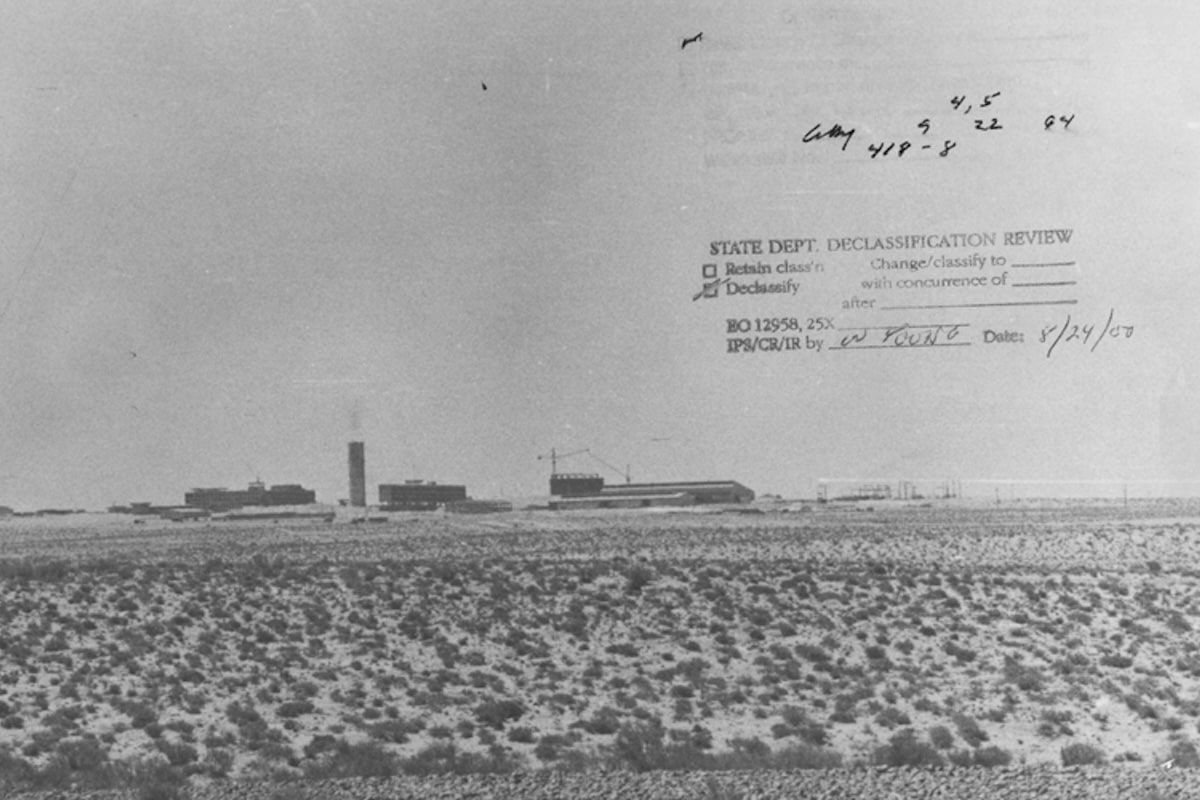
As historian Warren Bass notes in his book Support Any Friend: Kennedy’s Middle East and the Making of the U.S.-Israeli Alliance, Congressional concern over Israel’s nuclear capabilities manifested almost immediately after the London Daily Express broke the news about Israel’s nuclear reactor in Dimona in December 1960, during the waning days of the Eisenhower administration.
In an executive session of the Senate Foreign Relations Committee (SFRC) on January 6, 1961, Secretary of State Christian Herter informed committee members that he rushed over to Capitol Hill to testify just as a “long wire of a conversation between our Ambassador and [Israeli Prime Minister David] Ben-Gurion on the subject of this reactor” was coming in. While only having been able to read the first third of the cable, Herter pronounced Dimona to be a “disturbing element” because “this reactor apparently has been under construction for some time without anything public having been said about it.”
Herter’s statement occasioned a furious denunciation by Sen. Bourke Hickenlooper (R-IA)–the great-uncle of current Sen. John Hickenlooper (D-CO)–who accused Israel of lying to the U.S. “like horse thieves on this thing.” He deemed it “very serious” for Israel to “perform in this manner in connection with this very definite production reactor facility which they have been secretly building, and which they have consistently and with a completely straight face, denied to us they were building.”
In a follow-up meeting with State Department officials on January 9, 1961, Hickenlooper and other members of the SFRC, including Sen. Al Gore, Sr. (D-TN)–father of the future Vice President Al Gore, Jr.–reiterated their frustration at Israel having “deliberately misled” the US about its nuclear reactor, which it had previously stated was a textile factory.
The Symington Amendment
While this initial Congressional consternation over Dimona took place behind closed doors, Senator Stuart Symington (D-MO) decided to go public with information about Israel’s nuclear capabilities in July 1970.
In his book The Sampson Option: Israel’s Nuclear Arsenal and American Foreign Policy, Seymour Hersh recounts how Symington went on a national Sunday morning television interview program and stated that there was “no question that Israel is doing its best to develop nuclear weapons.”
This admission by Symington, a former Secretary of the Air Force in the Truman administration, was significant since, later that decade, he authored and shepherded through Congress an eponymous amendment to the Foreign Assistance Act–the Symington Amendment–which, according to the State Department “barred U.S. economic and military assistance to any country that imported or exported spent nuclear fuel reprocessing or uranium enrichment equipment, materials, or technology but failed to comply with International Atomic Energy Agency (IAEA) full-scope safeguards.”
Hersh claims that the Symington Amendment “as written, had no impact on those nations, such as Israel, which had been involved in the transfer or sale of nuclear materials prior to the bill’s enactment. Israel, in other words, had been grandfathered out.”
This interpretation of the amendment is debatable–its text does not contain a cut-off date before which countries transferring nuclear materials were exempted; however, the present tense nature of the language could be interpreted as forward-looking only.
In any case, the Symington Amendment provided a national security waiver and it was only ever applied once when the Carter administration sanctioned Pakistan.
The Egyptian-Israeli Peace Treaty
After the Carter administration successfully brokered the Camp David Accords between Israel and Egypt in 1978, leading to a peace treaty between the two nations the following year, Congress sought to bolster the agreement by passing legislation to provide for US funding of new airfields in Israel to replace those it would evacuate in the Sinai Peninsula, loan guarantees to both countries to finance the purchase of weapons, and additional economic aid to Egypt.
Sen. Jesse Helms (R-NC) sought to insert a poison pill amendment into the legislation to prohibit funds under this act from being appropriated to countries which were not signatories to the Nuclear Non-Proliferation Treaty (NPT). In other words, Israel, which at the time and still today has not signed the NPT, making it a nuclear rogue state whose nuclear arsenal is outside the bounds of an International Atomic Energy Agency (IAEA) inspection regime, would be ineligible to receive any proposed assistance under this legislation.
On May 14, 1979, Helms discussed his amendment on the Senate floor. While Helms carefully couched his language, stating that it was only alleged that Israel was a nuclear power, the import of his remarks was clear that he believed that to be the case. “Does Israel have the bomb?” Helms asked. “If press reports and other documents are to be believed, there is a strong possibility that Israel, indeed, has become a member of the nuclear club.” Helms also cited reports that Israel had already acquired “more than a dozen nuclear weapons” and inserted into the Congressional Record several pages of articles, all of which pointed to a definitive conclusion that Israel had nuclear weapons.
While Helms’s amendment was defeated, his raising of Israel’s nuclear capabilities, along with a demand for a nuclear-free zone in the Middle East, was significant.
A Nuclear-Free Zone in the Middle East
The idea of establishing a nuclear-free zone in the Middle East had bipartisan support. In addition to Helms’s advocacy for it, Sen. William Proxmire (D-WI)–best known for his indefatigable pursuit of Senate ratification of the Genocide Convention, delivering more than 3,000 Senate floor speeches over 19 years–also took up this cause.
On December 21, 1982, Proxmire praised the Reagan administration for beginning preliminary diplomatic discussions toward a treaty on a nuclear-free Middle East. He noted that creating such a zone would be a “substantial task given the strong possibility of Israel[’s] development of nuclear weapons” and urged the Arms Control and Disarmament Agency (ACDA)–a formerly independent government agency later folded into the State Department during the Clinton administration–to “redouble its efforts” toward this goal.
Just a few years later, Proxmire was less circumspect about Israel’s nuclear arsenal. Speaking on the Senate floor on January 21, 1985 on the dangers of global nuclear proliferation, Proxmire stated unreservedly that “Israel and South Africa are quiet, small, side door entrance members” to the nuclear club. Proxmire also argued that Israel’s nuclear arsenal encouraged regional proliferation: “Israel’s nuclear capacity represents a provocative incentive for bitterly hostile Arab States to develop their own nuclear capability.”
The Glenn Amendment
Like Symington, Senator John Glenn (D-OH) was also very committed to deterring nuclear proliferation and also lent his name to an eponymous amendment–the Glenn Amendment–to the Arms Export Control Act (AECA) that prescribed comprehensive sanctions against a nuclear state transferring a nuclear explosive device to a non-nuclear state, or against a non-nuclear state receiving or detonating a nuclear explosive device.
As part of his efforts to tighten the control over US exports of dual-use items that could potentially facilitate nuclear proliferation, Glenn prompted the General Accounting Office (GAO) to undertake a study of the matter. The GAO found that the US had “issued 238 licenses for computers to certain Israeli end users linked to the unsafeguarded Israeli nuclear program.” These computers “were generally more powerful than any exported to sensitive end users in other countries of concern. They were also more powerful than those used to develop many of the weapons in the U.S. nuclear arsenal.”
While the State Department made clear to the GAO that the US did not support Israel’s nuclear program, the report nevertheless noted a political rationale for allowing these licenses, namely that the State Department “has approved such computer exports because of the overall U.S.-Israeli relationship and the U.S. policy of maintaining Israel’s qualitative military superiority over its neighbors.”
While not a clear admission of Israel having a nuclear weapons arsenal, the GAO report provided important details on how the US was facilitating Israel’s nuclear program despite formal disapprobation. Glenn inserted this report into the Congressional Record on January 4, 1995.
Israel and the Comprehensive Test Ban Treaty
The Comprehensive Test Ban Treaty (CTBT), a multilateral convention banning any explosion of nuclear material, opened for signatures in September 1996, with President Bill Clinton being the first leader to sign the treaty on behalf of the US. The Senate, however, stalled debate on ratifying the treaty, eventually rejecting ratification in 1999.
Many Republicans opposed treaty ratification of the CTBT because they argued that the inability of the US to test nuclear weapons through explosions would degrade US nuclear capabilities. As part of an argument for why banning the testing of nuclear weapons would not prevent nuclear proliferation, Sen. Jon Kyl (R-AZ) noted on the Senate floor on October 8, 1999 that “the Israeli nuclear arsenal has been constructed without testing.”
To add gravitas to his argument, Kyl subsequently inserted into the Congressional Record a letter from six former Republican Secretaries of Defense–James Schlesinger, Frank Carlucci, Donald Rumsfeld, Dick Cheney, Cap Weinberger, and Melvin Laird–arguing against CTBT ratification. This letter, too, contains an unequivocal affirmation of Israel’s nuclear arsenal. The former Defense Secretaries wrote that “the possession of nuclear weapons by nations like India, Pakistan, and Israel depends on the security environment in their region, not by whether or not the U.S. tests.”
The need for sanctions
Lastly in what may have been the first–and the last–actual piece of legislation in Congress that recognized Israel’s nuclear arsenal, Rep. Jim McGovern (D-MA) introduced a resolution in Congress in 2019 supporting the goals of the Treaty on the Prohibition of Nuclear Weapons.
In this resolution, Israel is acknowledged as one of nine countries possessing nuclear weapons.
While Rep. Castro’s letter has brought renewed scrutiny on Israel’s nuclear arsenal, it is far from being unprecedented, and is only the latest iteration of an on-again, off-again six-decade-long Congressional concern with Israel’s nuclear weapons.
Even if the Trump administration fails to respond to Rep. Castro’s letter with a clear affirmation of Israel’s nuclear arsenal, there is plenty of historical evidence that both Congress and the Executive Branch have acknowledged Israel’s possession of nuclear weapons.
The United States must now act to compel Israel to sign the NPT and bring its nuclear program under IAEA safeguards. Should Israel refuse to do so and continue to act as a nuclear rogue state, this would be just one more reason why Congress should impose comprehensive sanctions on Israel.
Josh Ruebner Dr. Josh Ruebner is Policy Director of the IMEU Policy Project and a Faculty Fellow at Georgetown University’s Center for Social Justice. He is the author of the upcoming book The United States and the Palestinian Nakba: A Transnational History, 1947-1950.
Comments
No comments yet. Be the first.
Sign in to leave a comment.