When abortion by mail is about profit, women pay the price
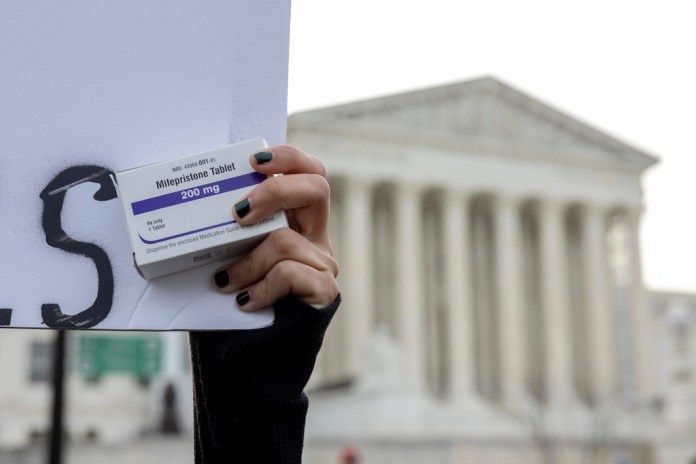
In just a matter of days, the rules around abortion by mail have shifted back and forth. First, the 5th Circuit temporarily blocked the mailing of mifepristone into Louisiana, then abortion providers immediately pivoted to alternative abortion pill regimens, and finally, Supreme Court Justice Samuel Alito temporarily restored nationwide access while the court considers next steps.
That rapid scramble revealed that when abortion pill access is threatened, the abortion industry moves fastest not to protect women, but to protect its business model.
Within hours, abortion provider Carafem posted a notice on its website: “Legal Update: Due to a recent court ruling, we are temporarily unable to mail mifepristone, one of the medications used in an abortion with pills. We are still providing misoprostol-alone abortions through mail.”
That notice showed how quickly abortion providers were willing to pivot to a non-Food and Drug Administration-approved misoprostol-only model to keep abortions flowing and profits intact. But after Alito administratively stayed the 5th Circuit’s May 1 order — temporarily restoring nationwide access to mifepristone by mail through at least May 11 while the court considers further briefing — that message quietly disappeared.
When one abortion pill pathway was challenged because of safety concerns, the response was not caution. It was not concern for women. It was not a pause to ask whether mailing powerful drugs across state lines without in-person medical oversight was truly best for patients. It was an immediate shift to another abortion pill regimen to keep the abortion-by-mail business model moving.
For Big Abortion, the priority is not women’s health. It is preserving access to abortion pills by any means necessary because abortion by mail is more profitable than in-person appointments.
The abortion industry would like Americans to believe that mailing abortion drugs is simply about “access.” But if that were true, they would not fight so hard against even the most basic safeguards.
For years, mifepristone came with common-sense protections: in-person dispensing, confirmation of gestational age, screening for ectopic pregnancy, informed consent, and opportunities to identify coercion, abuse, or trafficking. These were not radical restrictions. They were basic protections for women facing a serious medical decision.
Then, after Dobbs v. Jackson Women’s Health Organization, the Biden administration made expanding abortion access a political priority and directed federal agencies to do just that. The FDA responded by dismantling those protections, first suspending enforcement of the in-person visit requirement and then removing it in 2023, allowing abortion drugs to be prescribed online and shipped through the mail without a doctor ever seeing the patient face-to-face.
This was not modernization. It was deregulation, and it created exactly the kind of abuse Louisiana is now fighting in court.
Women such as Rosalie Markezich show why this matters. When Markezich learned she was pregnant, she smiled. She wanted that baby. But her boyfriend decided the child would “ruin his life.” Without her consent, he used her personal information to order abortion drugs from California and had them mailed to her home in Louisiana.
When she resisted, he became angry. He drove her to a hospital parking lot, shouted at her, and terrified her into submission. Fearing for her safety, she took the pills just to survive the moment. She still mourns the loss of her child.
Later, she said, “If mail-order abortion wasn’t a thing, I’m 100% sure I would have my child.”
This is what happens when convenience replaces care. And, sadly, Markezich is not alone. Many men in Ohio, Massachusetts, Texas, and more have been charged with forcing their partners to take the abortion drugs.
Abortion pill manufacturers and providers continue trying to circumvent Louisiana’s laws, not because women are safer this way, but because easier access means a stronger bottom line. Fewer in-person visits mean lower overhead. Faster distribution means more volume. More pills mailed means more profit. In fact, the chief financial officer of Danco Laboratories even noted in a 2022 deposition that investments have been “extremely profitable.”
Women are not transactions. They are not customers to be rushed through an online checkout process and left alone to bleed in their bathrooms. They deserve real care.
For decades, local pregnancy centers across Louisiana and across the country have been serving women with pregnancy tests, ultrasounds, parenting support, housing referrals, material assistance, counseling, and long-term care. And we do it without charging her.
Pregnancy help does not profit from her fear. It walks with her through it.
At Heartbeat International, we support the largest network of pregnancy help organizations in the world because every woman deserves compassionate care without a price tag. Pregnancy help organizations offer real help, real support, and real care — free of charge.
The abortion industry calls what they do “access.” We call it exploitation.
From our more than 50 years of service, we have seen that when profit drives the system, women pay the price.
Comments
No comments yet. Be the first.
Sign in to leave a comment.